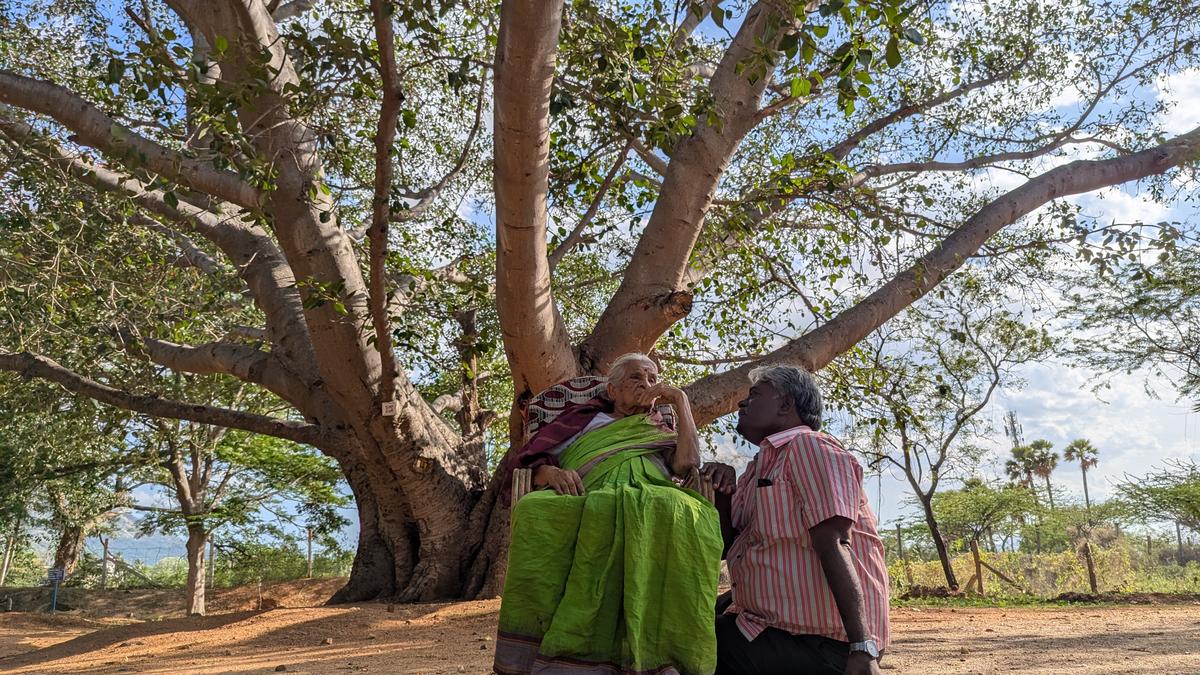
Krishnammal Jagannathan: a symbol of Gandhian model of empowerment
The Hindu
Explore Krishnammal Jagannathan’s inspiring journey as a Gandhian advocate for landless empowerment in Tamil Nadu.
The images of the 100-year-old Krishnammal Jagannathan sitting under a peepal tree at Gandhigram, Dindigul, at the beginning of the documentary, and her standing beside a well without a drop of water at the end, quietly trace the arc of her life’s journey.
The movement she spearheaded, along with her late husband Jagannathan, spread like the peepal tree itself, taking root across villages and securing land for the landless. Yet, the dry well reflects another reality — the growing scarcity of idealism-driven movements, both political and non-political, in Tamil Nadu.
A Gandhian who draws inspiration from Vallalar Ramalinga Adigal — the saint who could not bear even the sight of a withering plant — Ms. Krishnammal turns to prayer with disarming simplicity. Standing beside the parched well in Gandhigram, she seeks divine grace, hoping it will, one day, brim with water again.
“The well remains dry and my mind is in agony. There will come a time when the well will be desilted. Ayya, by your mercy, let the well overflow with water,” she prays in a trembling voice in the documentary Nilam+Needhi=Krishnammal Jagannathan, directed by Ravi Subramanian.
She represents one of the two major strands that fought for the empowerment of landless labourers in Tamil Nadu — the Gandhian movement inspired by Mahatma Gandhi and Vinoba Bhave, and the Communist-led agrarian struggle.
Though emerging from different ideological traditions, the two movements often intersected at several moments in history. The film captures one such meeting point through a long conversation between Ms. Krishnammal and K. Balabharathi, former CPI(M) MLA and a full-time worker of the party.


Economist Arvind Subramanian advises CM Revanth Reddy on strengthening Telangana's finances during a meeting in Hyderabad.

Supreme Court emphasizes stakeholder consultation for legal education reforms, hesitant to change five-year law course duration.

Authorities in Andhra Pradesh are set to tranquillise a roaming tiger near Annavaram temple for safety and conservation.

MEA criticizes USCIRF for bias, urging focus on vandalism of Hindu temples in the U.S. over selective criticism of India.

Bengaluru's Urban Development aims to beautify underutilized flyover spaces, enhancing city aesthetics and improving green cover initiatives.

Indian Navy warships escort merchant vessels in the Gulf of Oman, ensuring safe passage amid regional tensions under Operation Sankalp.

A rare crab species exhibiting both male and female traits was discovered in Silent Valley, revealing unique biological characteristics.

Gujarat court convicts five in 2016 Una flogging case; punishment announcement scheduled for March 17, 2026.

The Greater Bengaluru Authority (GBA) has extended the deadline for citizens to submit claims and objections to the revised draft voters’ list for the upcoming elections to five city corporations under its jurisdiction until March 20.

SSC Public Examinations-2026 commenced peacefully, with a 98.90% attendance across 3,415 centres and rigorous monitoring in place.

Flying Squad Team seizes whistles, ‘manjappai’ bearing TVK name in Thoothukudi

Thousands gathered for a Ramzan prayer meet, promoting spiritual renewal and civic responsibility amidst calls for peace and justice.

Players get double bill horror as Resident Evil returns with Grace, a new series character, and other fan favourites in their latest edition