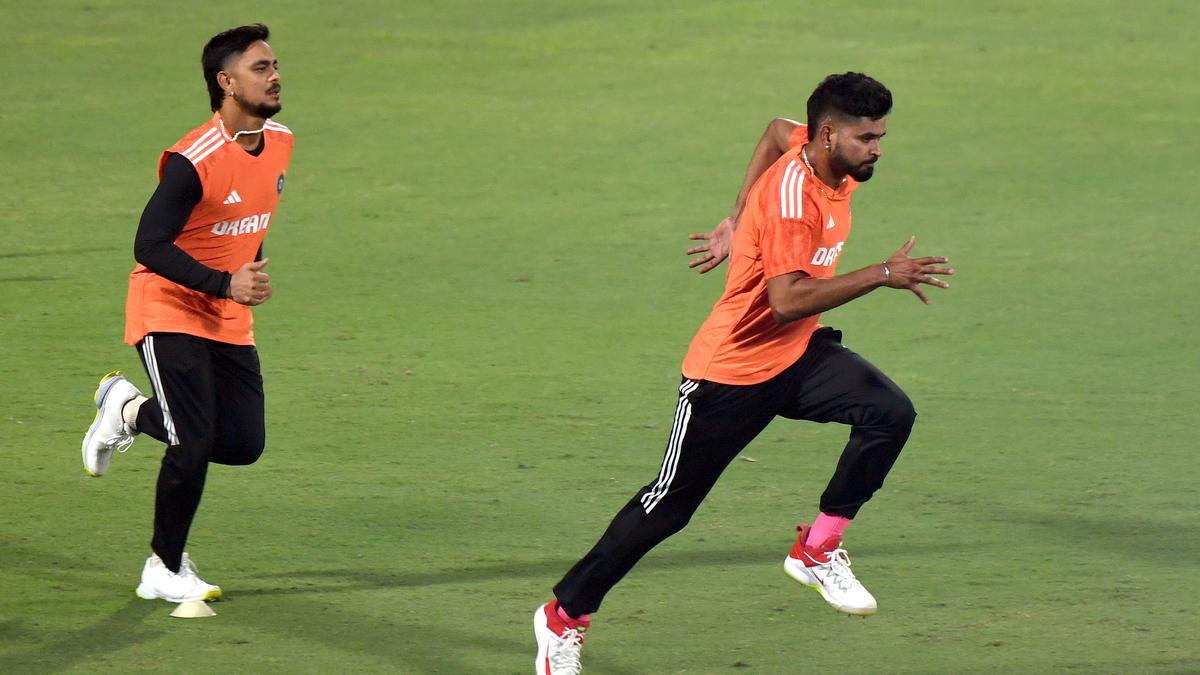
India’s stars — aspirants and the established — get ready for the rigours of domestic cricket Premium
The Hindu
Big names in Indian cricket return to domestic cricket for the Duleep Trophy, highlighting the importance of red-ball cricket.
After what seems like an eternity – perhaps that’s because it really is – some of the biggest active names in Indian cricket will assemble under one umbrella to ply their wares in domestic cricket. That shouldn’t be news in itself, but if it is, it’s because of the short shrift the domestic game has increasingly been receiving from those that have graduated beyond that level and have gone on to represent the country.
This year’s Duleep Trophy, or at least its first round, to be specific, will witness many of the big boys in action for the four teams picked by the national selectors ahead of the international home season, beginning in Chennai on September 19. India will host Bangladesh for two Tests, and three Twenty20 Internationals, before taking on New Zealand in three further Tests, after which they will emplane for Australia for their first five-Test showdown Down Under since 1991-92.
India’s last Test match was in Dharamshala against England, in the first week of March. Since then, there has been a steady diet of T20 cricket — the IPL, the T20 World Cup, a five-match tour of Zimbabwe, and three games in Sri Lanka — that only ended with the three-match One-Day International series which the Indians surrendered to the Lankans 0-2 earlier this month.
As such, the first round of the Duleep Trophy, scheduled to begin on September 5, offers those certain to be in the Test squad and those aspiring to break in, or break back in, their only meaningful red-ball, first-class competitive outing before the first Test against Bangladesh. Some of the players are already on their way to fine-tuning their games at the ongoing Buchi Babu Trophy tournament in Tamil Nadu, but there is nothing like a First Class game to get the red-ball juices flowing all over again.
The notable absentees from the Duleep Trophy are Test and ODI skipper Rohit Sharma, his predecessor Virat Kohli, pace spearhead Jasprit Bumrah and off-spinning great R. Ashwin. They are the exceptions to the rule; in recent times, the Board of Control for Cricket in India has read the riot act, making it mandatory for those available to play at the domestic level. Things shouldn’t have come to such a pass, but with players tending to prioritise international and franchise cricket at the expense of turning out for their respective states, the governing body had no option but to step in. The omission from the list of centrally contracted players of Shreyas Iyer and Ishan Kishan for failing to play for Mumbai and Jharkhand respectively in the Ranji Trophy was the clearest indication that dereliction of duty would come at a price.
It wasn’t always like this, you know. Even till the early 2000s, little was made of a Sachin Tendulkar practically stepping off an aircraft after an overseas tour to turn out in Mumbai colours, or a Rahul Dravid or an Anil Kumble doing likewise for Karnataka. It was from the not-so-green pastures of state vs state and zone vs zone face-offs that the route to the national team opened up. Players hardly thought they were doing their state a favour by representing it at every available opportunity. Because some of the most luminous stars were on show, fans too flocked to the grounds in large numbers. While it is fashionable now to decry the lack of spectator interest in the domestic game, maybe it really isn’t hard to see why the fans stay away. After all, if that’s what the players choose to do, who can really blame the audiences, short-changed as they are when it comes to basic facilities even at venues hosting international games?
Over the last few years, the only time some of the big boys have sporadically played in the Ranji Trophy is when they have been on the comeback trail, or when they have had to prove their match-readiness after an injury lay-off. Ashwin is one of the few honourable exceptions; he loves nothing more than playing a game of cricket, any game of cricket. For the rest, a return to the ‘drudgery’ of domestic cricket is a punishment of sorts. In private, many players have spoken of a lack of ‘motivation’ to play at a level lower than international cricket, but how motivation (or the lack of it) can even be a factor when one is representing the entity that facilitated an ascension to the higher echelons is hard to fathom.


Modi and Jaishankar advocate for dialogue as India and France collaborate to de-escalate tensions amid escalating strikes on energy infrastructure.

The star-studded event was held in Mumbai and was attended by rithik Roshan, Alia Bhatt, Bobby Deol, Shahid Kapoor, Vijay Varma, Sonakshi Sinha, Jyotika, Ali Fazal, Sonali Bendre, Preity Zinta, Ravi Kishan and others

Shorts News:We are working on securing LPG, petroleum to meet our energy security needs: MEA

P. Veldurai served five years as MLA and was later asked to repay ₹21 lakh in Tamil Nadu.

Supreme Court reserves verdict on defining 'industry' under Industrial Disputes Act, impacting educational and healthcare sectors.

Dindigul Collector S. Saravanan held a meeting with Election Observers to ensure smooth election monitoring across seven constituencies.

Despite delays from the Centre, 24 States allocate funds for a new rural jobs program, using past MGNREGA expenditure as a baseline.

Congress’s third candidate list for Assam Assembly elections highlights the Pradyut factor and notable party shifts among MLAs.

Scholars foresee political shifts and governance concerns at BRS Ugadi celebrations, predicting potential opposition strength amid public dissatisfaction.

Election observers deployed in Thoothukudi; field inspection begins

Sri Sathya Sai Prema Sadan celebrated Ugadi with Vedic chants, Ugadi Pachadi, and Sri Rama Navami preparations in Visakhapatnam.

Visakhapatnam celebrated Ugadi with Panchanga Sravanam, cultural events, and auspicious predictions for a prosperous new year.

Celebrating diverse top talents, including visually impaired achievers, artists, and cultural icons honored with Ugadi awards.