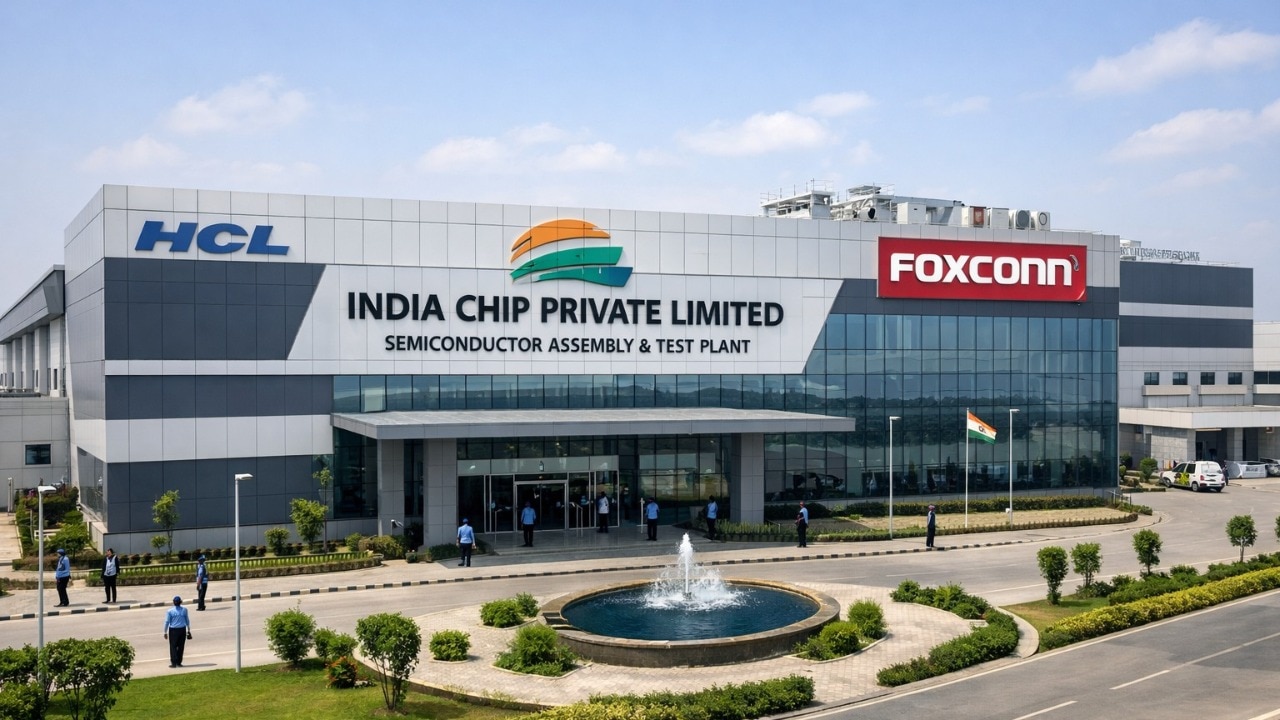
India Chip begins work on factory in Noida, aims to process 20,000 wafers per month when operational
India Today
HCL Group has partnered with Foxconn to set up India Chip in Noida. The facility plans to process 20,000 wafers a month, making display driver chips for smartphones, TVs, and laptops, and meet a large part of India's increasing demand for semiconductors.
India Chip, a joint venture between HCL Group and Foxconn, has started building its factory in Noida. The factory, which saw its foundation stone laid down by PM Narendra Modi a few days ago, will assemble, package and test display driver chips which power screens in smartphones, TVs, laptops and other electronic devices.
The plant, coming up near Jewar on the Yamuna Expressway, will be an advanced Outsourced Semiconductor Assembly and Test (OSAT) unit designed to process up to 20,000 wafers per month when fully operational in 2028. Built as a joint venture between HCL and Foxconn and backed by an investment of Rs 3,700 crore, the facility will manufacture display driver chips — key components that power screens in smartphones, televisions, laptops and other digital devices.
India Chip is structured as a 60:40 joint venture between HCL Group and Foxconn. Beyond processing wafers, the OSAT plant will assemble and test semiconductors, a critical stage that ensures chips meet performance and reliability standards before being integrated into consumer electronics. The company says the facility could meet nearly 25 per cent of India’s domestic demand for display driver chips, a category that is currently fully imported, while also exporting 20–30 per cent of production to global markets.
The foundation stone for the project was laid by Prime Minister Narendra Modi, who joined the ceremony virtually, alongside Uttar Pradesh Chief Minister Yogi Adityanath and Union IT Minister Ashwini Vaishnaw.
As India’s electronics manufacturing scales up, especially in mobile phones and consumer electronics, demand for screen components has surged. At present, manufacturers rely entirely on imports for display driver integrated circuits. By localising this segment, India Chip aims to plug a key gap in the value chain and reduce external dependencies.
The company expects the project to create over 3,500 direct and indirect jobs, while also encouraging the development of a local semiconductor ecosystem, including suppliers, logistics partners and ancillary units.


Paul McCartney's last solo album, McCartney III (2020), recorded during the pandemic, topped UK charts, marking his first solo number one since 1989, showcasing his creative freedom and personal musical expression.

ICAI CA Final January 2026 results have been declared today, March 1. Candidates who appeared for Group 1 and Group 2 exams can now check their scorecards, merit list and All India Rank holders on the official website, icai.nic.in. Direct result link is now active.

Pinterest CEO Bill Ready wants governments to ban social media for teenagers under 16, saying current platforms are harming young people's mental health and development.

Reddit is exploring biometric verification methods such as Face ID and Touch ID to ensure users are real humans, not bots, while pledging to maintain the platform's tradition of anonymity. CEO Steve Huffman said the company is planning to address the rising influence of AI-generated content and protect authentic user engagement.

Delhi is strengthening its push for UPSC success by recognising top achievers and improving support for aspirants. In a first-of-its-kind initiative, the government engaged directly with successful candidates to understand their preparation journey.

WhatsApp is reportedly working on a new privacy feature that will allow messages to automatically disappear shortly after being read. The upcoming feature, called "After reading," is expected to give users more control over their conversations, especially when sharing sensitive information.

RBSE Class 10 Result 2026 is expected to be declared soon, with students eagerly awaiting the official announcement date and time. The Rajasthan Board 10th result will be available online, making it important for students to stay updated on where and how to check their scores quickly.

In a push towards more inclusive school environments, the Central Board of Secondary Education has rolled out fresh directives on menstrual hygiene across its affiliated institutions. The move comes after a landmark ruling by the Supreme Court of India that places menstrual health within the framework of fundamental rights.

Tata Motors has introduced a more affordable dual-motor QWD variant of the Tata Harrier.ev, bringing all-wheel drive capability and strong performance to a wider audience at a lower entry price.

OpenAI is reportedly planning a major hiring push, aiming to nearly double its workforce to around 8,000 employees by the end of 2026 as competition in AI continues to intensify.

The Goa Board has announced the much-awaited Class 12 (HSSC) Result 2026 on its official website. Students can check the direct link, download steps, SMS option, login credentials, exam highlights, and re-evaluation details.

CBSE has launched an AI-based remote proctored exam in 2026 to assess 10,000 school counsellors in phases. The online evaluation will test their skills, ethics, and practical application in school settings.

OpenAI is now aiming to build a fully automated AI researcher that can plan, analyse, and solve complex problems on its own, calling it the company's "North Star" for the next few years.