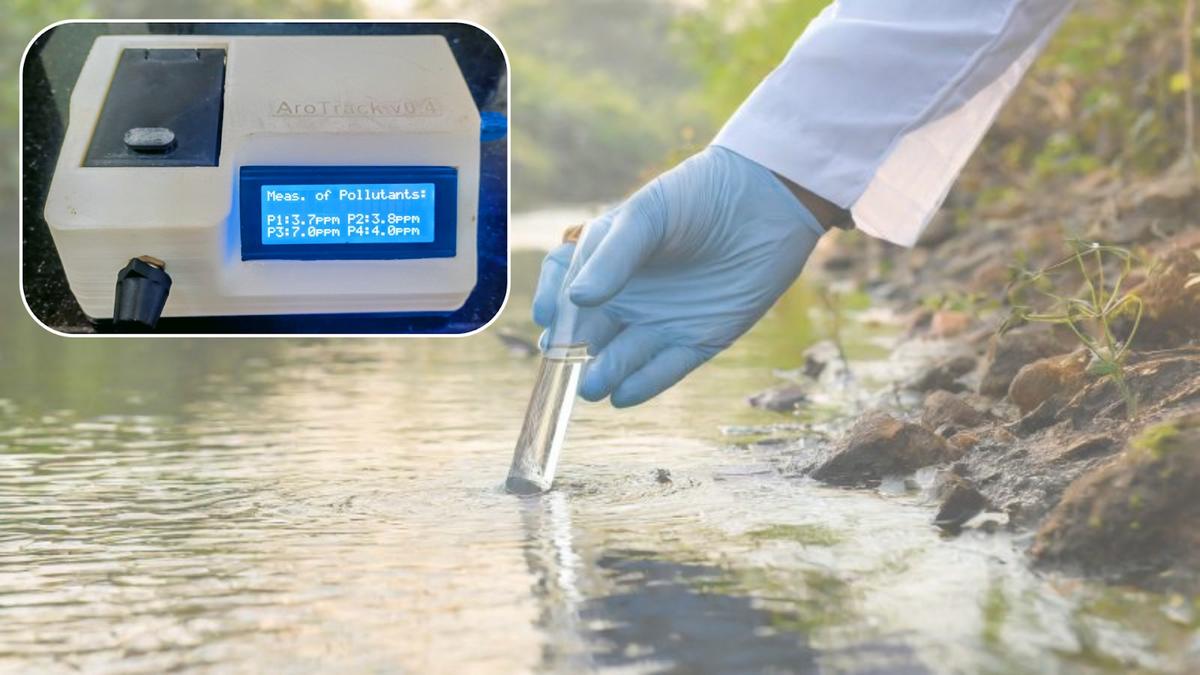
IIT Bombay scientists develop water-pollutant detecting device ‘AroTrack’
The Hindu
IIT Bombay introduces AroTrack, a portable device detecting harmful pollutants in water, offering a cost-effective solution for environmental management.
In a significant development for sustainable environmental management, scientists at the Indian Institute of Technology Bombay (IIT Bombay) have introduced AroTrack, an economical and portable device to accurately detect harmful pollutants such as phenol or benzene in water.
Scientists claim that the device can be a game-changer given the increasing water pollution due to industrialisation, urbanisation, and unregulated effluent discharge.
AroTrack device uses proteins typically found in bacteria living in heavily polluted environments to effectively identify multiple aromatic pollutants in water. Once mixed in the water sample, the protein undergoes a highly selective ATP hydrolysis chemical reaction if an aromatic compound is present in the sample. This reaction is expressed with a change in the colour of the protein solution, which AroTrack can then detect. The device is highly robust and compact, measuring slightly smaller than a small projector.
Professor Ruchi Anand from the Department of Chemistry, Professor Rajdip Bandyopadhyaya from the Department of Chemical Engineering and their team at IIT Bombay introduced a simple and affordable biosensing device capable of detecting harmful compounds such as, phenol, benzene, and xylenols.
The key component of the device is a biosensing module called MopR - a sensitive sensor for detecting phenol. Ms. Anand’s research team engineered it from the Acinetobacter calcoaceticus bacteria in 2017. MopR is both selective and stable, meaning it can detect pollutants even in complex environments with a high degree of precision.
Researchers at IIT Bombay have further diversified the MopR biosensor to detect other pollutants from the benzene and xylenol groups by engineering mutations in the bacterial protein. “The protein biosensing is very specific as the protein sensing pocket is tailor-made for the ligand (ion or molecule, like phenol or benzene). We have engineered mutations in the DNA of the protein sequence that can give mutant versions of the protein that now sense different molecules, creating a battery of sensors. Each sensor is particularly designed for a ligand,” Ms. Anand explains.
Once interfaced with an in-house, multi-channel monitoring apparatus, the MopR-based sensor forms the core of the newly developed aromatics tracking device—AroTrack. Talking about how the AroTrack detects the pollutants using the biosensor modules, Mr. Bandyopadhyaya explained, “AroTrack contains a light emitting diode [LED]-phototransistor assembly, that shines a light of appropriate wavelength through the sample and detects how much is absorbed. A more intense colour generates a higher absorbance.”


AIADMK faces perception challenges and electoral setbacks in Tamil Nadu, struggling to maintain its traditional stronghold and voter base.

K. Ashok appointed Executive Director of BHEL Tiruchi, succeeding S. Prabhakar after 36 years of experience in the company.

Garbage collection resumes in Bengaluru amid contractor disputes over payment delays and new waste segregation rules by BSWML.

Delhi High Court rules universities cannot restrict peaceful expression of dissent, emphasizing the importance of independent thought and discourse.

Mettur Dam's water level is at 82.83 feet, with an inflow of 384 cusecs and discharge of 800 cusecs.

Lebanon expels Iran's ambassador, declaring him persona non grata, while maintaining a Charge d'Affaires at the embassy.

Sunny Joseph accuses Pinarayi Vijayan of targeting Rahul Gandhi as part of a political deal with the BJP.

AIADMK faces perception challenges and electoral setbacks in Tamil Nadu, struggling to maintain its traditional stronghold and voter base.

Sunny Joseph accuses Pinarayi Vijayan of targeting Rahul Gandhi as part of a political deal with the BJP.

Mahesh Dattani and Jonathan Taikina Taylor collaborate play, ‘The Monk & The Warrior’, to be staged at Mumbai’s Experimental Theatre from April 2 to 5

NHAI's rooftop solar plants on three toll plazas generate 521 daily units, saving 1.87 lakh conventional power units annually.

Congress criticises PM Modi's Rajya Sabha statement on West Asia, calling it a "self-praise" prepared text without Opposition clarification

Kerala has 2.71 crore voters for the April 9 Assembly polls, with 2,040 polling stations marked as critical.