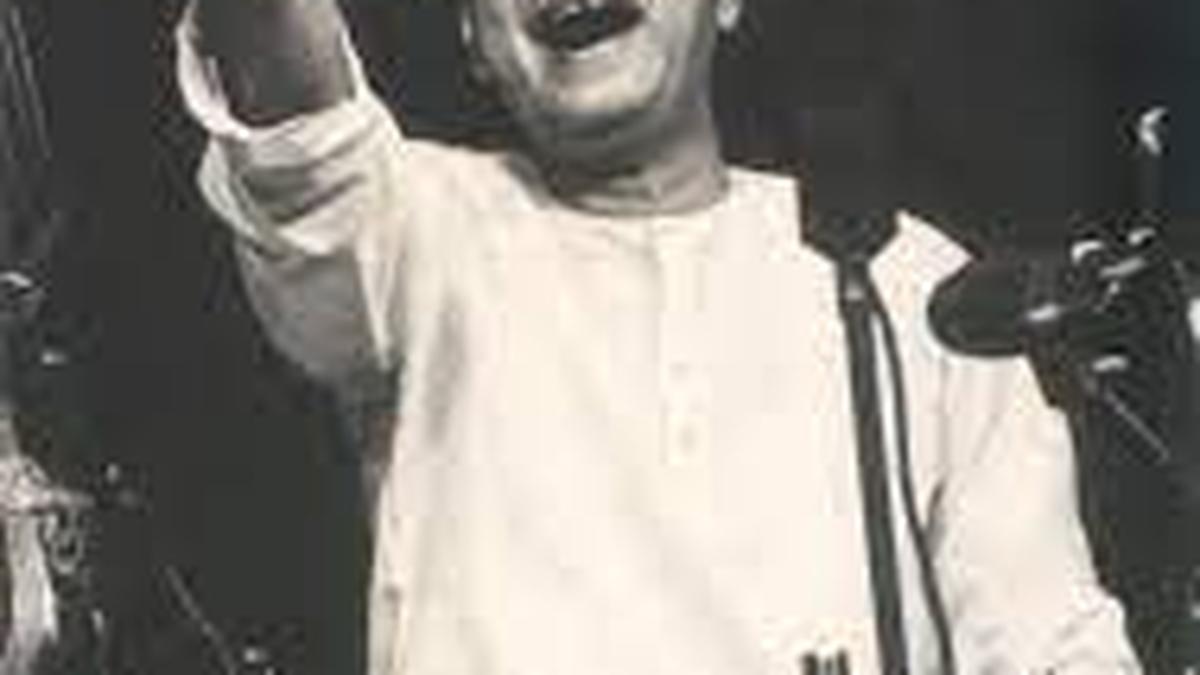
How the musical paths of stalwarts Pt. C.R. Vyas and Pt. Ram Marathe crossed
The Hindu
Celebrating the music of Pt Ram Marathe and Pt. C. R. Vyas
Delhi’s India International Centre recently hosted the centenary celebrations of two great vocalists — Pt. Ram Marathe and Pt. C. R. Vyas — from Maharashtra. Surprisingly, both were at the same point in their lives, disciples of the inimitable Pt. Jagannathbua Purohit, (1904-1968) called ‘Gunidas’, who learnt from several gurus, notable among them being Ustad Vilayat Hussain Khan of the Agra gharana.
Pt Ram Marathe was one of the most popular actors and Natya Sangeet singers of his time, in addition to being a classical vocalist and tabla player. Regarded as a master of ‘jor ragas’, he performed in more than 7,000 theatre shows. Known for his indefatigable energy, Pt Ram Marathe would sometimes present a four-hour concert after performing in two plays. Though he passed away in 1989 at the age of 65, he was honoured with the Sangeet Natak Akademi award in 1988. There are 18 singers in his family. The four of whom include his grandchildren Bhagyesh Marathe and Prajakta, cousin Swarangi Marathe and Pallavi Pote. Adwait Keskar his great grandson is currently learning from Pt Ulhas Kashalkar.
Pt C.R. Vyas held a white collar job, yet was regarded as an erudite singer. Like Pt Ram Marathe, he was in constant quest for musical knowledge, and learnt from several gurus. Unassuming, he pursued music for his own joy. Today, two of his three sons are musicians — vocalist Suhas Vyas and santoor player Satish Vyas. Amongst his more celebrated disciples are Prabhakar Karekar, Sanjeev Chimmalgi and Ganapati Bhat. Pt Jitendra Abhisheki too learnt from him. In 1977, Pt. Vyas started the annual Gunidas festival, as a tribute to his guru, which is still being held by his culture-curator son Satish.
At the ICC event two vocalists paid a musical homage to these two masters, who incidentally were good friends too. Shashwati Mandal sang the rare raag Swanandi. She learnt it from Suhas Vyas and Sanjeev Chimmalgi. After the vilambit khayal, the second bandish in Ek taal had an interesting context — apparently while travelling one day from Matunga in Mumbai, Pt Vyas fell asleep and dreamt of this raga created by his guru. When he suddenly woke up, he found he had missed his stop and the musical dream ended abruptly. In depair, he created the composition that Shaswati sang, where the evocative lyrics speak of this journey: ‘chaturai ki thi mose, sapna mohe daras deke. Jab jaag pari paahe, gunijaan dukh paayo.’
Shashwati’s piece de resistance was an unusual Punjabi composition ‘Dildaar mustafa’ in raag Shahana taught to her guru Pt Madhup Mudgal by Sumati Mutatkar, of the Agra gharana. Shashwati intricate taans were awe-inspiring. She was accompanied on the harmonium by her husband Mausam, and on the tabla by Ustad Akram Khan.
The next concert was by Bhagyesh Marathe. Bhagyesh has a powerful and bhava-rich voice. His singing shows his taalim. He sang an appealing raag Bihag. The vilambit composition was his own, in honour of his grandfather’s most popular role as Shiva. There was no need for the antara as the sthayi encompassed the entire octave. He concluded with raag Sohni, ‘Pyaara menda, nazar nahi aavega’, another popular bandish in Punjabi taught to him by Ustad Vilayat Hussain Khan. Apart from Braj, Hindi and Urdu, there are many khayals in Punjabi, which proves the region was once home to Hindustani music.
Bhagyesh was ably accompanied on the harmonium by Paromita Mukherj, a fine instrumentalist trained by Pt V.G. Jog and Ustad Ashish Khan, amongst others. Her spirited musical responses elicited appreciation from the audience. On the tabla was the amazing Vinod Lele from Banaras gharana.


‘One Piece’ Season 2 review: As the Straw Hats enter the Grand Line, Netflix’s live-action adaptation finds its sea legs with bigger islands, stranger villains and the same stretch-happy sense of boundless adventure

Geeta Gandbhir, the Indian-origin American filmmaker is waves at this year’s Oscars with not one, but two nominations. Her documentaries, ‘The Perfect Neighbor’ and ‘The Devil is Busy’ are in the race for the Academy Award

Directed by filmmaker and environmentalist Pradip Krishen, the film follows a group of "dope-smoking, bellbottom-wearing and vaguely idealistic" final-year students racing to complete their theses.

Alan Ritchson powers through 'War Machine', a lean sci-fi action thriller on Netflix. A competent, Reacher-style chase adventure with nonstop tension and solid set pieces

Explore the Unshelving Memories exhibition in Thiruvananthapuram, showcasing diverse book art by 61 talented artists until March 15.

Oscars 2026 date and timings: Watch the 98th Academy Awards live on March 15, 2026, at 4:30 a.m. IST in India on various platforms.

The 12-day Tribal Art Festival, taking place in Delhi until March 13, brings together more than 75 tribal artists and over 1,000 artworks representing more than 30 tribal art traditions.

Tom Cruise wins Best Actor at the 2026 Saturn Awards, while 'Avatar: Fire and Ash' takes home multiple major honors.

The new God of War is a coming-of-age story that builds Kratos into the formidable warrior seen in later games

Rachel Weisz dazzles in Vladimir, a sharp, sexy Netflix mini‑series that probes power, desire, and academia in eight smart, bingeable episodes

Thiagarajan Kumararaja’s groundbreaking debut film, ‘Aaranya Kaandam’, is hitting theaters again, more than a decade after its original drop on June 10, 2011

The three-part docu-series is a moving show of force, which could have benefited more from narrative clarity

Corey Parker, 'Will & Grace' actor and esteemed acting coach, has passed away at 60 after battling cancer.