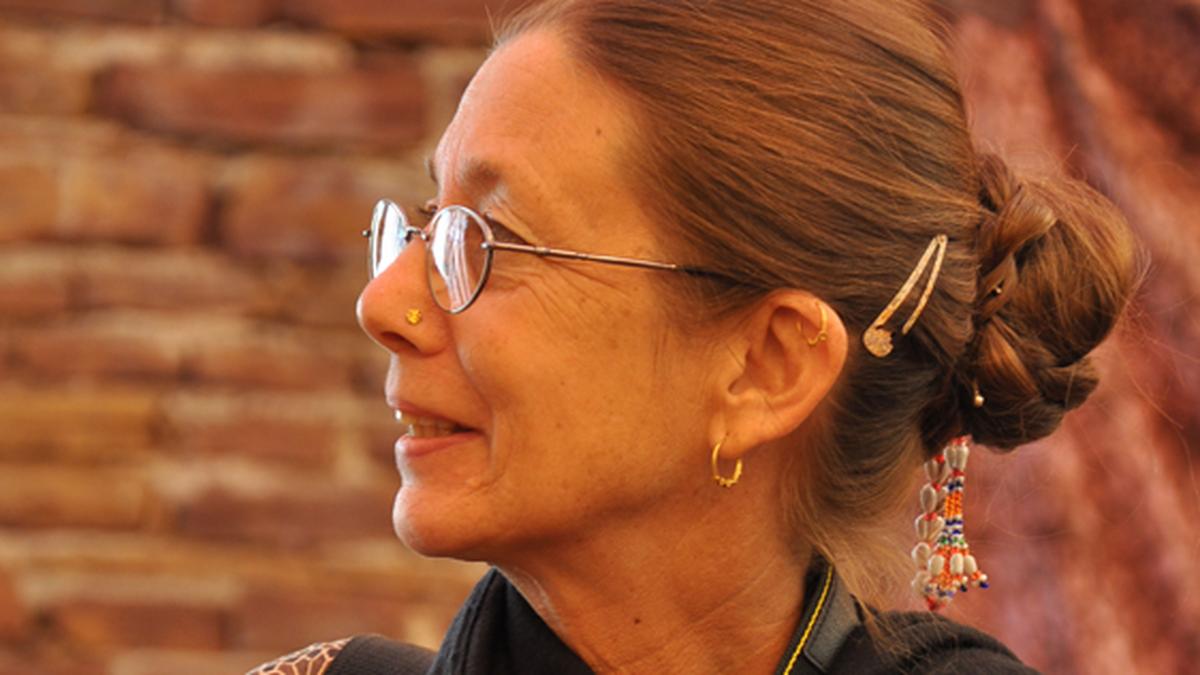
How Judy Frater empowers Gujarat artisans and preserves India’s cultural heritage
The Hindu
Judy Frater’s legacy: Building respect for Indian crafts as art and sustainable tradition
At the International Music & Arts Society’s heritage lectures, American social entrepreneur, author, and expert in textile arts, Judy Frater spoke about her latest book Artisans by Design, an odyssey of education for textile artisans in India’. Each slide she presented unfolded as a chapter in her passionate journey — a reflection of her deep bond with the craft, and her affection for the artisans who create it.
Her slight frame and diminutive stature belie her tenacity and conviction that enabled her to live in the inhospitable Kutch region for 30 years. She learnt Gujarati to communicate with the Rabbaris, whose embroidery drew her to India. She undertook a research project on the area’s rich textile traditions and their cultural history, and developed programmes for traditional artisans in the contemporary world, founding Kala Raksha institutions, aided by Fulbright, Ford Foundation and Ashoka Fellow Grants.
The traditional hand embroidery from the nomadic Rabari community of Gujarat and Rajasthan, features geometric patterns and chain stitches. | Photo Credit: Special Arrangement
Rabbari embroidery was executed by different ethnic groups, some nomadic. So, the work emerged as more than just skills — it embodied cultural heritage, craft and communication. She realised that one could “read” the embroidery, as their verbal stories unfolded on the fabric. Her collected samples are now considered a precious resource in the Kala Raksha Museum.
In 2005, the first school, Kala Raksha Vidyalaya, bridged tradition with the contemporary, dealing with important issues surrounding small-scale artisan production, value and sustainability. Its aim was designed as a year-long course, structured across six intensive sessions spread over two weeks. . She hoped the transformative effect of education would bring confidence and empowerment to these textile craftspeople, who were primarily engaged in embroidery, bandhani, hand block-printing and weaving.
Realising that artisans’ involvement and participation were crucial throughout their precarious journey — from income generation to cultural empowerment, from creations to the marketplace — their needs and inputs were prioritised, ensuring they were invested in the process of setting up the courses. Her wonderfully structured classes brought out the best in their creativity and potential.


LPG shortages caused by the West Asia conflict threaten to shut down half of Mumbai's restaurants, impacting livelihoods significantly.

Mysuru hoteliers face a crisis as LPG supply disruptions threaten operations of 1,500 eateries, potentially forcing many to shut down.

Kremlin confirms Putin's mediation proposals for the Iran conflict remain available, emphasizing patience in negotiations and agreements.

Supreme Court suggests deferring to Parliament on UCC instead of striking down Shariat Act's inheritance provisions for Muslims.

T.N. CM Stalin unveils a statue at Marina Beach emphasizing education's significance and releases a book on Chennai's century-old trees.

Andhra Pradesh invites investors to develop theme parks and amusement projects, offering incentives through its new Tourism Policy 2024-29.

V.O.C. Port sets a national record by handling 147 windmill blades from a single vessel, enhancing renewable energy cargo capabilities.

Shorts News:Experts identify Tomahawk near Iranian school, Trump calls missile ‘very generic’

KPCC warns leaders against premature candidate declarations and coalition seat-sharing, emphasizing adherence to party screening processes.

Shorts News:Watch: How Pirappamankad became a hit on social media

Kerala High Court issues notices to actor Dileep as government challenges acquittal in 2017 actor rape case.

Judy Frater’s legacy: Building respect for Indian crafts as art and sustainable tradition

A mother and daughter died in an accident involving a truck near Perumbakkam while on their way to school.