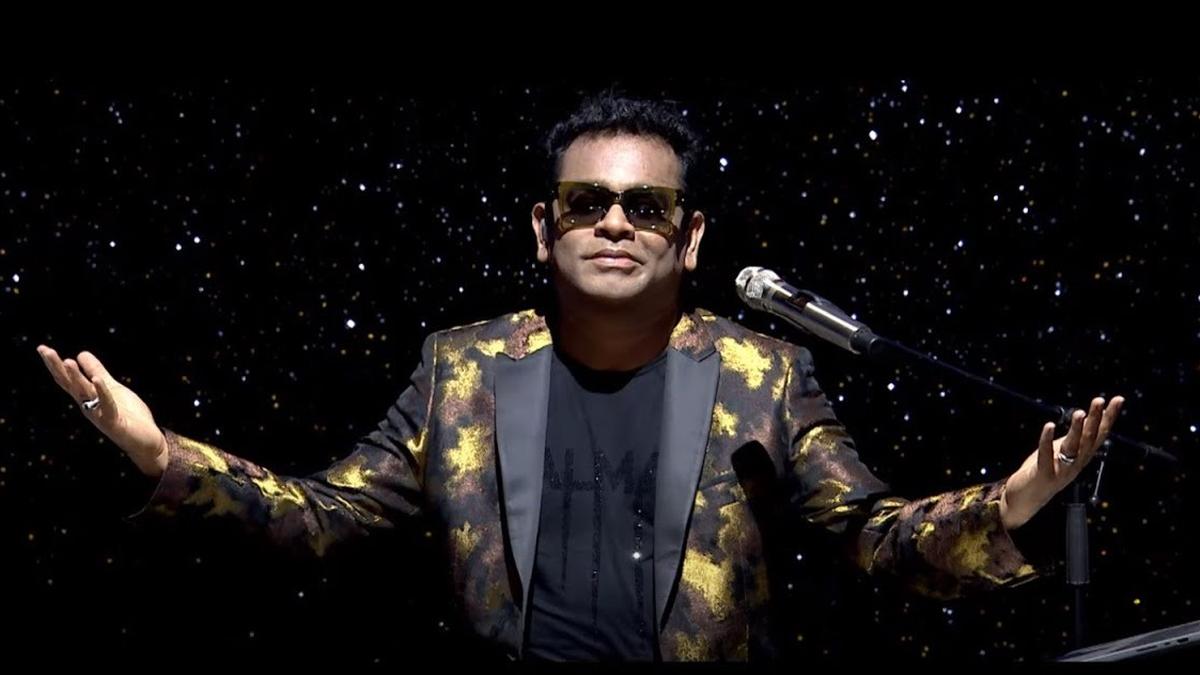
How A.R. Rahman is reimagining himself for the stage
The Hindu
From a composer to a performer, how A.R. Rahman has reimagined himself?
The loud cheer from the Chennai crowd at A.R. Rahman’s concert last Sunday, as part of his Wonderment Tour, echoed through the cool night sky. It was a dazzling fusion of lights, beats and hit melodies. In the past few months, Rahman has emerged as a performer, who loves to engage with different genres of music.
Audience in Mumbai and Delhi witnessed this recently as the Oscar-winning composer delved deep into Classical ragas and sufi mysticism. Aptly titled ‘JHALAA’, it wove together his musical and spiritual thoughts. In doing so, Rahman reminds us that the future of culture lies not in reinvention alone, but in thoughtful continuity—where beauty, discipline and meaning endure across generations.
The 12-member JHAALA team, mentored by A.R. Rahman. | Photo Credit: Special Arrangement
Formed after a global talent search that received over 500 entries, JHALAA brought together 12 young artistes, trained in Indian classical arts, and mentored by A.R. Rahman. The ensemble is defined by its commitment to live, acoustic performance, free from pre-recorded tracks or digital enhancement. Its repertoire spans compositions by legendary masters such as Ustad Bade Ghulam Ali Khan, Ustad Munna Shoakath Ali, Oothukkadu Venkata Subbaiyer, Ustad Ghulam Mustafa Khan, Pt. Laxmanprasad Jaipurwale, Kunwar Shyam Ji and Amir Khusrau, alongside select works by Rahman.
Each performance unfolded as a carefully structured journey through sound and movement. It began with a bandish in raag Bhatiyar, a morning raag, which belongs to the Marwa Thaat. A favourite of Rahman, it was delineated beautifully enveloping the whole place with its movement in Vakr — Sa dha, pa, dha, ma, pa, ga, ma, dha, Sa; in Aroha Re; in Komal touching tivr Ni — creating a stir, as the alaps and the taans overlapped harmoniously.
The evening also featured compositions such as ‘Aao balma’ in raag Yaman Kalyan, ‘Bhor bhayi’ in raag Gurjari Todi and Carnatic compositions like ‘Alaipayude’. Classical dance forms, including Kathak, Bharatanatyam and Kuchipudi were seamlessly interwoven, most strikingly in ‘Aigiri Nandini’, where the trishul became a visual invocation to Devi.


PM Modi and President Macron to strengthen India-France ties during their meeting in Mumbai on February 17, 2026.

DMK demands action against Congress leaders before seat-sharing talks, citing strained alliance ahead of Tamil Nadu elections.

Kerala Law Minister P. Rajeeve emphasizes balancing religious practices and constitutional rights in the Sabarimala women's entry debate ahead of Supreme Court review.

Karnataka High Court Dharwad Bench and Mandya district court evacuated after bomb threat email; police and bomb squad investigate.

Telangana to launch free HPV vaccination program for girls aged 14-15 to combat cervical cancer, starting end of February.

AR Rahman’s ‘The Wonderment Tour’ in Chennai promotes love and unity, captivating fans on Valentine’s Day with unforgettable performances.

Kerala tourism achieves record 2.58 crore visitors in 2025, with Idukki leading domestic arrivals, says Minister Mohamed Riyas.

A kitchen fire at Nexus Vijaya Mall in Vadapalani prompts emergency response and smoke evacuation efforts by officials.

Shivamogga airport will gain night landing capabilities by October, enhancing flight services to major cities like Mumbai and Delhi.

Delhi faces warm weather and persistent poor air quality, expected to last until February 17, 2026.

Six arrested, including alleged shooter, in Rohit Shetty firing case; police invoke MCOCA as investigation continues.

Scientists urge Tamil Nadu's CM to withdraw the Mamallan Reservoir proposal, citing severe risks to coastal wetland ecosystems.

BJP secures its first mayoral post in Telangana by winning Karimnagar Municipal Corporation, marking a significant political milestone for the party.