Here are the big stories from Karnataka today
The Hindu
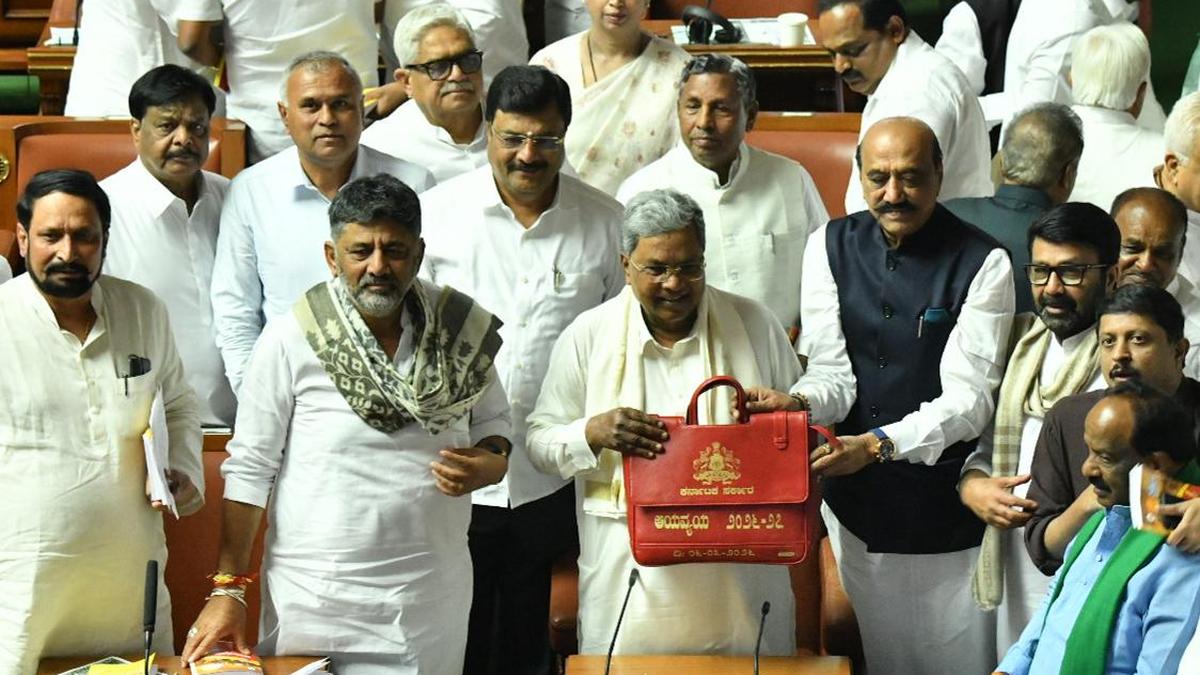
Karnataka Today newsletter: CM Siddaramaiah presents his 17th budget with an outlay of ₹4,48,004 crore
Chief Minister Siddaramaiah presented the State Budget for 2026-27 with a total outlay of ₹4,48,004 crore, a 13.3% increase compared to the Revised Estimates for 2025-26, pegged at ₹3,95,307 crore. This was despite concerns over a fall in Goods and Services Tax (GST) revenue due to rate rationalisation, which seems to have been countered by an increase in the State’s share of the tax devolution pool, as per recommendations of the 16th Finance Commission.
The budget adheres to norms of Karnataka Fiscal Responsibility Act, 2000, though very close to the upper limits. The fiscal deficit stands at ₹97,449 crore, or 2.95% of GSDP, as against the limit of 3%. The total liabilities stand at ₹8,24,389 crore, or 24.94% of the GSDP, as against the limit of 25%. Borrowing estimate is ₹1.32 lakh crore. Karnataka has been presenting revenue deficit budgets for consecutive years now. This year, the figure is pegged at ₹22,957 crore, up from ₹19,262 crore last year, as per budget estimates.
In a push to expand road network and tackle traffic congestion in Bengaluru, Chief Minister Siddaramaiah announced construction of an Intermediate Ring Road (IRR) connecting Nelamangala, Tavarekere and Bidadi. The project will be taken up using the financial resources of the Bangalore Metropolitan Region Development Authority (BMRDA) and local planning authorities.
In the year 2025-26, the State Government increased the grant for the development of Bengaluru from ₹3,000 crore to ₹7,000 crore. This grant will be continued in the current year as well. Further, the new city corporations under the Greater Bengaluru Authority (GBA) will mobilise resources for development work by issuing municipal bonds based on their balance sheets.
Karnataka Budget featured a few schemes to support eco-friendly agricultural practices, along with measures to strengthen initiatives to back cultivation of millets. The budet has proposed ‘Vasudhamruta’ programme to promote eco-friendly and sustainable agricultural practices by enhancing organic carbon content of soil, along with its physical, chemical, and biological properties.
The ‘Sasya Sanjeevini’ scheme has been announced to identify pests and diseases at the early stage, and to provide timely recommendations to farmers on control measures, such as use of eco-friendly bio-control agents and bio-pesticides, along with other safer control measures. Both schemes will be implemented over the next three years.


DMK prepares for a major rally in Tiruchi, with Stalin launching the election campaign at the 12th State conference.

Former Minister Vellamandi N. Natarajan is appointed as AIADMK organisation secretary after rejoining the party.

Pinarayi Vijayan criticizes the Indian government's submission to imperial powers over US-Israel strikes on Iran at a rally.

The BJP and the JD (S) criticised the State Budget presented by Chief Minister Siddaramaiah on Friday as one that burdened people by increasing pubic debt.

Protecting crowds from the scorching sun at election rallies in Madurai is essential for public safety and comfort.

Indian airlines have repatriated 15,000 passengers from West Asia amid escalating conflict, with 51 flights scheduled for March 7.

Karnataka's Budget emphasizes industrial growth, supporting MSMEs, and boosting investment opportunities for innovation and employment statewide.

Pondicherry University is set to launch a new postgraduate programme in hospitality management next academic year, enhancing industry-relevant education.

Iran urges India to question the U.S. about targeting Iranian ships, emphasizing diplomacy as the solution to conflict.

Bengaluru’s Victoria Hospital faces surprise renaming proposal in the Budget, leaving doctors and patients taken aback.

Celebrations ahead of International Women's Day featured games, recognitions, and empowerment initiatives for women in Visakhapatnam.

Hyderabad's CM highlights Musi river restoration as key to urban renewal, aiming for a cleaner, vibrant, and connected city.

Finnish President Stubb urges caution to avoid global conflict, backing the U.S. while criticizing its actions in West Asia.