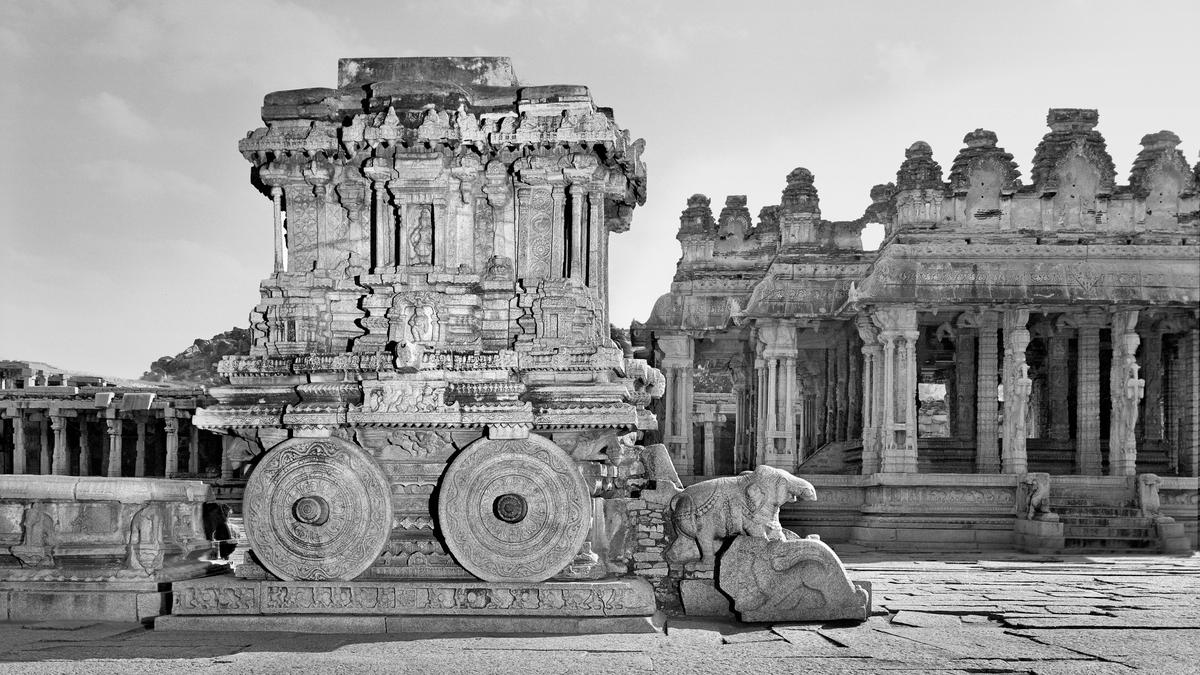
Hampi in light and stone | Landmark publication ‘City of Victory’ gets a new edition
The Hindu
Explore the updated edition of "City of Victory," a definitive visual and historical portrait of Hampi's Vijayanagara empire.
The Vijayanagara empire dominated the geopolitical landscape of the Deccan from the 14th to the 16th centuries before its destruction and abandonment. Vijayanagara, which means the City of Victory, continues into our times with the ruins at Hampi, now a World Heritage Site of immense cultural significance and newfound interest. The book City of Victory: Hampi Vijayanagara (Pictor), by archaeologists George Michell and John M. Fritz (with photography by John Gollings), is therefore not another architectural guidebook but a definitive visual and historical portrait of a city that was once the thriving capital of the most important Hindu kingdom in medieval South India.
The book is an updated presentation of the 1991 book by the authors. The older edition — with Michell’s lifelong work on Deccani architecture and its dissemination, alongside Fritz’s studies — was a landmark publication that brought early scholarly attention to Hampi. The new edition is designed for contemporary readers; Michell has reorganised the scholarship, updated the documentation work (that has continued since 1991), and published it in large format.
The book City of Victory: Hampi Vijayanagara
A few weeks ago, I had a chance to attend the photo exhibition that accompanied the book launch, at Bengaluru’s Venkatappa Art Gallery. To my luck, architectural photographer Gollings was on site for a walkthrough of the black-and-white photographs. Produced over 45 years, his lens captures buildings suspended in sweeping stone terrains, each shot a careful composition. One image was particularly arresting: the monumental 6.7-metre monolithic Lakshmi Narasimha at Hampi. Weathered, immense, and dignified even in ruin, it is among the most recognisable icons of Vijayanagara, commissioned by King Krishnadevaraya in 1528.
But something felt subtly unfamiliar. The deity, seated cross-legged in formidable calm, seemed familiar and yet altered. Gollings explained the shift. “In the 1980s, well-meaning conservators from the Archaeological Survey of India introduced a stone yogapatta — a supporting band across the knees — to stabilise the sculpture,” he said. “In doing so, they inadvertently transformed the iconography.” The original sculpture, once depicted with the goddess seated upon Narasimha’s lap, had long lost its form. With the addition of the band, the image was reinterpreted as Yoga Narasimha, the ascetic manifestation we recognise today.
It was a quiet revelation. What centuries had weathered and neglect had sustained, restoration had subtly redefined.


Youth and student groups criticize Karnataka's 2026-27 Budget for inadequate job creation and insufficient education funding.

Arvind Subramanian emphasizes the need for more manufacturing jobs in India to boost employment and address inequality.

Karnataka and Andhra Pradesh's social media bans for children face jurisdictional challenges amid central government regulations on internet use.

CM Revanth Reddy launches ‘Praja Palana–Pragati Pranalika’ with key projects in Hyderabad

Vaiko urges Tamil Nadu government to eradicate Prosopis juliflora, emphasizing environmental protection and community involvement in the initiative.

Congress will lead the alliance for the Puducherry Assembly polls, with seat-sharing talks underway with DMK and other partners.

As many as 56 candidates from Tamil Nadu who received coaching under Naan Mudhalvan Scheme have cleared the civil services examination 2025 conducted by the Union Public Service Commission.

T20 World Cup final set for a 'true surface' at Ahmedabad's Narendra Modi Stadium, promising an exciting match between India and New Zealand.

Karnataka and Andhra Pradesh's social media bans for children face jurisdictional challenges amid central government regulations on internet use.

The Karnataka Rajya Raitha Sangha (KRRS) has expressed dissatisfaction over the State Budget by maintaining that it lacked vision to ensure the development of agriculture and farmers.

DMK prepares for a major rally in Tiruchi, with Stalin launching the election campaign at the 12th State conference.

Former Minister Vellamandi N. Natarajan is appointed as AIADMK organisation secretary after rejoining the party.

Pinarayi Vijayan criticizes the Indian government's submission to imperial powers over US-Israel strikes on Iran at a rally.