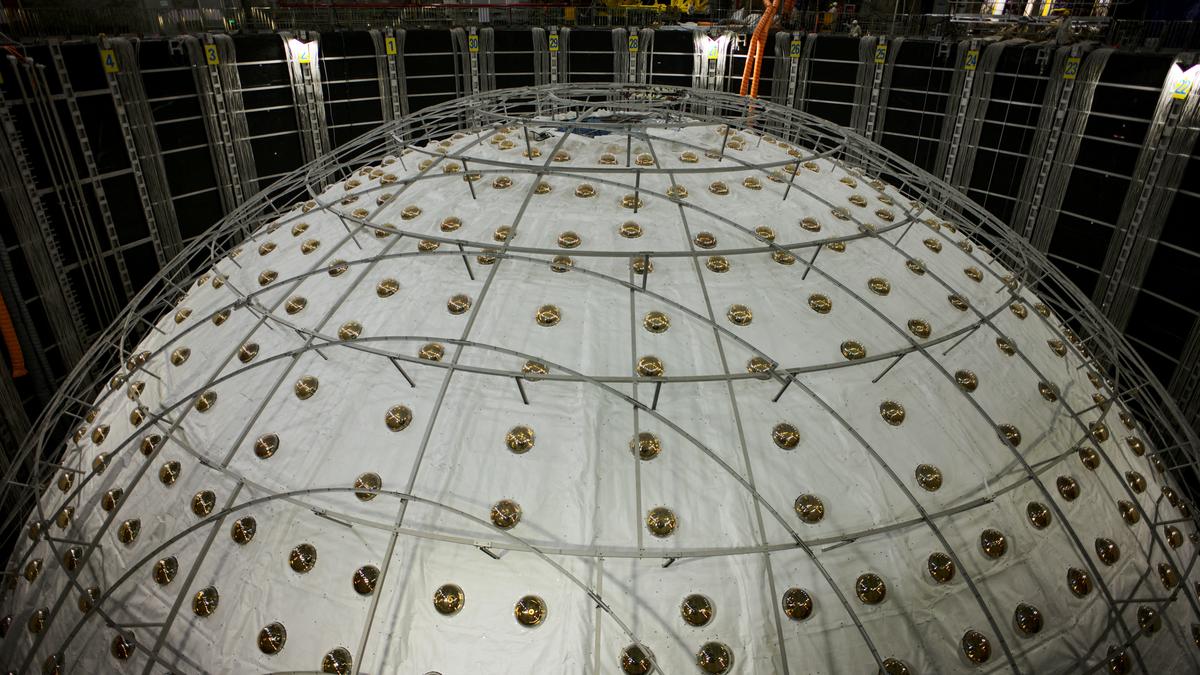
Massive experiments could soon reveal more about nature of ‘ghostly’ particles
The Hindu
Massive experiments may soon clarify the elusive nature and mass ordering of neutrinos, the universe's ghostly subatomic particles.
Imagine you are given three gumballs of different flavours. You are told that one of them is heavier than the others, and one is lighter. But which is which? Your task is made difficult by the fact that these gumballs weigh nearly nothing. And sometimes they swap flavours. Oh, and when you try to pick them up, most of the time they simply pass through your hand.
Such is the task facing physicists attempting to get a handle on the ghostly subatomic particle known as the neutrino. These teeny-tiny particles, which theory currently says come in three types, or “flavours,” flood the universe but rarely interact with the ordinary matter we are all familiar with. This makes them bafflingly hard to study, despite their amazing abundance.
But cracking the questions of how much neutrinos weigh, and which are the heaviest, is of vital importance to particle physicists. The Standard Model that they have painstakingly developed to describe all of nature’s particles and forces explicitly says that neutrinos have no mass at all. Yet observations have established that neutrinos do, in fact, have a very small mass. This is an annoying and critical exception to the standard rules of physics, with implications for other theories. For anyone who wants to understand the universe, fixing this problem is imperative.
The good news is that physicists are making excellent progress and have a good chance of figuring out the order of neutrino masses in just a few years, certainly by 2030, they say. “I think we will have a strong evidence, one way or the other,” says André de Gouvêa, a theoretical particle physicist at Northwestern University.
Data collected in experiments done around the world over the past 35 years have led to better and better estimates for the average mass of the neutrino (diagram shows error bars for each measurement). The latest results (inset) show a narrower range of uncertainty and put the value very close to zero, at least 500,000 times lighter than an electron. | Photo Credit: Knowable Magazine
While they may be shy, neutrinos are everywhere: They are the second most abundant thing in the universe after photons, particles of light.


Kremlin refuses to share crude export data to India, citing concerns over "ill-wishers" amid changing geopolitical dynamics.

Massive experiments may soon clarify the elusive nature and mass ordering of neutrinos, the universe's ghostly subatomic particles.

Protesters in Manipur demand justice for victims of ethnic violence, including BJP MLA Vungzagin Valte, during a road march.

Start your day with key updates: Iran's naval ship docks in Kochi, RSP's election success in Nepal, and more news.

A devastating firecracker factory explosion in Andhra Pradesh killed 28 workers, highlighting severe safety violations and tragic losses.

Maharashtra's ₹7.69 lakh crore budget includes a farmer loan waiver and ambitious plans to boost the agricultural economy significantly.

Domestic LPG prices rise by ₹60 to ₹913 per cylinder in Delhi due to West Asia conflict impacts.

Over 204 Indian cities exceed air quality standards, with Ghaziabad being the most polluted, according to CREA's analysis.

Explore the updated edition of "City of Victory," a definitive visual and historical portrait of Hampi's Vijayanagara empire.

Mahila court in Coimbatore to announce judgment on March 7 in high-profile gang-rape case involving three accused.

A.P. CM Naidu criticizes YSRCP for neglecting public issues in Assembly while emphasizing responsible budget management and coalition unity.

Youth and student groups criticize Karnataka's 2026-27 Budget for inadequate job creation and insufficient education funding.

Arvind Subramanian emphasizes the need for more manufacturing jobs in India to boost employment and address inequality.