Guru Margi Sajeev on what ails Koodiyattam
The Hindu
The way forward for Koodiyattam
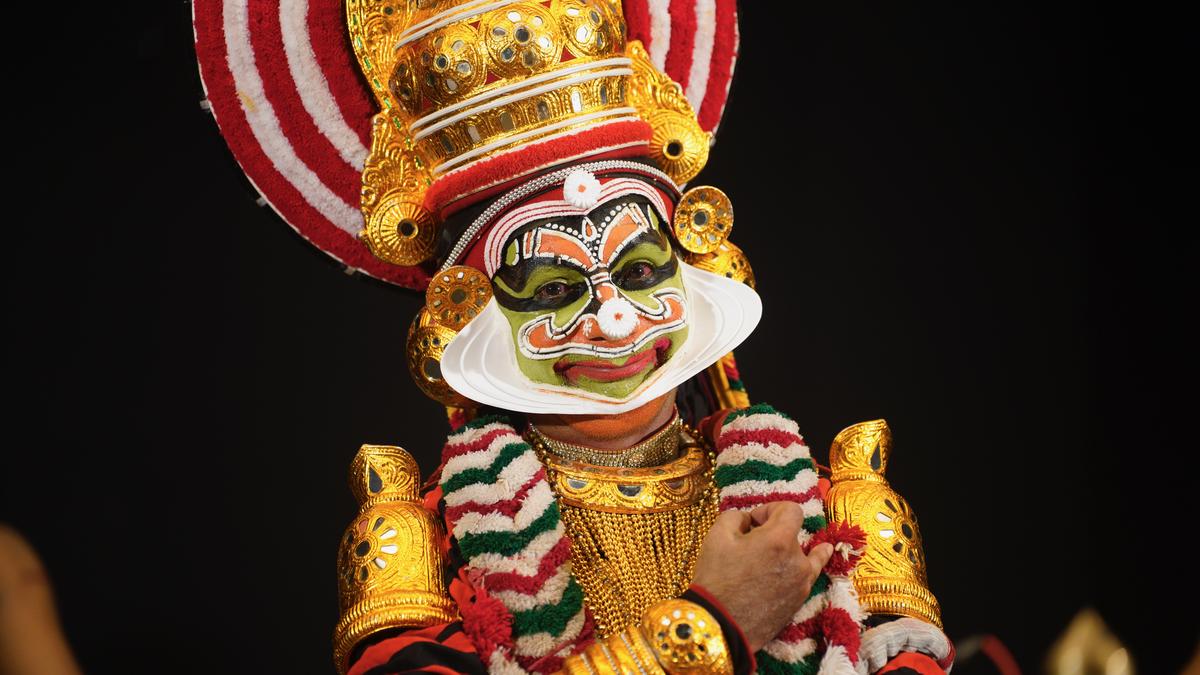
Margi Sajeev Narayana Chakyar as the love-smitten Ravana sits glued to his peetam (stool) for a little over three hours and slowly, using only his eyes and face, describes the expressions of Ravana’s ten faces as they react to Sita’s beauty. As Soorpanakha, with the lilting monologue in a crude form of Malayalam, his act evokes sympathy for the demoness. Every role that is physically demanding or needs long periods of concentration is safe in the hands of this versatile actor.
A day-long event on June 2 to honour Sajeev on his 60th birthday was an occasion for the Koodiyattam community to celebrate the art form and at the same time voice concerns about its future. A common refrain heard from many gurus and speakers was the failure to draw new students, especially boys, because of the lack of patronage faced by the artistes.
Sajeev, who has spent 45 years as a Koodiyattam actor and guru, says very little has changed in this respect. “I still remember the day we moved to Thiruvananthapuram from Moozhikkulam with my younger brother Madhu. It was shortly after my arangetram at age 14. The move came after Margi started Koodiyattam classes and my father was appointed the teacher. We were excited about going to a big city but at the same time like all Koddiyattam practitioners wondered if the artform can provide a livelihood.”
Sajeev recalls with a chuckle that he and his brother started learning typewriting and shorthand as a backup option, with half-hearted permission from his gurus. “Though I am happy to say today that we never had to fall back on it This question of an uncertain future even today bothers Koodiyattam students. For instance, my daughter Anjana, a Koodiyattam artiste, is currently doing her graduation. It is not easy to draw new students, while some drop out midway and some others take up other professions.
Sajeev, currently the head of Koodiyattam at Margi Thiruvananthapuram, was trained in the traditional gurukula by his father Kochukuttan Chakyar, and his uncle Ammannur Madhava Chakyar.
Koodiyattam was undergoing seismic shifts when Sajeev was growing up. The ritual art form, performed only in temples, moved to the performance arena. Once taught only at gurukulas run by the Chakyar families, training began to be imparted at institutions when Kerala Kalamandalam, now a performing arts university, offered classes in Koodiyattam for the first time in 1965. With that Koodiyattam also ceased to be the exclusive domain of Chakyar and Nambiar communities.
According to Sajeev, there have been major changes in the world of Koodiyattam — in the way it is taught and performed, in its costumes, and in new stories that are being adapted. Ammannur, a visiting professor at Margi, used to follow the gurukula system. “There was no syllabus. We took up a new story or role only when our gurus thought we had mastered what was being taught. For example, we did Nithyakriya, a preliminary pure dance sequence, for three years. “


Oscars 2026 security heightened amid FBI warnings of a potential Iranian drone threat ahead of the Hollywood ceremony.

Directed by Rahul Pandey, the series also stars Naila Grewal, Nidhi Bisht, Anant Joshi, Anjum Batra and Kusha Kapila

A tribute to the versatile actor and comedian V.K. Ramasamy in his birth centenary year.

‘One Piece’ Season 2 review: As the Straw Hats enter the Grand Line, Netflix’s live-action adaptation finds its sea legs with bigger islands, stranger villains and the same stretch-happy sense of boundless adventure

Geeta Gandbhir, the Indian-origin American filmmaker is waves at this year’s Oscars with not one, but two nominations. Her documentaries, ‘The Perfect Neighbor’ and ‘The Devil is Busy’ are in the race for the Academy Award

Directed by filmmaker and environmentalist Pradip Krishen, the film follows a group of "dope-smoking, bellbottom-wearing and vaguely idealistic" final-year students racing to complete their theses.

Alan Ritchson powers through 'War Machine', a lean sci-fi action thriller on Netflix. A competent, Reacher-style chase adventure with nonstop tension and solid set pieces

Explore the Unshelving Memories exhibition in Thiruvananthapuram, showcasing diverse book art by 61 talented artists until March 15.

Oscars 2026 date and timings: Watch the 98th Academy Awards live on March 15, 2026, at 4:30 a.m. IST in India on various platforms.

The 12-day Tribal Art Festival, taking place in Delhi until March 13, brings together more than 75 tribal artists and over 1,000 artworks representing more than 30 tribal art traditions.

Tom Cruise wins Best Actor at the 2026 Saturn Awards, while 'Avatar: Fire and Ash' takes home multiple major honors.

The new God of War is a coming-of-age story that builds Kratos into the formidable warrior seen in later games

Rachel Weisz dazzles in Vladimir, a sharp, sexy Netflix mini‑series that probes power, desire, and academia in eight smart, bingeable episodes