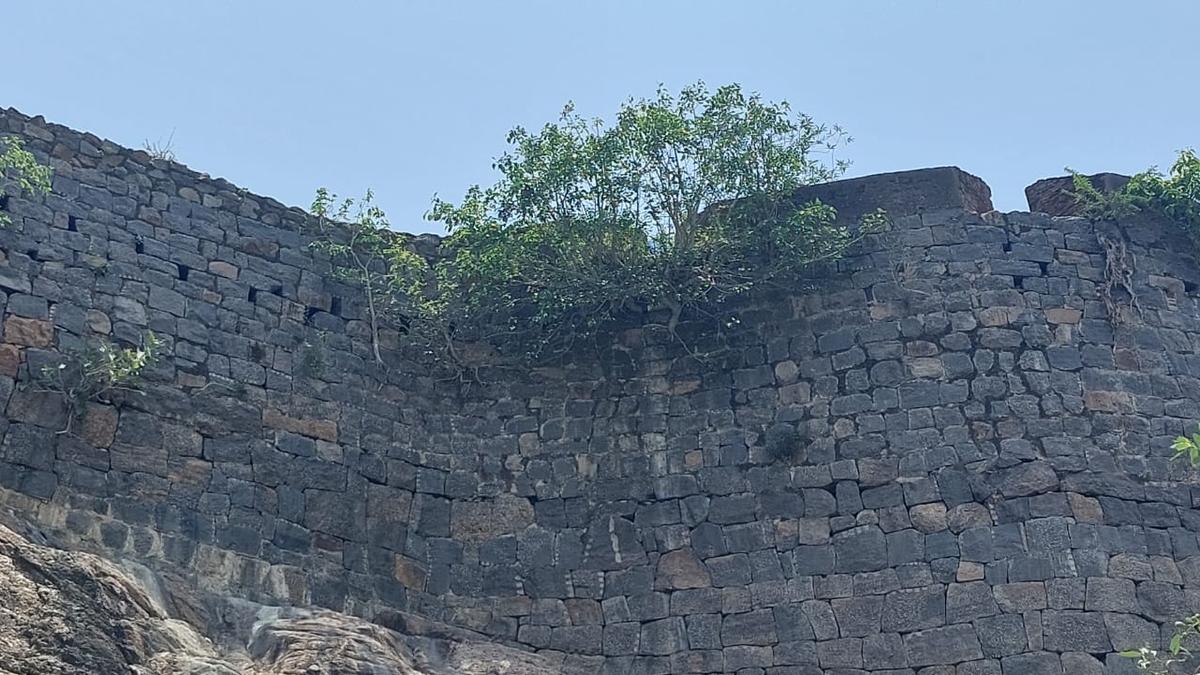
Growth of plants on walls of Perambalur’s Ranjankudikottai raises concern
The Hindu
Concerns raised over greenery growth on 17th century fortress walls near Perambalur, prompting calls for maintenance and promotion.
Heritage enthusiasts have expressed concern over the lush growth of greenery on the walls of Ranjankudikottai, a 17th century fortress near Perambalur.
The fort, oblong in shape with semicircular bastions and a moat encircling it, is maintained by the Archaeological Survey of India (ASI). There are three fortifications at different levels, built with cut stone blocks.
Believed to have been constructed by a Jagirdar of the Nawab of Carnatic during the 17th century, the fort was the site of a Battle of Valikondah between the English and the French in 1751, says the official website of Perambalur district.
In 1752, the fort was also the scene of surrender of French troops under D’Auteuil, which was sent to relieve the garrison at Srirangam. When D’Auteuil retreated to Ranjankudi, the Jagirdar took the side of the British and denied entry to the French troops to the upper level of the fort. D’Auteuil surrendered in the fort.
“Lush growth of greenery could be seen at several places along the upper fort walls, especially on its southern and western sides. There are a few well grown trees too. As their roots penetrate through the walls built of brick and mortar, cracks can develop on the walls and damage them,” observed Ramesh Karuppaiah, a heritage enthusiast of Perambalur, calling for periodic cleaning and proper maintenance of the historic structure.
The fort had already sustained some damage earlier. In 2021, the upper fort wall on the south east corner of fort had suffered damages when several stones were dislodged during the monsoon rains. The ASI had subsequently carried out repairs.
Although the repairs have been completed, the growth of weeds and trees on the structure pose a threat to it, said Mr. Karppaiah.


Modi and Jaishankar advocate for dialogue as India and France collaborate to de-escalate tensions amid escalating strikes on energy infrastructure.

The star-studded event was held in Mumbai and was attended by rithik Roshan, Alia Bhatt, Bobby Deol, Shahid Kapoor, Vijay Varma, Sonakshi Sinha, Jyotika, Ali Fazal, Sonali Bendre, Preity Zinta, Ravi Kishan and others

Shorts News:We are working on securing LPG, petroleum to meet our energy security needs: MEA

P. Veldurai served five years as MLA and was later asked to repay ₹21 lakh in Tamil Nadu.

Supreme Court reserves verdict on defining 'industry' under Industrial Disputes Act, impacting educational and healthcare sectors.

Dindigul Collector S. Saravanan held a meeting with Election Observers to ensure smooth election monitoring across seven constituencies.

Despite delays from the Centre, 24 States allocate funds for a new rural jobs program, using past MGNREGA expenditure as a baseline.

Congress’s third candidate list for Assam Assembly elections highlights the Pradyut factor and notable party shifts among MLAs.

Scholars foresee political shifts and governance concerns at BRS Ugadi celebrations, predicting potential opposition strength amid public dissatisfaction.

Election observers deployed in Thoothukudi; field inspection begins

Sri Sathya Sai Prema Sadan celebrated Ugadi with Vedic chants, Ugadi Pachadi, and Sri Rama Navami preparations in Visakhapatnam.

Visakhapatnam celebrated Ugadi with Panchanga Sravanam, cultural events, and auspicious predictions for a prosperous new year.

Celebrating diverse top talents, including visually impaired achievers, artists, and cultural icons honored with Ugadi awards.