From Snow to Storm: Western disturbances no longer just a winter story
India Today
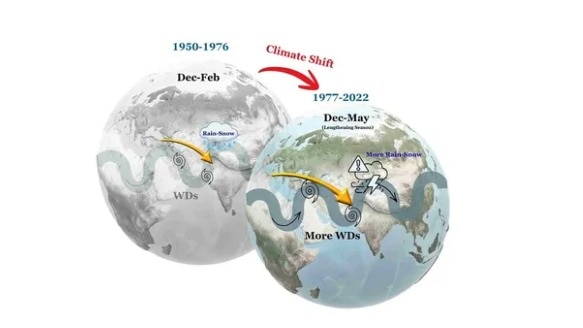
IIT Roorkee research suggests that western disturbances are no longer impacting only the country's winter cycle but are also significantly influencing the pre-monsoon period and the onset of summer.
A new study by researchers at an Indian Institute of Technology has found that western disturbances, a key weather system affecting northern India, are changing in both timing and intensity. The findings have raised concerns about climate resilience, disaster preparedness and water security in the Himalayan region.
Western disturbances are low-pressure systems that originate in the Mediterranean region and travel eastwards. They bring winter rain to north India and snowfall to the Himalayas. For decades, they have been linked mainly to the winter season, playing an important role in replenishing glaciers and supporting agriculture.
However, the new research shows that these systems are now becoming more active beyond winter, especially during the pre-monsoon months of March to May. The study, published in the International Journal of Climatology, suggests that climate warming is not only increasing extreme weather events but also altering the structure and seasonal role of large atmospheric systems.
Researchers analysed over 70 years of atmospheric and rainfall data. They found that western disturbances are now travelling longer distances and absorbing more moisture before reaching the Indian subcontinent.
Upper-level winds associated with these systems have also strengthened. Together, these changes are leading to heavier rainfall outside the traditional winter period.
Spandita Mitra, a PhD scholar in the Department of Hydrology involved in the study, said long-term climate data is essential to track these shifts. She noted that erratic rainfall and sudden extreme events seen in recent years reflect these broader atmospheric changes.


Paul McCartney's last solo album, McCartney III (2020), recorded during the pandemic, topped UK charts, marking his first solo number one since 1989, showcasing his creative freedom and personal musical expression.

ICAI CA Final January 2026 results have been declared today, March 1. Candidates who appeared for Group 1 and Group 2 exams can now check their scorecards, merit list and All India Rank holders on the official website, icai.nic.in. Direct result link is now active.

Pinterest CEO Bill Ready wants governments to ban social media for teenagers under 16, saying current platforms are harming young people's mental health and development.

Reddit is exploring biometric verification methods such as Face ID and Touch ID to ensure users are real humans, not bots, while pledging to maintain the platform's tradition of anonymity. CEO Steve Huffman said the company is planning to address the rising influence of AI-generated content and protect authentic user engagement.

Delhi is strengthening its push for UPSC success by recognising top achievers and improving support for aspirants. In a first-of-its-kind initiative, the government engaged directly with successful candidates to understand their preparation journey.

WhatsApp is reportedly working on a new privacy feature that will allow messages to automatically disappear shortly after being read. The upcoming feature, called "After reading," is expected to give users more control over their conversations, especially when sharing sensitive information.

RBSE Class 10 Result 2026 is expected to be declared soon, with students eagerly awaiting the official announcement date and time. The Rajasthan Board 10th result will be available online, making it important for students to stay updated on where and how to check their scores quickly.

In a push towards more inclusive school environments, the Central Board of Secondary Education has rolled out fresh directives on menstrual hygiene across its affiliated institutions. The move comes after a landmark ruling by the Supreme Court of India that places menstrual health within the framework of fundamental rights.

Tata Motors has introduced a more affordable dual-motor QWD variant of the Tata Harrier.ev, bringing all-wheel drive capability and strong performance to a wider audience at a lower entry price.

OpenAI is reportedly planning a major hiring push, aiming to nearly double its workforce to around 8,000 employees by the end of 2026 as competition in AI continues to intensify.

The Goa Board has announced the much-awaited Class 12 (HSSC) Result 2026 on its official website. Students can check the direct link, download steps, SMS option, login credentials, exam highlights, and re-evaluation details.

CBSE has launched an AI-based remote proctored exam in 2026 to assess 10,000 school counsellors in phases. The online evaluation will test their skills, ethics, and practical application in school settings.

OpenAI is now aiming to build a fully automated AI researcher that can plan, analyse, and solve complex problems on its own, calling it the company's "North Star" for the next few years.