‘Free’ vaccines, single-dose nudge pushes India-made HPV vaccine to back of the line
The Hindu
India's HPV vaccine, Cervavac, faces delays for inclusion in immunization programs due to ongoing studies and competition from Gardasil.
A relaxation by the World Health Organization (WHO) in the prescribed dosage for the Human Papilloma Virus (HPV) vaccine and ‘free’ doses may have pushed back the inclusion of an India-made vaccine into the national programme to inoculate children against HPV.
This, despite the Health Ministry in 2023 committing to preparing the India-made vaccine for inclusion in the Universal Immunisation Programme (UIP), publicly available documents suggest.
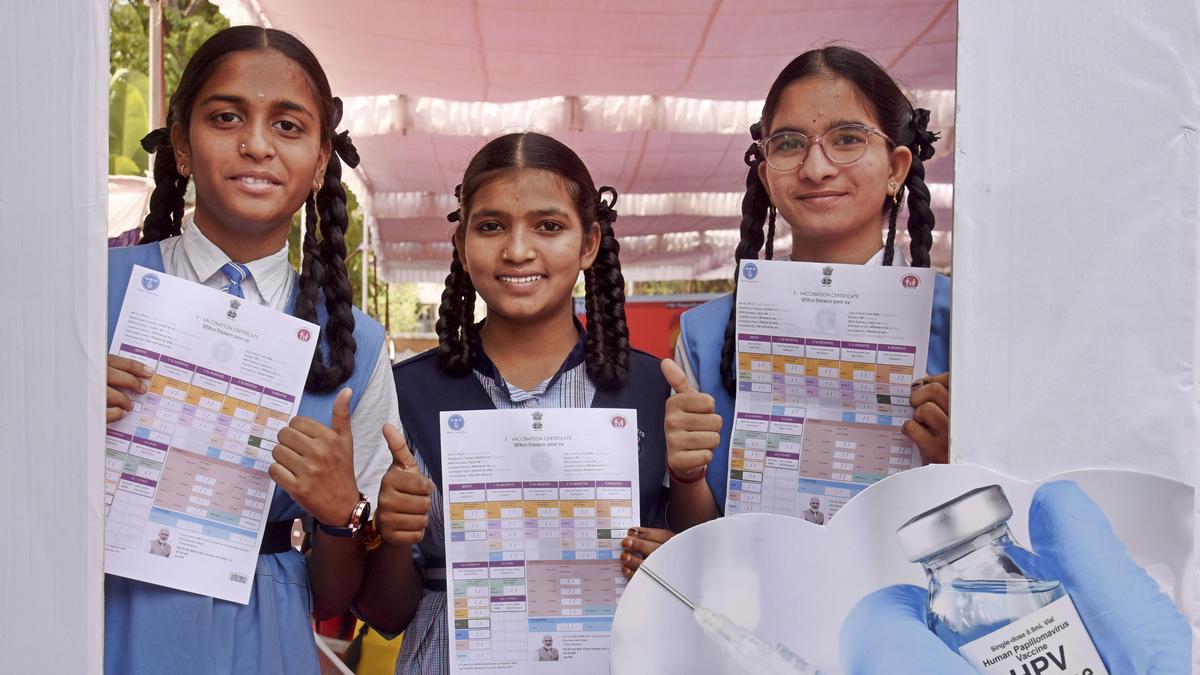
Prime Minister Narendra Modi, on February 28, launched a campaign in Ajmer, Rajasthan, to vaccinate 1.15 crore, 14-year-old girls with Gardasil-4, developed by Merck and available in India since 2009. It is one of the most well-tested HPV vaccines and part of the immunisation programmes in several countries. In 2023, India got a US$250 million grant from the Global Alliance for Vaccines and Immunization (GAVI) to India to support, among other things, the introduction of the HPV vaccine and the Typhoid Conjugate Vaccine (TCV), as well as to strengthen routine immunisation systems. This would include, sources from the Health Ministry told The Hindu, up to 2 crore HPV vaccines for “free,” that India could then use in its immunisation programme.
The inclusion of Gardasil-4 however pushed back Cervavac, an indigenously developed quadrivalent HPV vaccine, that resulted from Grand Challenges India (GCI), a partnership of the Department of Biotechnology (DBT), BIRAC (Biotechnology Industry Research Assistance Council, a DBT public enterprise), the Bill & Melinda Gates Foundation (BMGF), and vaccine maker Serum Institute of India (SII). Following Phase ⅔ trials of the vaccine that showed it was “non inferior” to Gardasil, it was officially launched in September 2022 where science minister, Jitendra Singh, lauded it as an example of the private sector and the government coming together to create an affordable product. Adar Poonawalla, the CEO of the SII, had said then that the vaccine could be available for as little as ₹200-400 a dose, a tenth of retail costs, if part of a government procurement process.
Reports in January 2023 had said that the Health Ministry was planning to float a global tender for 16.02 crore doses of HPV vaccine in April towards the immunisation programme rollout in 2026.
The minutes of a meeting of the National Technical Advisory Group on Immunisation (NTAGI)-- India’s apex advisory body on vaccination – in July 2023 note that “...indigenously developed qHPV vaccine (Cervavac) may be considered for introduction in the UIP as a two-dose regimen.”


Udhayanidhi Stalin accuses the Union government of misleading Tamil Nadu about its commitment to the Tamil language.

Udhayanidhi Stalin accuses the Union government of misleading Tamil Nadu about its commitment to the Tamil language.

CJI Surya Kant meets Bhutan's king to enhance judicial digitalisation and strengthen India-Bhutan bilateral ties.

India's HPV vaccine, Cervavac, faces delays for inclusion in immunization programs due to ongoing studies and competition from Gardasil.

Puducherry forms a new Waqf Board after 11 years, featuring a diverse seven-member team led by V.P. Abdul Rahman.

From Sattvam’s sattvic kunafa to Asian thalis at Yoichi by Shiro and coastal dishes at Glass Kitchen & Bar, here are the newest food experiences to try in Bengaluru.

A humorous satire exploring parenting dynamics as an Indian father grapples with applying Chinese parenting techniques on his son.

Karnataka's Minister M. B. Patil claims BJP MPs fear approaching PM Modi to advance the Upper Krishna irrigation project.

India and China lead the Asia-Pacific in metabolic disease burden, highlighting urgent need for prevention strategies.

Jyoti Waghmare is nominated by Shinde Sena for Rajya Sabha, highlighting her political experience and advocacy for social issues.

Telangana Commission urges inclusion of 40 castes in OBC list before initiating Census-2027 for accurate representation.

Shorts News:BJP, JD(U) leaders will be decide the next Bihar CM: K.C. Tyagi

CM Stalin expresses satisfaction over successful DMK-Congress seat-sharing deal for Tamil Nadu Assembly elections during a family event.