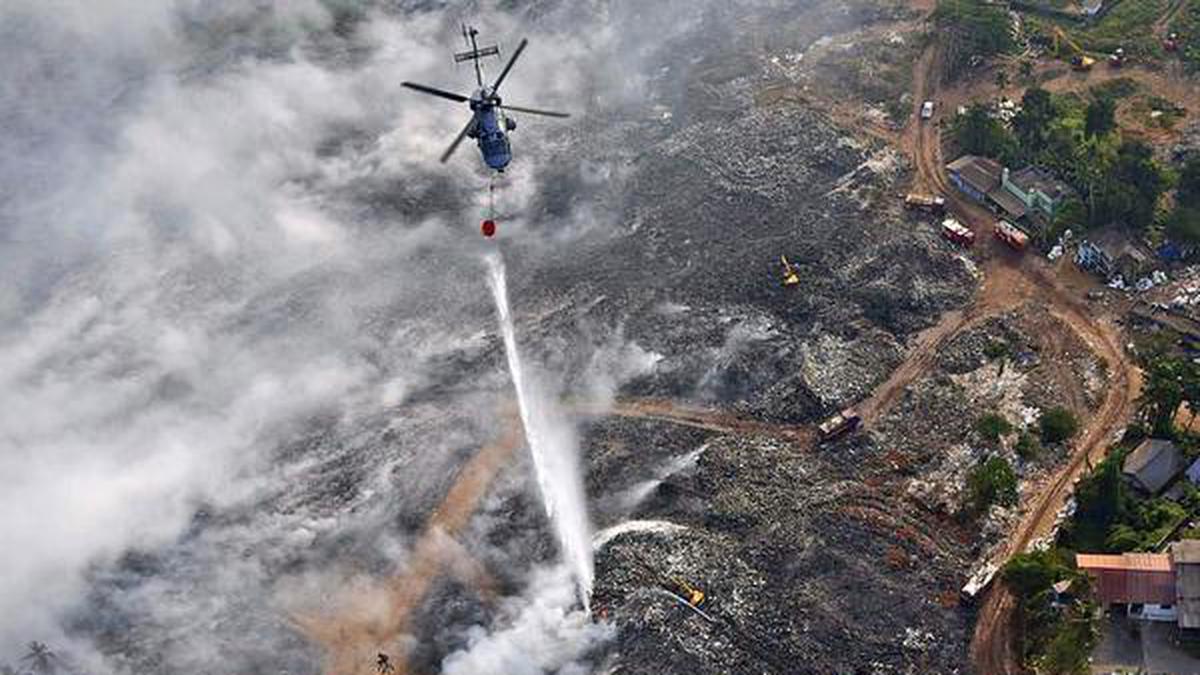
Explained | Why do landfills catch fire and what can we do about them?
The Hindu
India’s municipalities have been collecting more than 95% of the waste generated in cities but the efficiency of waste-processing is 30-40% at best.
The Kochi landfill site around Brahmapuram that caught fire earlier this month was a stark reminder that Indian cities need to be prepared for more such incidents as summer approaches. The fires emit greenhouse gases even as people living around the site were advised to stay indoors and don N95 masks until the fire was put out. These are very short-term measures; preventing these fires altogether requires long-term measures, including thorough and sustained interventions from municipalities.
India’s municipalities have been collecting more than 95% of the waste generated in cities but the efficiency of waste-processing is 30-40% at best. Indian municipal solid waste consists of about 60% biodegradable material, 25% non-biodegradable material and 15% inert materials, like silt and stone.
Municipalities are expected to process the wet and dry waste separately and to have the recovered by-products recycled. Unfortunately, the rate of processing in India’s cities is far lower than the rate of waste generation, so unprocessed waste remains in open landfills for long periods.
This openly disposed waste includes flammable material like low-quality plastics, which have a relatively higher calorific value of about 2,500-3,000 kcal/kg (compared to around 8,000 kcal/kg for coal), and rags and clothes. In summer, the biodegradable fraction composts much faster, increasing the temperature of the heap to beyond 70-80° C.
Higher temperature + flammable material = a chance for the landfill to catch fire. Some fires have been known to go on for months.
There are two possible permanent solutions to manage landfill fires.
One: Completely cap the material using soil and close landfills in a scientific manner. This solution is unsuitable in the Indian context as the land can’t be used again for other purposes. Closed landfills have specific standard operating procedures, including managing the methane emissions.


Forest, Ecology and Environment Minister Eshwar Khandre on Wednesday instructed forest department officials to ensure maintenance of elephant trenches and hanging solar fences, which have been installed in Kodagu district to control human-elephant conflict.

Indian wolf Geetha at Pilikula zoo gives birth to seven healthy pups, marking a first in captivity at the park.

Passengers on an Air India Express flight from Dehradun to Bengaluru were stranded in Chennai for over two hours due to diversion.

Explore India's missed opportunity in establishing a national gas grid amid the ongoing West Asia war's impact on energy supplies.

Maharashtra government plans to ban plastic flowers to protect local floriculture farmers and support sustainable practices.

Join Alva’s Samskrutika Vaibhava on March 21 in Mangaluru for a vibrant cultural showcase featuring over 500 student-artists.

The Hindu Morning Digest gives a select list of stories to start the day. Read the top news today on March 19, 2026

CM Fadnavis assures Mumbai celebrities of safety amid rising violence, emphasizing that the city will not descend into gang wars.

Dolores Huerta accuses César Chavez of sexual abuse, prompting reevaluation of his legacy in the labor rights movement.

LPG refill backlogs now range from 4 to 12 days as panic bookings decline amid ongoing restrictions, say distributors.

Acid attack on a minor girl sparks protests and Assembly outrage, with demands for swift justice and government accountability.

Three luxury cars were destroyed in a fire at a Vellore workshop, damaging nearby houses but causing no injuries.

Kerala's Pala constituency braces for a high-stakes three-way battle in the 2026 Assembly elections amid evolving political dynamics.