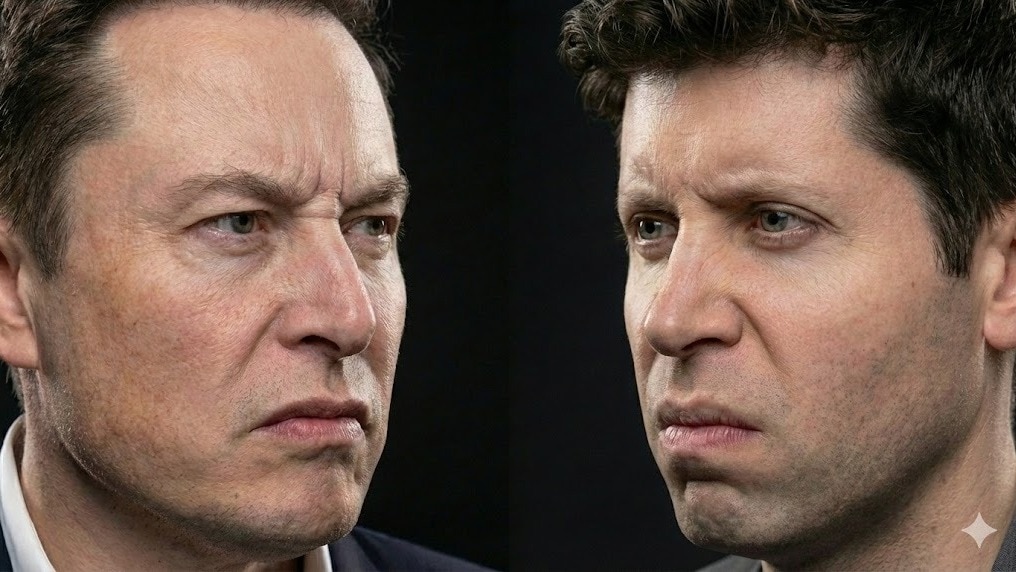
Elon Musk slams OpenAI safety, says xAI's Grok is safer than ChatGPT
India Today
Amid his ongoing legal battle with OpenAI, xAI CEO Elon Musk alleged in a deposition that ChatGPT is unsafe, linking the chatbot to user suicides while claiming that no such cases involve his own AI system, Grok.
Elon Musk and Sam Altman, two of the co-founders of OpenAI, are locked in a long-running feud over whether the company abandoned its original non-profit mission to benefit humanity in favour of maximising profits. While both sides have traded blows, in a newly released legal deposition, Musk made a serious accusation against his former partners. He claimed that their AI chatbot ChatGPT is linked to the deaths of some users, while his own AI system, Grok, has a cleaner track record.
“Nobody has committed suicide because of Grok, but apparently they have because of ChatGPT,” alleged Musk, referring to the other lawsuits OpenAI is currently facing. Here the plaintiffs claim that ChatGPT’s manipulative or emotionally intense conversations led to severe mental health distress, with some cases reportedly linked to suicide.
Musk made these remarks during his video testimony, recorded in September and publicly filed this week ahead of an expected jury trial next month, reports Tech Crunch. The deposition is part of Musk’s ongoing lawsuit against OpenAI, where he is positioning his AI company, xAI, as more safety-focused than OpenAI.
At the heart of this legal battle is OpenAI’s shift from being a nonprofit research lab to becoming a for-profit company. Musk, who was one of OpenAI’s co-founders, claims that this transition violated the company’s original mission and agreements. According to him, OpenAI was created to ensure AI would be developed safely and not controlled by a single powerful company.
In the deposition, Musk argued that commercial pressure, revenue, scale, partnerships, could push companies to move faster than safety allows. He has repeatedly said that AI development should prioritise caution over speed.
Musk’s criticism of OpenAI also ties back to a public letter he signed in March 2023. The letter, backed by more than 1,100 signatories including AI experts, called for a pause in developing systems more powerful than GPT-4. It warned that AI labs were in an “out-of-control race” to build increasingly powerful systems without fully understanding the risks.


Among the fashion standouts at the Oscars 2026 were Nicole Kidman, Teyana Taylor, Priyanka Chopra, Emma Stone, Audrey Nuna, Anne Hathaway and Pedro Pascal.

Thousands of degree certificates and mark sheets have remained unclaimed in several colleges for nearly four decades. Students passed their exams but never returned to collect their documents, leaving institutions struggling to store the growing pile of academic records.

In a small classroom in Aligarh's government school, waste materials are turning into machines. A government school teacher is guiding students to build simple robots and drones using scrap, helping them understand science through hands-on learning.

Elon Musk's satellite internet service, Starlink, is now available in Kuwait. This announcement comes at a time when the country has found itself impacted by the US-Israel war with Iran.

Delhi University has rejected Rahul Gandhi's claim of caste bias in interviews. In a post on X, the university said the Leader of the Opposition should verify facts before making such statements.

Apple is rumoured to be making its debut in the foldable smartphone market this year with the iPhone fold. From the design to the features, and the expected price, here is everything you need to know about the first-ever foldable iPhone.

The Central Board of Secondary Education, CBSE, has cancelled the Class 12 board examinations in several Middle Eastern countries due to the ongoing US-Israel-Iran war. The board also confirmed that the mechanism for announcing results for affected students will be announced at a later stage.

Chinese giant ByteDance has reportedly suspended its plans to release its latest AI video generation model, SeeDance 2.0, after major Hollywood studios raised disputes over copyright violations.

Bidyut Innovation MD Rahul Shah spoke during the India Today Conclave 2026. Shah reckoned that India could soon have its own robots competing those from other countries, perhaps at a fraction of the cost.

Alpha High School, an AI-driven education institute is rolling out a new course with a promise – earn $1 million by the time you graduate or you get a full refund. Here is how it works.

Devendra Singh Chaplot, an IIT Bombay alum has joined xAI to build super intelligence. His arrival was welcomed by xAI chief Elon Musk. Here is everything you need to know about xAI's latest Indian origin member.

Blending heritage with modern technology, Royal Enfield is preparing to enter the electric motorcycle space with the upcoming Royal Enfield Flying Flea C6, expected to debut in India around mid-2026.

IIT Madras and the Delhi government have signed an MoU to study 'smog-eating' surfaces to help tackle air pollution in the capital.