Economics will give way to politics and security in how nations make choices, Jaishankar says
The Hindu
Jaishankar highlights India's strengthened global partnerships and recent trade deals amid a changing global economic landscape.
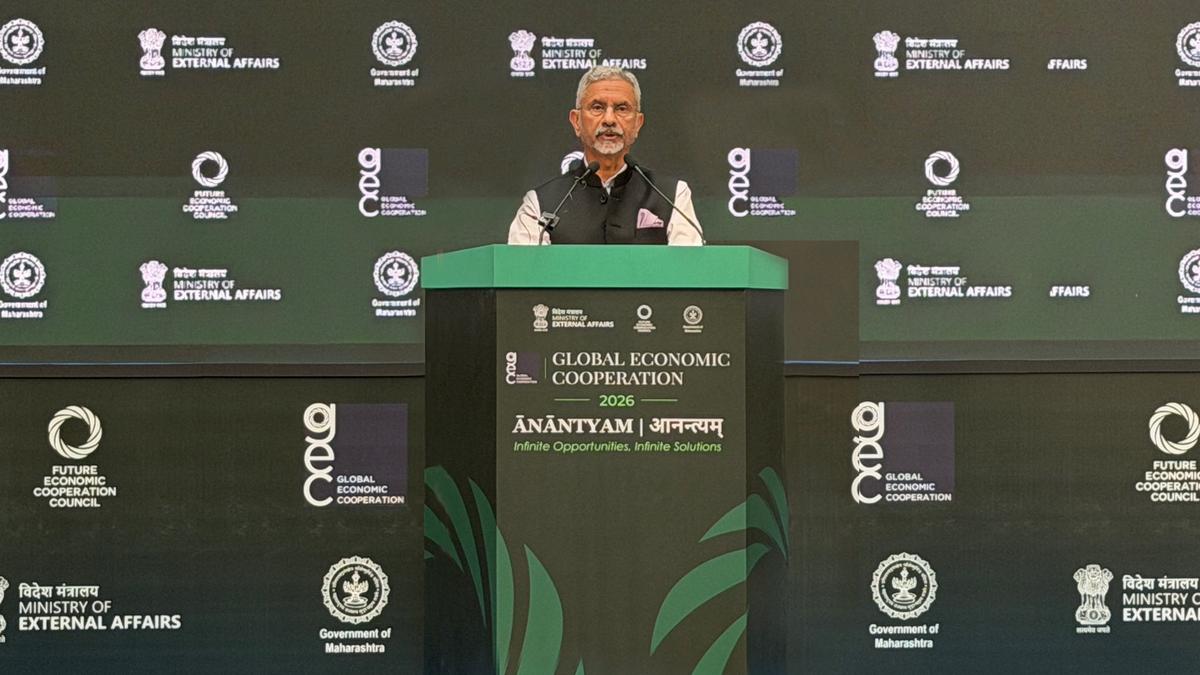
Political and strategic considerations will overshadow economic ones in the choices that countries make going forward, Minister of External Affairs S. Jaishankar said on Tuesday (February 17, 2026).
Speaking at the Global Economic Cooperation 2026 summit organised by the Future Economic Cooperation Council, Mr. Jaishankar asserted that the world has entered a volatile and uncertain period, “possibly the most turbulent in living memory”.
“Long-standing assumptions and expectations have now been questioned,” he said. “Key dimensions are transforming simultaneously, be they political, strategic, economic or technological. Solutions lie in de-risking and diversifying across multiple dimensions. This approach is increasingly visible in the policies of nations as much as in the choices of enterprises.”
“Economics will give way to politics and security when it comes to making choices, and technology will be even more transformative than ever before,” Mr. Jaishankar said.
The Minister explained that India’s response is to further build national capabilities, address growth challenges comprehensively, and deal with both short-term issues and long-term prospects.
“The reform express will continue to roll on,” Mr. Jaishankar asserted. “This has implications both on the supply and the demand side. From a position of strength, India is engaging international partners more intensively. This is demonstrated in recently-concluded trade deals. We will also be more salient in global production, services, technology, skills, and talent.”


India's merchandise exports remain flat in February, with Commerce Secretary warning of a potential dip in March due to trade constraints.

Hard Rock International closes 10 outlets in India, including three cafes in Bengaluru, while Goa hotel remains open.

The booming market for artificial intelligence servers brought Taiwan's Foxconn a 24 percent jump in annual net profit, the company said

In a statement on its website, Adobe said it has in recent years streamlined its sign-up and cancellation processes and made them more transparent.

Stock markets recover as Sensex and Nifty bounce back following a three-day slump, driven by value-buying in blue-chip stocks.

U.S. President Donald Trump’s administration is set to receive a roughly $10 billion fee from investors in the recently completed deal to take control of TikTok’s U.S. business, the Wall Street Journal reported

Meta is planning sweeping layoffs that could affect 20% or more of the company, three sources familiar with the matter told Reuters

Learn how to choose the best personal loan lender by evaluating eligibility, interest rates, and borrowing experience.

Discover why pension planning is essential in modern India to ensure financial security and peace during retirement.

The U.S. has launched two investigations under Section 301 of the Trade Act of 1974 against India and other economies to examine practices that may be ‘unreasonable or discriminatory and burden or restrict U.S. commerce’. One probe examines whether countries, including India, are using excess manufacturing capacity to export to the U.S. in a manner that hurts American businesses, while another looks at whether countries have taken ‘sufficient steps’ to prohibit imports of goods produced with forced labour.

NHAI raises annual pass fee to ₹3,075 from April 1, 2026, streamlining toll payments for FASTag users.

The U.S. probes forced labour in global supply chains, scrutinizing China and India's exports, warns the Global Trade Research Initiative.

The Hindu collection of images of the LPG crisis: War lights a kitchen fire