Digital University Kerala unveils breakthrough in analogue computing
The Hindu
Researchers demonstrate fully functional memristor-based crossbar arrays capable of performing analogue matrix multiplications
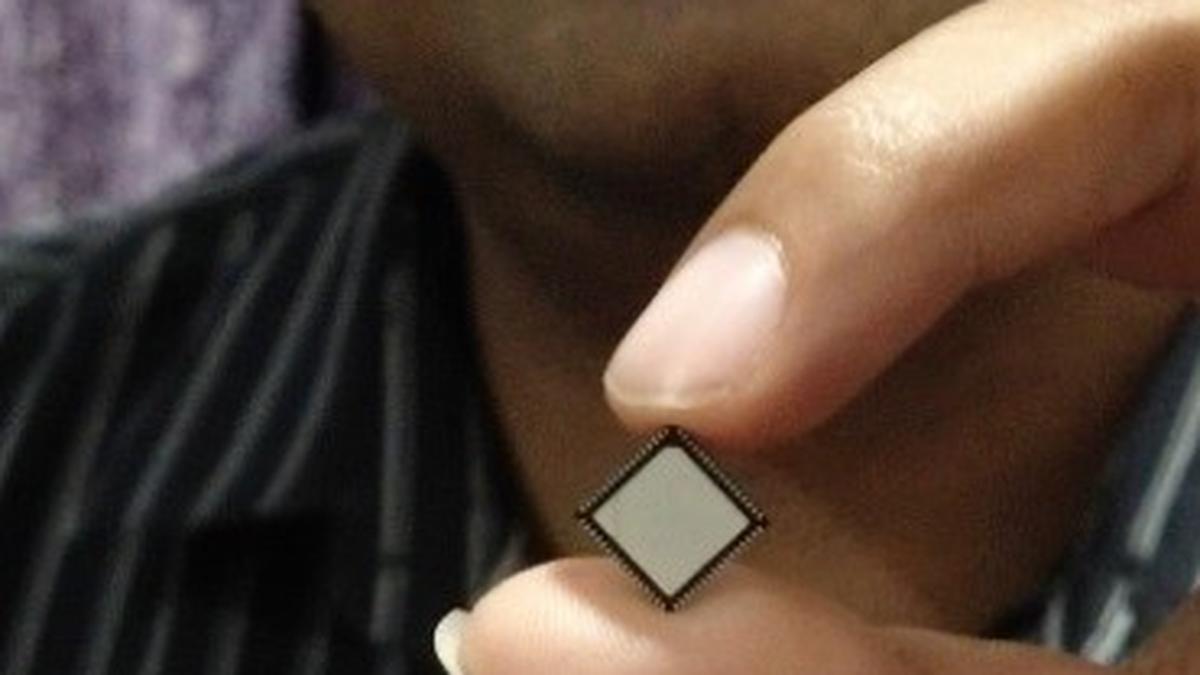
In a major leap for analogue computing, the AI Chips Centre at the Kerala University of Digital Sciences, Innovation and Technology (Digital University Kerala) has demonstrated fully functional memristor-based crossbar arrays capable of performing analogue matrix multiplications.
The milestone represents an advancement in scalable, energy-efficient computational architectures, particularly in neuromorphic computing and AI hardware.
At the core of this breakthrough by the team led by Professor Alex James is the development of analogue crossbar arrays that use memristors — resistive memory devices that can store and process information in analogue form. These arrays excel in matrix multiplications, a critical operation in machine learning, offering high speed and efficiency.
The crossbar arrays are built around a RISC-V core, making them programmable and reconfigurable, which allows them to adapt to various configurations like 1T1R (one transistor, one resistor) and 1T4R (one transistor, four resistors). This flexibility supports a range of applications, from convolutional neural networks (CNNs) to spiking neural networks (SNNs), making them ideal for AI, neuromorphic computing, and beyond.
In tandem with these hardware advancements, the team developed Pymem, a hardware-software co-design tool. Pymem simplifies the design of analogue neural networks, enabling researchers to simulate, optimise, and validate architectures tailored for memristor-based hardware. By bridging hardware design and software development, Pymem accelerates the creation of analogue neural networks, reducing development cycles and making analogue computing more accessible.
The team has already demonstrated the practical potential of their technology, such as using crossbar arrays for super-resolution imaging, achieving over 75,000 stable conductance levels. This innovation not only enhances the reliability of analogue computations but also shows its ability to tackle complex tasks with precision. The team’s ongoing research explores configurations optimised for real-world applications, including edge computing, robotics, and health care.
The work by Prof. James and his team positions Digital University Kerala to pioneer developments in energy-efficient hardware. Their innovations — combining scalable analogue architectures with tools like Pymem — present a compelling alternative to traditional digital systems.


Modi and Jaishankar advocate for dialogue as India and France collaborate to de-escalate tensions amid escalating strikes on energy infrastructure.

The star-studded event was held in Mumbai and was attended by rithik Roshan, Alia Bhatt, Bobby Deol, Shahid Kapoor, Vijay Varma, Sonakshi Sinha, Jyotika, Ali Fazal, Sonali Bendre, Preity Zinta, Ravi Kishan and others

Shorts News:We are working on securing LPG, petroleum to meet our energy security needs: MEA

P. Veldurai served five years as MLA and was later asked to repay ₹21 lakh in Tamil Nadu.

Supreme Court reserves verdict on defining 'industry' under Industrial Disputes Act, impacting educational and healthcare sectors.

Dindigul Collector S. Saravanan held a meeting with Election Observers to ensure smooth election monitoring across seven constituencies.

Despite delays from the Centre, 24 States allocate funds for a new rural jobs program, using past MGNREGA expenditure as a baseline.

Congress’s third candidate list for Assam Assembly elections highlights the Pradyut factor and notable party shifts among MLAs.

Scholars foresee political shifts and governance concerns at BRS Ugadi celebrations, predicting potential opposition strength amid public dissatisfaction.

Election observers deployed in Thoothukudi; field inspection begins

Sri Sathya Sai Prema Sadan celebrated Ugadi with Vedic chants, Ugadi Pachadi, and Sri Rama Navami preparations in Visakhapatnam.

Visakhapatnam celebrated Ugadi with Panchanga Sravanam, cultural events, and auspicious predictions for a prosperous new year.

Celebrating diverse top talents, including visually impaired achievers, artists, and cultural icons honored with Ugadi awards.