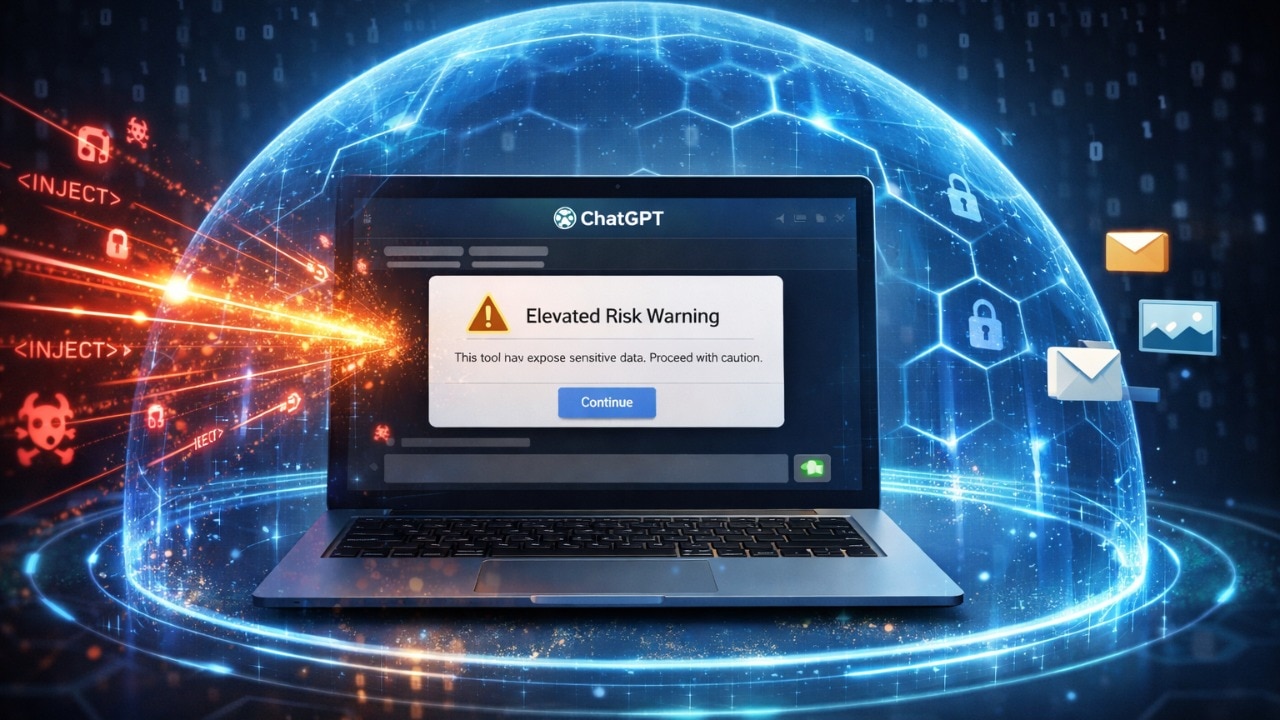
ChatGPT will now tell you when your private data may be at most risk of leaking
India Today
OpenAI has rolled out Lockdown Mode and new Elevated Risk labels in ChatGPT to help users keep their sensitive information safer. According to the company, these tools will warn users about potentially risky features and limit external connections, reducing the chances of data leaks caused by prompt injection attacks.
AI chatbots like ChatGPT have become a go-to helper for many, whether it’s professional tasks or personal work. But at times, sharing sensitive data or using connected features could put your data at greater risk. To help users stay safer, OpenAI has introduced two new security features: Elevated Risk labels and Lockdown Mode. The labels will warn users when a web-connected feature could expose more data, while Lockdown Mode will limit how ChatGPT connects to outside systems.
The company says these features are designed to give users clearer alerts and more control over their information, while also reducing the risk of prompt injection attacks. “As AI systems take on more complex tasks — especially those that involve the web and connected apps — the security stakes change. One emerging risk has become especially important: prompt injection,” the company wrote in its official blog post. “We’re introducing two new protections designed to help users and organisations mitigate prompt injection attacks, with clearer visibility into risk and stronger controls.”
Prompt injection is a technique where hackers hide malicious instructions inside web pages or files to trick an AI system into revealing confidential information or taking unintended actions. As millions of people across the globe are using AI chatbots like ChatGPT, for work like reading documents, browsing the web, or connecting to other apps, the risks from such tricks become more serious.
OpenAI’s new tools in ChatGPT aim to protect users from these threats.
OpenAI has introduced Lockdown Mode as an optional setting that will tightly restrict how ChatGPT interacts with external systems. When enabled, it will limit or disable certain tools and connections, such as live web browsing or integrations that send and receive information from outside services. By reducing these external interactions, OpenAI aims to shrink the “attack surface” that hackers could exploit.
According to the company, Lockdown Mode is not necessary for most everyday users. It is mainly designed for people who handle highly sensitive information or believe they may be at elevated risk, such as journalists, executives, researchers or security professionals.


Among the fashion standouts at the Oscars 2026 were Nicole Kidman, Teyana Taylor, Priyanka Chopra, Emma Stone, Audrey Nuna, Anne Hathaway and Pedro Pascal.

Thousands of degree certificates and mark sheets have remained unclaimed in several colleges for nearly four decades. Students passed their exams but never returned to collect their documents, leaving institutions struggling to store the growing pile of academic records.

In a small classroom in Aligarh's government school, waste materials are turning into machines. A government school teacher is guiding students to build simple robots and drones using scrap, helping them understand science through hands-on learning.

Elon Musk's satellite internet service, Starlink, is now available in Kuwait. This announcement comes at a time when the country has found itself impacted by the US-Israel war with Iran.

Delhi University has rejected Rahul Gandhi's claim of caste bias in interviews. In a post on X, the university said the Leader of the Opposition should verify facts before making such statements.

Apple is rumoured to be making its debut in the foldable smartphone market this year with the iPhone fold. From the design to the features, and the expected price, here is everything you need to know about the first-ever foldable iPhone.

The Central Board of Secondary Education, CBSE, has cancelled the Class 12 board examinations in several Middle Eastern countries due to the ongoing US-Israel-Iran war. The board also confirmed that the mechanism for announcing results for affected students will be announced at a later stage.

Chinese giant ByteDance has reportedly suspended its plans to release its latest AI video generation model, SeeDance 2.0, after major Hollywood studios raised disputes over copyright violations.

Bidyut Innovation MD Rahul Shah spoke during the India Today Conclave 2026. Shah reckoned that India could soon have its own robots competing those from other countries, perhaps at a fraction of the cost.

Alpha High School, an AI-driven education institute is rolling out a new course with a promise – earn $1 million by the time you graduate or you get a full refund. Here is how it works.

Devendra Singh Chaplot, an IIT Bombay alum has joined xAI to build super intelligence. His arrival was welcomed by xAI chief Elon Musk. Here is everything you need to know about xAI's latest Indian origin member.

Blending heritage with modern technology, Royal Enfield is preparing to enter the electric motorcycle space with the upcoming Royal Enfield Flying Flea C6, expected to debut in India around mid-2026.

IIT Madras and the Delhi government have signed an MoU to study 'smog-eating' surfaces to help tackle air pollution in the capital.