Cardamom harvest hit by unusual cold spell in Idukki
The Hindu
Unusual cold weather in Idukki causes delayed cardamom maturation, leading to fewer harvests and significant income loss for farmers.
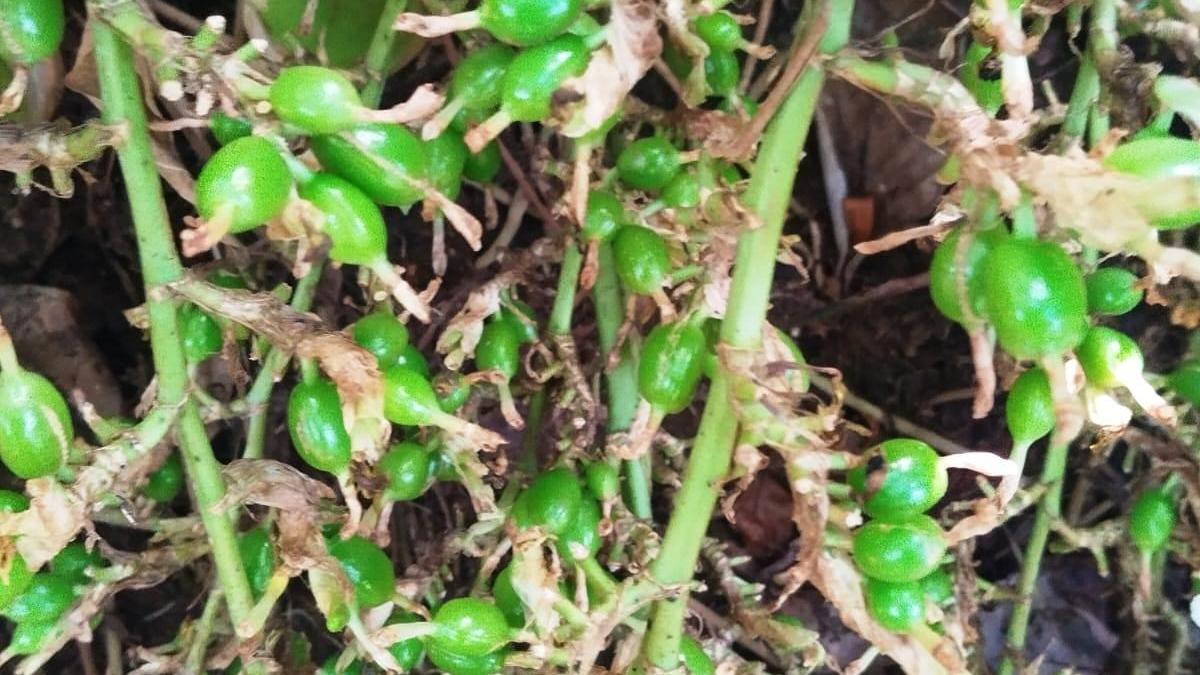
While paddy fields in the high ranges of Idukki and Wayanad districts are witnessing a rare phenomenon of panicles failing to emerge due to low temperature stress (LTS), the cardamom farmers in the Idukki region reported a significant slowdown in the maturation of cardamom capsules. During December and January, this delay resulted in fewer harvests and substantial income loss.
Farmers attributed the delay to the unusually cold weather the district experienced over the past two months. According to officials, the normal maturation period for cardamom ranges from 30 to 45 days, with longer cycles typically extending to 70 or 80 days. Recently, however, the interval has lengthened to 85–90 days.
Regi Thomas, a cardamom farmer from Anavilasom, near Kattappana, said the delayed maturation has caused severe hardship. “Normally, harvesting on our plantation is carried out every 45 to 50 days, or at most 60 days. This time, however, we began harvesting after a gap of 75 days, only to find that the capsules had not matured,” he said.
He added that the yield quality has also declined sharply. “Typically, 5 kg of green cardamom yields 1 kg of dried cardamom. This time, it took 7 kg of green cardamom to produce just 1 kg of dried cardamom. We had to stop harvesting midway. This is the first time we are experiencing such a situation.”
Stany Pothen, a planter and member of the Kerala Plantation Business Advisory Committee, said he also halted harvesting due to the high proportion of immature capsules. “When plants take longer to mature, it results in fewer harvests each year,” he explained. He added that labour shortages in October further compounded the problem. “Due to a shortage of plantation workers, many farmers harvested after nearly 100 days during the peak season.This disrupted the plants’ natural cycle and also contributed to the current maturation issues.”
Confirming the trend, Muthusamy Murugan, former head scientist at the Cardamom Research Station of Kerala Agricultural University in Pampadumpara, said the cold weather in December and January hindered the plants’ ability to absorb sufficient sunlight.


Economist Arvind Subramanian advises CM Revanth Reddy on strengthening Telangana's finances during a meeting in Hyderabad.

Supreme Court emphasizes stakeholder consultation for legal education reforms, hesitant to change five-year law course duration.

Authorities in Andhra Pradesh are set to tranquillise a roaming tiger near Annavaram temple for safety and conservation.

MEA criticizes USCIRF for bias, urging focus on vandalism of Hindu temples in the U.S. over selective criticism of India.

Bengaluru's Urban Development aims to beautify underutilized flyover spaces, enhancing city aesthetics and improving green cover initiatives.

Indian Navy warships escort merchant vessels in the Gulf of Oman, ensuring safe passage amid regional tensions under Operation Sankalp.

A rare crab species exhibiting both male and female traits was discovered in Silent Valley, revealing unique biological characteristics.

Gujarat court convicts five in 2016 Una flogging case; punishment announcement scheduled for March 17, 2026.

The Greater Bengaluru Authority (GBA) has extended the deadline for citizens to submit claims and objections to the revised draft voters’ list for the upcoming elections to five city corporations under its jurisdiction until March 20.

SSC Public Examinations-2026 commenced peacefully, with a 98.90% attendance across 3,415 centres and rigorous monitoring in place.

Flying Squad Team seizes whistles, ‘manjappai’ bearing TVK name in Thoothukudi

Thousands gathered for a Ramzan prayer meet, promoting spiritual renewal and civic responsibility amidst calls for peace and justice.

Players get double bill horror as Resident Evil returns with Grace, a new series character, and other fan favourites in their latest edition