Blue: the colour that moved kings before poets Premium
The Hindu
Explore the historical significance of blue, from ancient symbolism to its cultural impact and modern classification.
When Isaac Newton wrote Opticks, published in 1704, he divided the colour spectrum into the now famous VIBGYOR, a set of seven colours (the decision was not, as such, scientific because Newton’s choice was dictated by ‘7’ being a significant number in alchemy.) What Newton observed was a series of hues merging into one another, rather than discrete parcels. The Irish chemist Robert Boyle, who inspired Newton through his experiments, had observed the same spectrum when he pinched refined quicksilver in a “syrup of violets”, but spoke of only five colours. Many of Newton’s readers were not really sure if they could tell indigo from blue or violet at all. And yet Newton insisted that there were seven. The number was alchemically significant. It echoed the musical scale, the number of (visible) planets, and other harmonies of yore based on which Newton intended to structure what we now see as early modern thought.
Colour was being ordered, and this ordering was optical and administrative. Newton, who later served the British crown as Warden and Lord of Mint, stabilised colour into a sequence that could be taught, reproduced, and enforced.
Long before this abstraction, blue appeared in the Rig Veda, one of the earliest surviving bodies of liturgy, through Varuna, the god of cosmic order, oath, and surveillance. Varuna is described as syama and kṛṣṇa (meaning dusk-coloured and dark), terms that signal depth and enclosure rather than surface hue. The Indologist Michael Witzel has described Varuṇa as a figure of an early vedic kingship, a “nocturnal sovereign” whose power lies in distance, binding, and the night sky.
What is striking is that this chromatic marker of sovereignty co-evolves with a profound religious transformation. In the Mahābhārata and Itihasic-Purāṇic traditions, śyāma and kṛṣṇa become the most common names of Vāsudeva Kṛṣṇa, who emerges not merely as a heroic figure but as the lord of the cosmos itself. Across this shift, from ritual order of the vedas to the bhakti of Puranas, blue remains a sign of totality and command.
The Greek world, by contrast, hesitated before blue. Karissa St. Clair, in her book Secret Lives of Colours, notes that in Homer’s Iliad and Odyssey, blue is conspicuously absent. The sea is “wine-dark,” and the colour of the skies is unmentioned. Nineteenth-century thinker and politician William Gladstone famously remarked that Greeks could not see blue. And of course, this is not true. Colour theorists and historians have pointed out that in Homer’s epics, colour was organised around brightness, texture, and emotional force rather than hue.
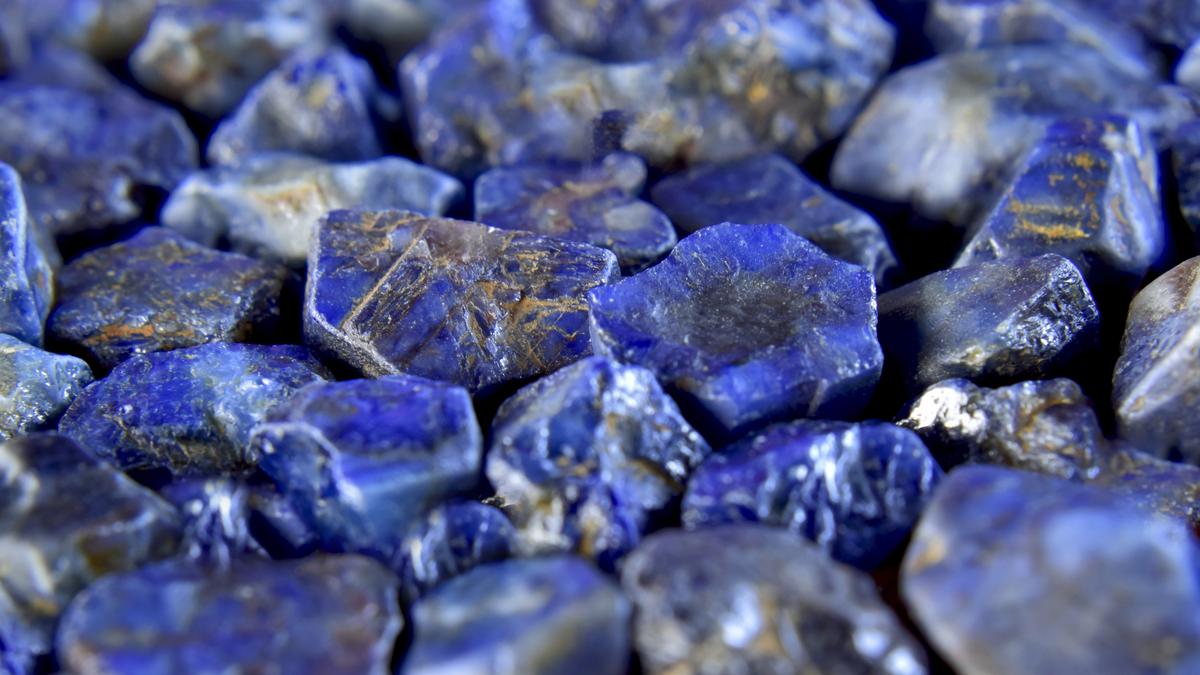
But a few thousand years before ancient Greece, the value of blue was negotiated materially through stone, right from the earliest stages of the Bronze Age. Lapis lazuli, deep blue and flecked with gold, travelled thousands of kilometres from the mines of Badakhshan in present-day Afghanistan to connect Mesopotamia, Egypt, the Indus Valley and China in trans-continental trade. Archaeological finds at the earliest agricultural sites such as Mehrgarh and Bhirrana (6th Millennium BCE) include lapis beads imported through these long-distance trade routes. In ancient Sumer, lapis was sacred to Inanna and in Egypt, it adorned divine brows and funerary masks apart from featuring in statuettes and seals. Lapis Lazuli marked divinity because it was rare, costly, and difficult to command.


The MG Majestor is a flagship full-size SUV combining a 2.0-litre twin-turbo diesel engine, ladder-frame construction and triple differential locks with a tech-loaded cabin featuring dual 12.3-inch displays and Level 2 ADAS. Blending genuine off-road capability with premium features and bold design, the Majestor aims to redefine MG’s presence in India’s premium SUV segment.

Kerala's first horror 3D game, Thekku Island, launches on February 27, featuring a gripping mystery and immersive gameplay.

Explore the science of taste, including aroma, fat detection, and the intriguing role of genetics in flavour perception.

Explore the historical significance of blue, from ancient symbolism to its cultural impact and modern classification.

Scientists discover QT45, a self-replicating RNA molecule, offering insights into the origins of life on Earth.

Discover how an ancient gene influences the sex of ant, bee, and wasp embryos, impacting conservation and breeding practices.

A committee will investigate systemic issues behind ISRO's PSLV rocket failures, focusing on manufacturing and accountability processes.

Why India is still awkward about kink, and why that may be changing

Learn how modified fluorescent proteins are evolving into quantum sensors, enhancing our understanding of cellular processes.

Discover three groundbreaking research developments: chick sound-shape connections, data storage in glass, and promising psychedelic depression treatment.

Explore the NGT's decision on the Great Nicobar project, balancing national security with environmental concerns and biodiversity impacts.

Legend would have us believe that English colonists were first introduced to popcorn on February 22, 1630. While historians are now more or less certain that that story is more myth than truth, there’s no denying that native Americans have had popcorns for thousands of years. Grab your popcorn as A.S.Ganesh lets you in on certain kernels of truth…

India is among the four biggest contributors of pesticide toxicity in the world, affecting both terrestrial and aquatic species, a study has found.