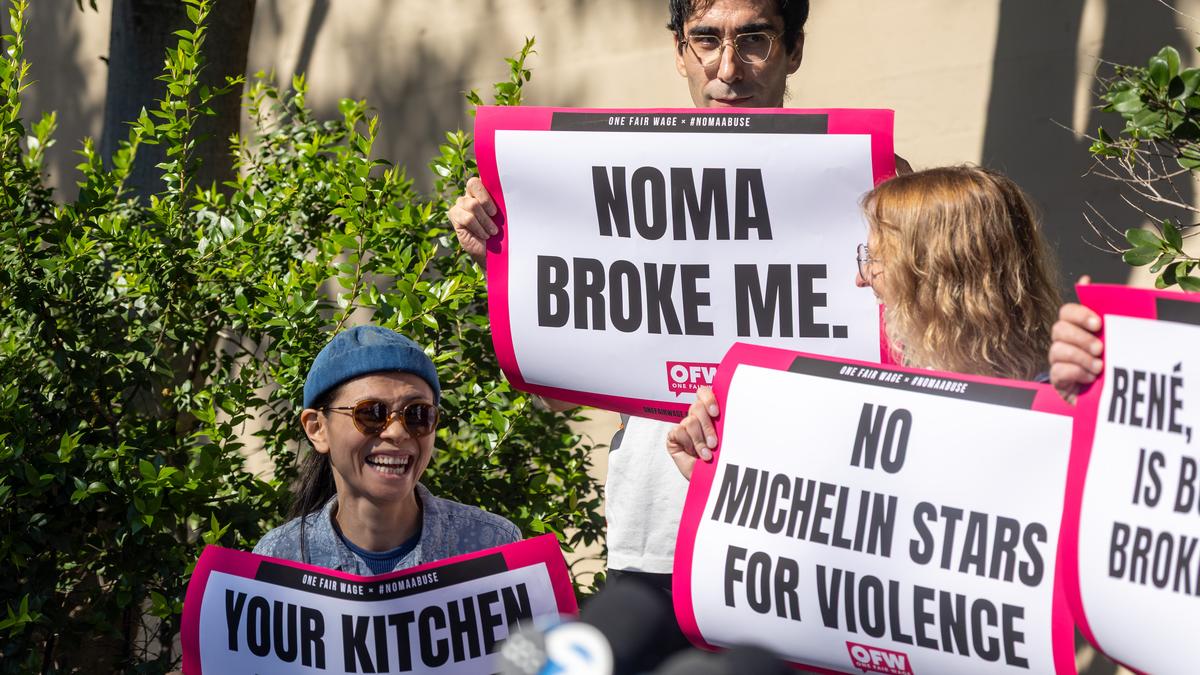
Beyond Noma: Rethinking the myth of the ‘brilliant but volatile’ chef
The Hindu
As debates sparked by René Redzepi put high pressure restaurant kitchens under scrutiny, London-based chef Karan Gokani examines power, pressure, and the real cost of culinary excellence — from Kitchen Confidential to The Bear, Boiling Point and Burnt
The recent conversation around toxic kitchen culture, prompted by stories around the Michelin starred Danish restaurant Noma and its chef René Redzepi, has pushed the inner workings of restaurant kitchens into public view. For the record, I have never eaten at Noma, nor do I know anything of its internal culture, so I am less interested in commenting on one chef or one restaurant than on what this moment reveals about our industry.
For a long time, the professional kitchen has carried a certain mythology: high stakes, machismo, alpha personalities, and a relentless fight to survive. Popular culture has fed that image for years. Anthony Bourdain’s Kitchen Confidential helped romanticise the kitchen as a pirate ship. The Bear, Hell’s Kitchen, Boiling Point and Burnt all play with the same idea, that brilliance and volatility are natural companions. In that sense, what we are seeing now is less a revelation than a tipping point. The culture being debated is not new. It has existed, and in some corners been admired, for years.
From inside the industry, though, the picture is more nuanced. For over a decade, I have run, cooked in, visited and collaborated with plenty of kitchens that do not carry these undertones. That is not to say kitchens are loving, gentle places. Nor are banks, law firms, hospitals, ad agencies or production houses. Any high-functioning workplace comes with stress, hierarchy and pressure. Kitchens simply add their own special ingredients to the mix. Physical labour, heat, noise, speed, antisocial hours, thin margins, neurodivergent personalities and the daily challenge of trying to produce something excellent while keeping a business alive. It is, in many ways, the perfect storm.
Within that storm, I have seen very different kinds of leadership. There is the chef who came up the hard way and feels their place at the top now gives them licence to do the same to others. It is often framed as tough love, not unlike ragging or hazing at university. ‘I went through it, so you should too’. ‘It made me who I am, so perhaps it will do the same for you’. ‘If you cannot handle it, maybe you do not deserve to make it’. Then there is the chef who went through exactly that world and decided it stops with them. The kitchen can still be exacting and serious, but fear, humiliation and bullying have no place in it.
I think we make a mistake by talking about restaurants as though they are all one thing. A 30-seat, $1,000 tasting-menu restaurant is a very different beast from one turning 1,000 covers a day at $30 a plate. Both create experiences, one aspirational and the other accessible. Both require systems, labour, discipline and graft, but the psychology is not the same.
In the rarefied world of stars, rankings and global acclaim, there is often an almost spiritual belief that sacrifice is the price of recognition. A young chef starts to believe that surrendering time, money, relationships, health and sometimes self-respect is simply the price of reaching the summit.


NIPER Raebareli partners with Roche Pharma to Strengthen Pharmaceutical Education and Research Capability Building Collaboration

NH 169 near Yedapadavu reopens for traffic after a month-long closure, easing commuter challenges along the Mangaluru-Moodbidri route.

Telangana will launch its first Census from May 11, 2026, detailed schedule announced

Telangana allocates ₹1,224 crore for tourism in 2026-27 budget

As debates sparked by René Redzepi put high pressure restaurant kitchens under scrutiny, London-based chef Karan Gokani examines power, pressure, and the real cost of culinary excellence — from Kitchen Confidential to The Bear, Boiling Point and Burnt

Tourist rescued after falling 100 feet at Gudalur while taking a selfie, thanks to a collaborative rescue effort.

Opposition demands Odisha Health Minister's resignation amid assembly chaos over hospital fire that killed 12 patients.

K. Sudhakaran and T.O. Mohanan's meeting signifies unity in the Congress after the Kannur candidature dispute ahead of Kerala Assembly polls.

Telangana Government launches Indiramma Family Life Insurance scheme, offering ₹5 lakh coverage to 1.15 crore families statewide.

Tamil Nadu's first State-wide raptor assessment reveals 51 bird of prey species, including rare and endangered varieties.

Harteerath Singh Ahluwalia’s book ‘The Power of Doing Good’ coming out this Vaisakhi, from HarperCollins India

Explore a comprehensive dictionary of animal names from Tamil classics, highlighting their rich vocabulary and ecological significance.

Despite the rise of renewable energy in Karnataka's energy landscape, LPG remains essential for the State's eateries and households owing to challenges in transitioning to sustainable cooking alternatives.