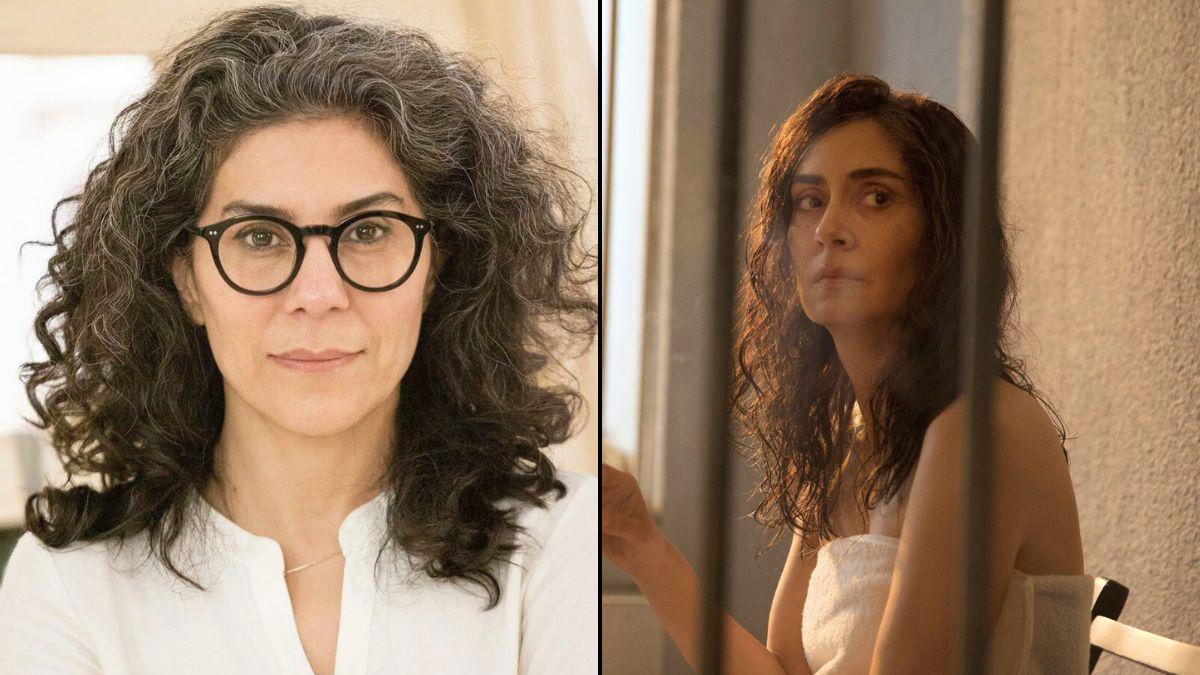
Berlinale 2026 | Iranian filmmaker-activist Mahnaz Mohammadi: ‘I’m not making political films’ Premium
The Hindu
From prison cells to clandestine sets, Mohammadi discusses Berlinale-premiered ‘Roya’, resistance, hope and why ‘cinema can’t bring justice — but can create hope’
Iranian filmmaker-activist Mahnaz Mohammadi, 51, lets me record her on camera, at the 76th Berlin International Film Festival, where her sophomore feature Roya premiered in the Panorama segment. She says she loves Indians. An Indian friend had gifted her a clock, whose time she didn’t change. Now, that frozen time acts like a good memory. Life is a series of fragments that flits between memory and forgetting, the conscious and unconscious. And that too, is the structure of her new film.
The Women Without Shadows (2003) director is known for her documentary films. Mohammadi, after her Toronto-premiered debut feature Son-Mother (2019), has been banned by Iran from making films. Her active involvement in Campaign for Equality (aka One Million Signatures Campaign), 2006, to demand changes to discriminatory laws against Iranian women, put her in the line of fire, with the Iranian authorities persecuting and arresting her multiples times, in 2007, 2009, 2011, and in 2014 for five years in Tehran’s Evin Prison. Also an actor, she is a cultural voice that confronts censorship, gender inequality, and freedom of expression in Iran. Her deeply humanistic films focuses not on politics for its own sake but on lived experiences under repression, giving voice to those silenced by the system, by the Iranian regime.
In her latest film, shot clandestinely, featuring a Turkish actress, Roya is an Iranian teacher who is imprisoned in Tehran’s Evin Prison for her political beliefs and is faced with a choice: either to make a forced televised confession or remain confined to her 3-sq.m cell. As past and present slip out of sequence and exchange places, she moves between inner landscapes and lived experience, revealing how isolation can reshape perception, identity, and the fragile possibility of resistance.
After many years of working with documentary forms, she returns to narrative cinema, albeit non-linear, her sophomore feature doesn’t try to reproduce reality but presents a dialogue between perception and memory. Dualities of dream and reality, past and present blur. For trauma, memory doesn’t move in a straight line. Resistance is not opposing a force, but refusing to disappear.
Excerpts from a roundtable interview:
You have a Turkish actress essay the role of Roya, not an Iranian actress. Was it done to protect identities since you made the film secretly?


Discover why wildfire smoke swirls in one direction, influenced by atmospheric layers and buoyant air movement.

From prison cells to clandestine sets, Mohammadi discusses Berlinale-premiered ‘Roya’, resistance, hope and why ‘cinema can’t bring justice — but can create hope’

NTK announces 234 candidates for the 2026 Assembly polls, with Seeman contesting from Karaikudi, seeking social transformation.

Silicon Beach Programme offering 840+ IT job openings in coastal Karnataka, connecting experienced professionals with leading companies and fostering economic growth by turning the region into a tech hub.

Telangana BJP chief Ramchander Rao arrested to prevent his visit to tense Kamareddy amid clashes between political groups.

Kerala Human Rights Commission investigates newborn's death post-C-section amid allegations of medical negligence and public protests.

Discover the Delhi-Meerut Namo Bharat Corridor and Meerut Metro launch details, including routes, fares, and timings.

Maoist leader Devji reportedly surrenders to Telangana police, marking a significant success in anti-Maoist operations.

Prime Minister Narendra Modi's 131st episode of Mann Ki Baat on February 22, 2026

New research suggests that insights from feline cancer could lead to improved breast cancer treatments for humans.

Gunfight erupts in Kishtwar, J&K as Army conducts search for suspected terrorists in Chatroo forests.

Gurugram man faces FIR for allegedly burning his live-in partner's private parts with sanitiser in a brutal attack.

Sharad Pawar, 85, hospitalized in Pune for mild dehydration; doctors confirm his condition is stable and he requires IV fluids.