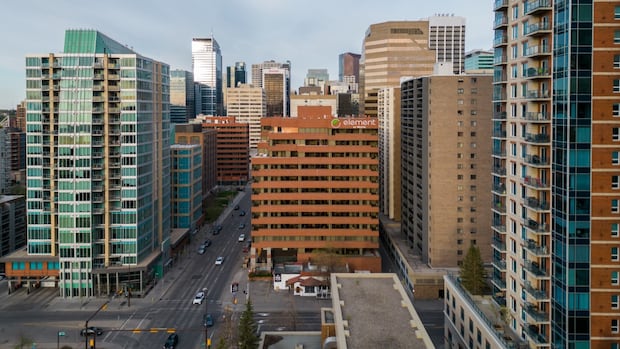
As 1st office-to-hotel conversion opens in downtown Calgary, what's next for revival bid?
CBC
On Thursday, a former office tower in Calgary's downtown reopened as the Element Calgary Downtown hotel, marking the city's first completed office-to-hotel conversion under its downtown office conversion program.
For officials who have spent years plotting the program, it's not just about the hotel, which sports 226 rooms, along with a rooftop bar.
More than that, officials say it represents an important step on a long journey to diversify the downtown, providing more things for people to do in the core than just go to work.
"For us, it's pretty exciting," said Thom Mahler, the director of the city's downtown strategy, in an interview.
"If you remember going back to 2014, 2015, a lot of stuff we talked about then at that time was how our downtown was heavily reliant on one industry, very focused on head office and office space."
It's a notable moment in the ongoing plan to reinvent Calgary's hollowed-out downtown core.
But there's still a long road ahead, as many approved projects remain unfinished and vacancy rates remain high.
Still, for Calgary Mayor Jyoti Gondek, it's the sort of project she feels the city should have acted quickly on when the energy sector was in dire straights 10 years ago.
"It took us a lot of time, because we had so many cynics who said, you can't do anything but office downtown. And to those cynics, I say, you were wrong," Gondek said. "We proved out that you can do things differently."
Calgary's downtown problem did start in earnest in 2015, after the price of oil crashed.
At that time, an office-leasing principal at Avison Young told Bloomberg News it was a "bloodbath." The COVID-19 pandemic five years later only made things worse.
Today, while the bleeding may have been slowed, recovery remains a work in progress.
Industry figures vary, but as of the first quarter of 2025, about 30.2 per cent of Calgary's downtown office space was vacant, down from a peak of 33.8 per cent in the second quarter of 2022, according to the real estate firm CBRE Canada.
Meanwhile, overall Class AA real estate — sometimes referred to as "trophy buildings" — was around 17 per cent vacant.


About 30 properties in the Fraser Valley are under evacuation alert as the atmospheric river pummeling B.C. increases flood and landslide risks in several parts of the province.

WARNING: This story references allegations of child abuse.

Police say it was a 67-year-old Chatham man who died while scuba diving at the Erieau marina on Wednesday morning.

Enmax declared its lowest dividend, to be paid to the City of Calgary, in four years in its 2025 financial results.

Rilee Willianen says the City of Thunder Bay has received wide-ranging feedback about its plans to create designated encampment sites.

The Ontario government is planning to outlaw sky-high ticket resale prices, according to a news release.

As March break comes to an end, there are lots of fun events happening on the weekend in Waterloo region, Guelph and Wellington County.

Yukon RCMP are renewing their plea for public help in the investigation into an unsolved 2023 double homicide near Mayo.

Thousands of Muslims in Calgary will mark the end of Ramadan by celebrating Eid al-Fitr on Friday, bringing to a close a month of worship, reflection and fasting.

Dozens of people walked through downtown London Wednesday night shining candles in honour of a First Nation’s woman found dead in the city last month, while also calling for increased awareness about missing and murdered Indigenous peoples.

Have tips for navigating telecom customer service? We want to hear from you. Click the “Join the Conversation” button above. On the app? Join here.

The Health Sciences Centre's cardiac catheterization lab has just completed a major upgrade. It’s been a makeover five years in the making, and officials say the waitlist is already improving.

Jamie Cleveland started his Ford Escape like he did every morning outside his Dartmouth, N.S., apartment building.