An economic trajectory marked by resilience and challenges Premium
The Hindu
The State’s economic transition is rooted in a balanced expansion of both its manufacturing and service sectors. Of note, is its manufacturing sector.
In the last three years, the Nobel Prize in Economics has been awarded to scholars who have shown that institutions, including social institutions, matter for economic development. This thesis is not novel, but its recognition is particularly relevant to India, where differentiation and discrimination based on caste and gender continue to persist in the economic domain. This is true of Tamil Nadu as well, though to a lesser extent. The State has demonstrated how social inclusion and economic development can be a mutually reinforcing process.
Tamil Nadu has done well on both the economic and social development fronts. With 6% of the country’s population, Tamil Nadu contributed 9.21% to the national Gross Domestic Product (GDP) in 2023-24. According to Reserve Bank of India (RBI) data on Indian States, in 2024-25, the State had the second-highest per capita Net State Domestic Product (NSDP) in constant prices (2011-12 prices) among major States.Tamil Nadu’s real economic growth rate of 11.19% for 2024-25 marks the highest for any State in the country, besides being the highest for the State in the past 10 years. This economic dynamism, unlike that of other dynamic States like Gujarat or Maharashtra, is equally backed by consistent improvements in human development.
The State has the second-lowest headcount measure of poverty as well as the second-lowest multidimensional poverty index. The State also ranks third in the Sustainable Development Goals (SDG) Index. Tamil Nadu has the second-highest gross enrolment ratio in higher secondary education and the highest in tertiary education. It was ranked the best in the Social Progress Index (SPI) developed by the Institute for Competitiveness and Social Progress Imperative. This unique development trajectory has been sustained through simultaneous and spatially distributed investments in hard infrastructure like power and transport, as well as in health and education. Tracing the key economic achievements of the State since the pandemic, this essay goes on to highlight the challenges that the State has to confront to sustain its path of inclusive economic growth.
Balanced economic transformation
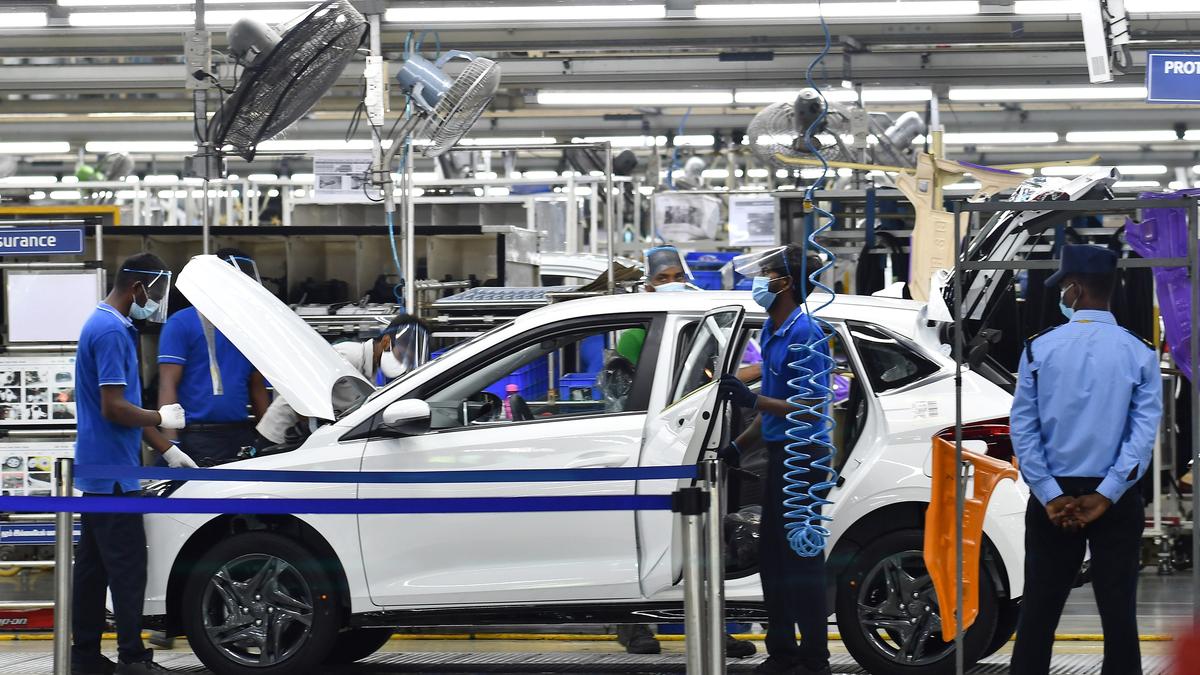
The State’s economic transition is rooted in a balanced expansion of both its manufacturing and service sectors. Of note, however, is its manufacturing sector. During a period when manufacturing has not found its feet at the all-India level despite several measures, the State has emerged as a model of sustained manufacturing dynamism. It has been a major producer and exporter of automobiles and auto components, garments, textiles, and leather goods since the 2000s, and continues to be so. While its competitiveness in these sectors has a longer history, its success in electronics production and exports is recent. It accounted for more than 41% of India’s electronics exports in 2024-25, and is poised to take advantage of the ‘China-plus-one’ strategy of global electronics majors. Home to seven of Apple’s 14 assembly and component firms in India, the State has announced a separate policy for electronic component production, seeking to embed the investments in the State’s ecosystem, and thereby strengthen local linkages.


India's merchandise exports remain flat in February, with Commerce Secretary warning of a potential dip in March due to trade constraints.

Hard Rock International closes 10 outlets in India, including three cafes in Bengaluru, while Goa hotel remains open.

The booming market for artificial intelligence servers brought Taiwan's Foxconn a 24 percent jump in annual net profit, the company said

In a statement on its website, Adobe said it has in recent years streamlined its sign-up and cancellation processes and made them more transparent.

Stock markets recover as Sensex and Nifty bounce back following a three-day slump, driven by value-buying in blue-chip stocks.

U.S. President Donald Trump’s administration is set to receive a roughly $10 billion fee from investors in the recently completed deal to take control of TikTok’s U.S. business, the Wall Street Journal reported

Meta is planning sweeping layoffs that could affect 20% or more of the company, three sources familiar with the matter told Reuters

Learn how to choose the best personal loan lender by evaluating eligibility, interest rates, and borrowing experience.

Discover why pension planning is essential in modern India to ensure financial security and peace during retirement.

The U.S. has launched two investigations under Section 301 of the Trade Act of 1974 against India and other economies to examine practices that may be ‘unreasonable or discriminatory and burden or restrict U.S. commerce’. One probe examines whether countries, including India, are using excess manufacturing capacity to export to the U.S. in a manner that hurts American businesses, while another looks at whether countries have taken ‘sufficient steps’ to prohibit imports of goods produced with forced labour.

NHAI raises annual pass fee to ₹3,075 from April 1, 2026, streamlining toll payments for FASTag users.

The U.S. probes forced labour in global supply chains, scrutinizing China and India's exports, warns the Global Trade Research Initiative.

The Hindu collection of images of the LPG crisis: War lights a kitchen fire