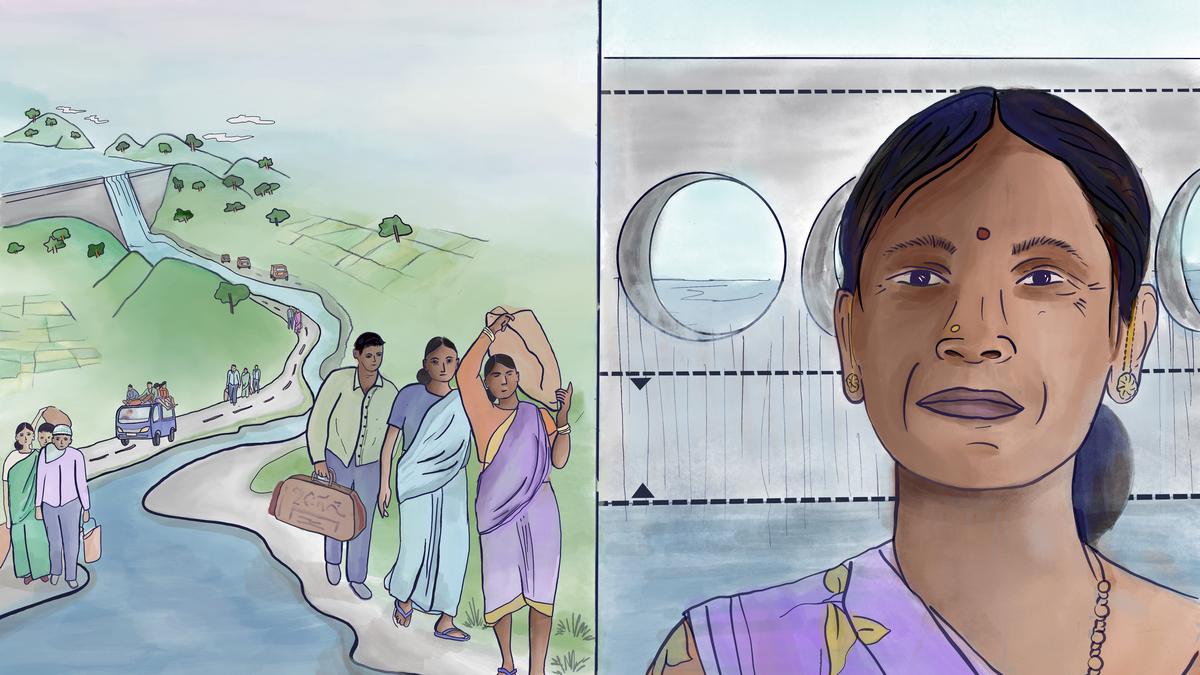
A book that delves into the collective memories, lived experiences and imaginations of the people who live along the Vrishabhavathi
The Hindu
Kadambari says they started with the somewhat ambitious idea of creating a digital repository for those interested in the river to communicate with each other. “We saw that a lot of nature-based solutions and urban systems are a bit disconnected,” says the Bengaluru-based information designer, who has recently co-authored a graphic narrative centred on the Vrishabhavathi, titled Whose river is it anyway?, along with Namrata and Megha Kashyap. “Multiple stakeholders engage with the river at different parts of its journey but do not speak to each other. Also, some stakeholders use the river disproportionately, and some are impacted disproportionately; we wanted to highlight that everybody doesn’t have equal access or is equally affected.”
For most Bengalurians, Vrishabhavathi, a tributary of the Arkavathi, is a stream (sometimes just a trickle) of untreated, filthy water. But in 2020, during the first COVID-19 wave, Kadambari Komandur stumbled across a newspaper article with a picture of the river looking much cleaner than usual. She shared it with some of her friends on a WhatsApp group, one of whom was Namrata Narendra, an urban researcher, architect and illustrator, from Bengaluru, now doing her PhD in the Netherlands on periurban water provisioning in North East India.
“Kadambari lives in Malleshwaram, and I live in Nayandahalli (when she was in Bengaluru), so we have both been around the river,” says Namrata. Additionally, since they both studied at the RV College of Architecture, they often saw the Vrishabhavathi en route to their college. “It is present in that area very visibly,” she says. “So, we wanted to do something about it.”
Kadambari says they started with the somewhat ambitious idea of creating a digital repository for those interested in the river to communicate with each other. “We saw that a lot of nature-based solutions and urban systems are a bit disconnected,” says the Bengaluru-based information designer, who has recently co-authored a graphic narrative centred on the Vrishabhavathi, titled Whose river is it anyway?, along with Namrata and Megha Kashyap. “Multiple stakeholders engage with the river at different parts of its journey but do not speak to each other. Also, some stakeholders use the river disproportionately, and some are impacted disproportionately; we wanted to highlight that everybody doesn’t have equal access or is equally affected.”
In keeping with this idea, Kadambari and Namrata (Megha, a designer from Bengaluru, interested in the connections between people, nature, and cities, joined them later in 2023) began contacting several experts, including Shubha Ramachandran of the Biome Environmental Trust, Nirmala Gowda and Madhuri Mandava of Paani Earth, and ecologist Harini Nagendra from Azim Premji University. “Over these conversations, we understood the scale of what we were trying to do,” explains Kadambari. “They guided us away from moving in that direction to something more focused and allowed us to use our skill sets: illustration, research and documentation.”
Although there was already a lot of published work about the Vrishabhavathi, it is often very technical, says Kadambari. “It was very inaccessible, hard for us to read, and we wondered how people could access it,” she adds.“So, we thought that maybe graphic storytelling and communication were things we could do.”
Their initiative also led to an interesting collaboration with Nirmala and Madhuri, who were already doing a lot of work in the Arkavathi/Vrishabhavathi basin. “Theirs was a much more technical approach, looking at rivers from the perspectives of Geographic Information System (GIS) implementation,” says Kadambari. However, as the Paani Earth team was researching, uncovering different stories and meeting new people, they also realised that many more things were happening on the ground that needed to go beyond just technicalities, she believes. Kadambari and Namrata realised it would be beneficial to partner with the Paani Earth researchers, who would provide starting points (from their field work) that they could delve into for their storytelling, recalls Kadambari.
A river, after all, is more than simply a water body; it also shapes nostalgia, mythologies, culture, and spiritual beliefs. “We recognised the need to move beyond traditional academic frameworks,” says Kadambari. Research alone doesn’t always inspire change, especially when it comes to complex systems. For issues as deeply emotional and personal as a river, engaging with those emotions can be a powerful catalyst.”


Record sales of sheep and goats at Manapparai cattle shandy surge despite MCC cash restrictions ahead of Ramzan.

NCC cadets participated in a community development walkathon and awareness skit, organised by Ramaiah University and sponsored by 40 Karnataka Battalion.

Join a free webinar on March 20 exploring patient-centric, tech-enabled TB care ahead of World Tuberculosis Day.

Gold worth ₹2.5 crore seized in Nilgiris due to lack of documentation during transport to private jewellery stores.

Explore the inspiring journey of Geetha Kannan, a national-level Paralympic swimmer and junior cooperative auditor, overcoming challenges with resilience.

BJP's Dilip Ghosh claims Mamata Banerjee is trapped in Bhabanipur, facing tough election challenges from Suvendu Adhikari.

DMK MP R. Girirajan petitions Madras High Court for ED to investigate AIADMK leaders for money laundering linked to corruption cases.

V.D. Satheesan urges the Election Commission to remove LDF government hoardings, citing violations of the Model Code of Conduct.

Featuring Sanjay Dutt and Nora, the Kannada original version of the song, titled ‘Sarse Ninna Seraga Sarse’, was slammed for its “oscene” lyrics by fans and people from film fraternity on social media

Supreme Court questions West Bengal's claim that ED lacks rights to challenge obstruction during I-PAC raids by Chief Minister.

Madras High Court bans unauthorized Dhurandhar merchandise sales on major platforms and orders ISPs to block pirated content.

Ex-AAP councillor Tahir Hussain seeks one-month interim bail on medical grounds to undergo surgery related to a hernia.

BJP leader Dilip Ghosh aims to secure over 1 lakh votes, promising a victory margin greater than in 2016 elections.