Young owls in Calgary at risk of 'unethical' photography practices
CBC
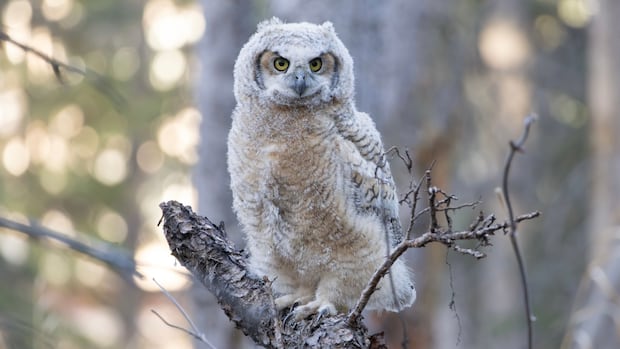
Owls can be pretty easy to find in Calgary. Their impeccable camouflage, perfected over the course of millions of years of evolution, isn't very effective when the tree they're in is surrounded by dozens of photographers.
In a popular Calgary park, longtime birdwatcher and wildlife photographer Jean Wallace found herself in the presence of a family of great horned owls. That sounds like a magical moment with nature, but Wallace was concerned about the actions of other photographers.
"They were only about five feet from the owl tree and started hooting at them," she said. "Another woman then pulled out her phone [and played] a recording of a mother great horned owl calling its young."
Their attempts to trick the owlets into looking at them, coupled with some trespassing beyond park boundaries to get the right shot, compelled Wallace to tell the photographers they were acting unethically, to no avail.
"They just shrugged and went on taking pictures," she said. "I just walked away. I wasn't going to confront eight people by myself in the woods."
Wallace took to social media to voice her concerns, affirming long-standing issues in the birdwatching community around ethical owl photography. Some popular wildlife groups on platforms like Facebook have taken steps to reduce unethical photography practices, including preventing members from publicly sharing animals' locations or posting photos of bird nesting sites. Some pages have even banned owl photos entirely due to the attention owls attract in particular.
Birders are always happy to see owls, but a line must be drawn between respectful birdwatching and practices that border on harassment of the animals, said Wallace.
"I think that when you start affecting their behaviours, whether they're flying away from you or flying toward you or freezing, it's stressful to them," she said. "It also can affect whether or not they're going to be getting enough food, whether you've interrupted their hunting process, whether or not you've interrupted them feeding their young."
Unethical photography practices can have dire consequences for nestling and fledgling owls, said Colin Weir, managing director of the Alberta Birds of Prey Foundation.
"Sometimes the parents can abandon a nest, or sometimes the parents will not come into a nest if there is disruption going on nearby, which could be very detrimental to the nestlings," he said.
Located east of Lethbridge, the Alberta Birds of Prey Centre is the largest birds of prey facility in Canada. The site covers 70 acres of wetland and is home to a wide variety of birds, including numerous owl species, for rehabilitation or, if release into the wild is not a possibility, as permanent residents.
Since 1984, Weir has taken in and rehabilitated thousands of birds from across Alberta.
"Most of the wildlife photographers that I've known or seen in the wild, their first concern is always the birds and their welfare," said Weir.
"Occasionally, there are a few individuals that sometimes push that envelope a little too far, and it leads to a lot of upset both for the individual owls, as well as drawing the wrath of birdwatchers, other photographers that are nearby."


A judge is expected to rule in June on a proposed settlement for a class-action lawsuit involving a crash landing of an Air Canada flight in Halifax more than a decade ago.

An inmate who was on the loose after escaping a jail in Shediac has been caught, New Brunswick RCMP said in a press release late Monday afternoon.

Premier Wab Kinew draped the Manitoba flag over an empty seat as politicians from across the aisle said goodbye to one of their own in an emotional tribute at the legislature on Monday.

Saskatoon police have identified the driver of a vehicle that struck a railway overpass above Circle Drive on Sunday — the third such collision in the city this month.

People who live near Lac Pelletier say effluent from a nearby cattle feedlot has spilled off the site and into a ditch that feeds into the lake downstream.

A man charged in a pair of stabbings in central Edmonton seven years ago has been found guilty of manslaughter.

Police in Metro Vancouver are warning drivers to remain attentive, even in a self-driving vehicle, after ticketing a woman who "appeared to be literally asleep at the wheel" on Highway 1.

Some century-old churches on P.E.I. are renovating to become more accessible, which includes updates to accommodate many different kinds of needs.

Toronto police headed to school zones Monday as part of a safety blitz following March Break.

WARNING: This story details experiences at residential schools.

The N.W.T. Coroner Service has identified the Nunavut man who died in RCMP custody in Yellowknife last Thursday.

The Liberal government's nominee to be the next fiscal watchdog insists she'll run an independent and non-partisan ship — even though her candidacy has created a political rift.

Two years after Calgary city council held its longest public hearing in the city's history, another marathon session began on Monday to tackle the same contentious subject: blanket rezoning.