World’s longest banana infructescence discovered in Andamans
The Hindu
Discover the Musa indandamanensis, a wild banana species with record-breaking infructescence, crucial for plant breeding and conservation efforts.
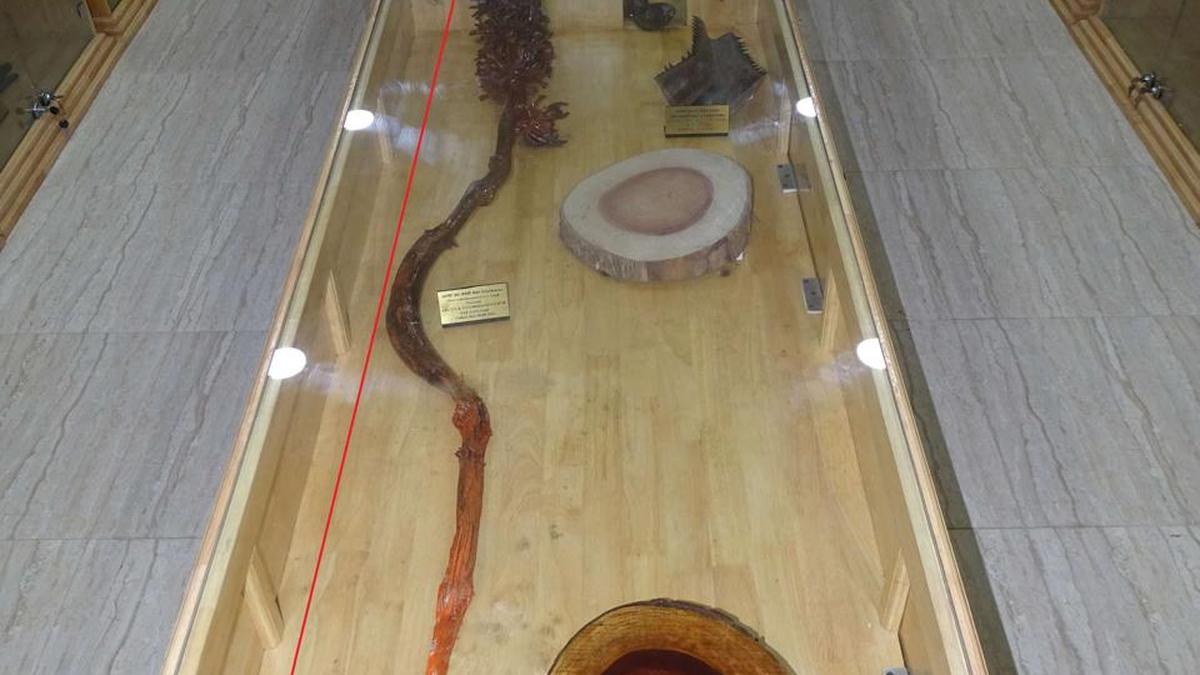
An infructescence of about 4.2 metres has been recorded in a species of wild banana from Andaman and Nicobar islands, making it the longest infructescence recorded in bananas across the world. The details of the discovery were published in an international peer reviewed science journal Botany Letters earlier this year.
The infructescence was recorded in an endemic species of wild banana, the Musa indandamanensis, that was first recorded from a remote tropical forest near Krishna Nala reserve forest in the Andaman and Nicobar islands in 2012 and found mention in a science journal in 2014.
Initially when the species of Musa indandamanensis was discovered in the Little Andaman islands by Lal Ji Singh, head of the regional centre of Botanical Survey of India in the Andaman and Nicobar Island, the infructescence of the specimens were about 3 metres long. Usually, the infructescence ( fruit bunch lux axis) of cultivable species of bananas are about 1 metre long, the scientist said.
A few months ago, Dr Singh and his team came across the species of wild banana in Campbell Bay in the Nicobar group of islands, and the infructescence recorded was longer than all other specimens recorded in the past. “Musa indandamanensis L.J. Singh holds the record for having the long infructescence of banana in general and wild bananas in particular which is an endemic variety found in ANI (Andaman and Nicobar Islands),” reads the paper published by Botany Letters earlier this year.
“Though the length of the trees recorded in 2012 and recently are the same, standing at about 11 metres in height, the girth of the stem of the wild banana trees differ. The species recorded from Little Andamans had girth of less than 100 cm, however the specimens recorded from Campbell Bay had a larger girth of about 110 cm,” Dr. Singh said.
After the discovery of the infructescence, specimens have been sent to museums across the country including the Indian Museum in Kolkata, where a 4.2 metre long specimen has been on display in the industrial section of the Botanical Survey of India for several months. Another specimen over four metres is in the Andaman and Nicobar Regional Centre museum.
Since the species has been assessed as ‘Critically Endangered,’ as a part of ex- situ conservation of Musa indandamanensis, saplings of this species have been introduced in Acharya Jagadish Chandra Bose Indian Botanic Garden Howrah, Botanical Garden of Andaman and Nicobar Regional Centre, and the Central Regional Centre Prayagraj in Uttar Pradesh.


Supreme Court affirms the public's right to critique its judgments while addressing concerns over an NCERT textbook's content.

Amit Shah reviews Manipur's security, urging the CM to tackle drug cartels and aid displaced communities after ethnic violence.

Kerala's fisherfolk urge political parties to address livelihood concerns, demanding fair pricing, rule enforcement, and better support during elections.

Moderate rainfall in Visakhapatnam brings relief but causes traffic disruptions and power outages across the city.

Shubman Gill’s Gujarat Titans banks on its tried-and-tested formula

Agriculture Ministry reviews unseasonal rains' impact, assesses farm losses, and discusses relief measures for affected farmers.

Premium petrol prices rise by ₹2 per litre, but government claims no impact on the common man amidst global oil tensions.

Kum. Veerabhadrappa’s acclaimed novel Aramane has been adapted into a television serial. Kannada channel DD Chandana (Doordarshan) has launched the serial with the same name. National Award-winning filmmaker Mansore is the director behind the project,

Diya Chitale and Manav Thakkar reach semifinals, while Yashaswini Ghorpade upsets top seed Sreeja Akula at National TT Championships.

DYFI criticizes A.P.'s job calendar for failing unemployed youth, demanding a revision to include 1 lakh posts and higher age limits.

‘Lethargic’ officials who left Chambal sanctuary to the mercy of sand miners will be held liable: SC
Supreme Court holds negligent officials accountable for enabling illegal sand mining in Chambal Sanctuary, emphasizing habitat protection laws.

Work on the Srisailam Left Bank Canal tunnel resumes after 13 months, with completion targeted by 2027-end, says Minister Reddy.

Ancient ‘Vanni’ tree at Sri Meenakshi Sundareswarar Temple tilts; steps on to restore it