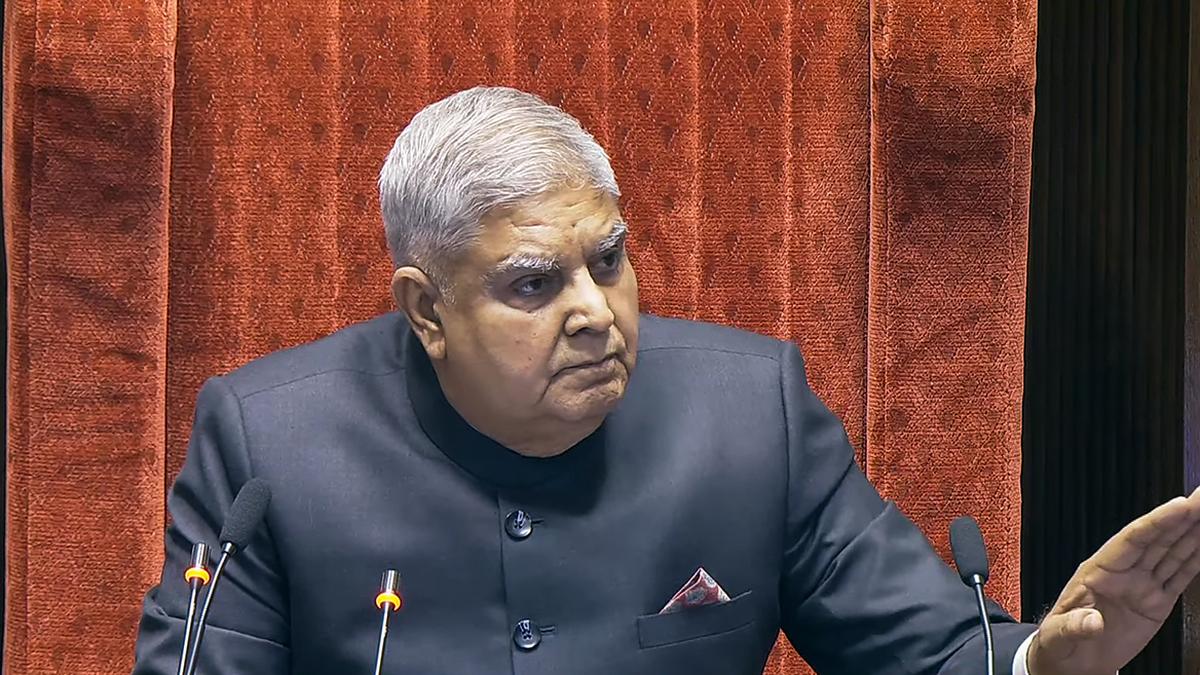
Will the no-confidence motion against Rajya Sabha chairperson Jagdeep Dhankhar succeed? Premium
The Hindu
Experts have pointed out that the resolution is unlikely to yield any result since the Opposition does not have the requisite numbers. However, there is no bar on the resolution being considered in the next session of Parliament
On December 10, the opposition submitted a notice to move a no-confidence or impeachment resolution against Vice President and Rajya Sabha chairman Jagdeep Dhankhar. The notice accuses him of engaging in “partisan” conduct and being an “impassioned spokesperson” of the government’s policies at public fora. A similar motion had been considered by the Opposition during the Budget Session in August but was ultimately shelved as the Session drew to a close.
As the second-highest constitutional authority after the President, the Vice-President draws his or her powers from Article 63 of the Constitution. Article 64 further confers upon the post the power to serve as the “ex-officio Chairman of the Council of States (Rajya Sabha).” Thus, the Vice-President discharges the duties of both the Vice-President and Chairperson of the Rajya Sabha.
Parliament Winter Session Day 13 LIVE
The process for the removal of both the Vice President and Rajya Sabha chairperson has been laid down under Article 67. The provision stipulates that the Vice-President will hold office for a term of five years from “the date on which he enters upon his office”. However, he or she may leave mid-term by submitting a resignation letter to the President.
Additionally, Article 67(b) provides for the removal of the Vice-President if a majority of Rajya Sabha members pass a resolution to that effect, which must then be “agreed to” by the House of the People (Lok Sabha). However, the provision specifies that no such resolution can be moved unless at least a prior fourteen days’ notice has been given.
“The resolution can only be considered for discussion once the constitutionally mandated 14-day notice period has elapsed. It must then be approved by a simple majority in both Houses for passage and implementation,” P.D.T. Achary, former Secretary General of the Lok Sabha, told The Hindu.
It is however unlikely that the no-confidence motion will be taken up for discussion in the House since the Winter Session of Parliament is scheduled to conclude on December 20, which is less than 14 days away. For instance, in 2020 then Rajya Sabha Chairman M. Venkaiah Naidu dismissed a no-confidence motion against Deputy Chairman Harivansh on the ground that it required a 14-day notice.


Sunny Joseph accuses Pinarayi Vijayan of targeting Rahul Gandhi as part of a political deal with the BJP.

AIADMK faces perception challenges and electoral setbacks in Tamil Nadu, struggling to maintain its traditional stronghold and voter base.

Sunny Joseph accuses Pinarayi Vijayan of targeting Rahul Gandhi as part of a political deal with the BJP.

Mahesh Dattani and Jonathan Taikina Taylor collaborate play, ‘The Monk & The Warrior’, to be staged at Mumbai’s Experimental Theatre from April 2 to 5

NHAI's rooftop solar plants on three toll plazas generate 521 daily units, saving 1.87 lakh conventional power units annually.

Congress criticises PM Modi's Rajya Sabha statement on West Asia, calling it a "self-praise" prepared text without Opposition clarification

Kerala has 2.71 crore voters for the April 9 Assembly polls, with 2,040 polling stations marked as critical.

Garbage collection resumes in Bengaluru amid contractor disputes over payment delays and new waste segregation rules by BSWML.

Hyderabad faces traffic challenges due to rising vehicle numbers; government appoints international consultant for effective infrastructure solutions.

Discover the Delhi Capitals' IPL 2026 player roster, schedule, and support staff as they pursue their first championship.

Sanya Malhotra and Aditya Rawal have started shooting for their upcoming romantic-thriller, Sundar Poonam.

Telangana Government plans a ₹940 crore double-decker elevated corridor from Panama Godowns to Hayatnagar on the Vijayawada highway.

PM Modi emphasizes India's pursuit of diverse gas and crude oil sources amid the global energy crisis due to West Asia conflict.