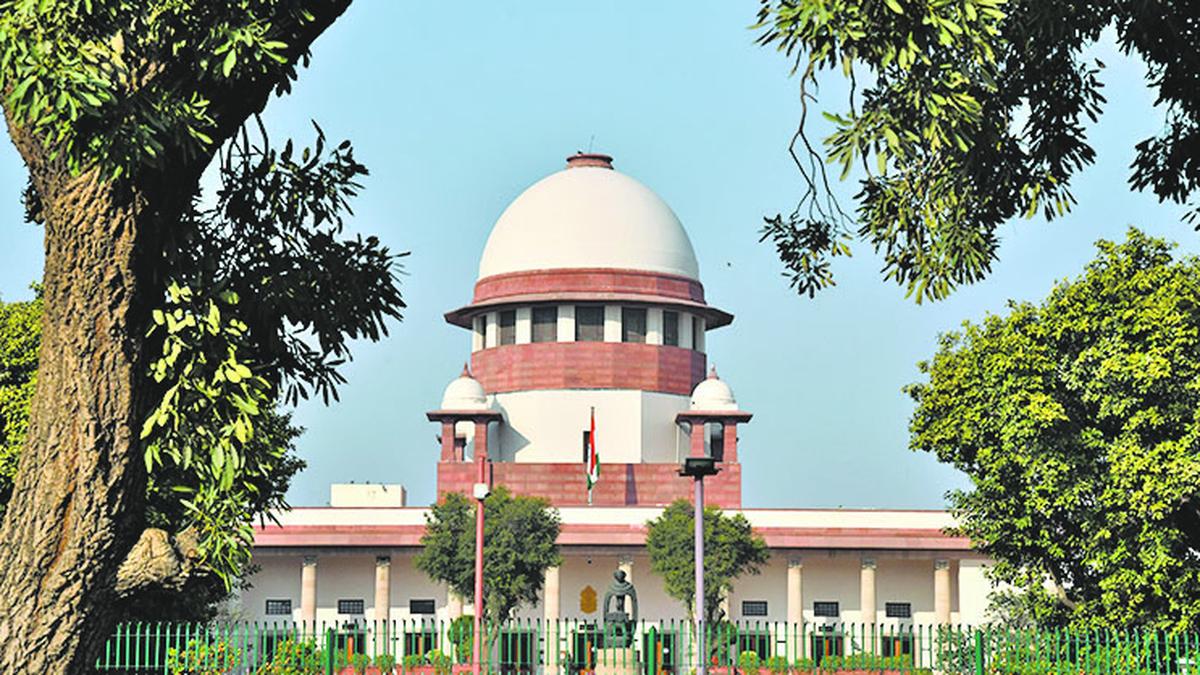
Will resolve Governor-T.N. govt. tussle in the spirit of the Constitution, says SC
The Hindu
Supreme Court to mediate Tamil Nadu government vs. Governor R.N. Ravi dispute over higher education Bills, seeking resolution.
The Supreme Court on Tuesday (February 4, 2025) promised to resolve the tug-of-war between the Tamil Nadu government and Governor R.N. Ravi “in the spirit of the Constitution”, and in the “interest of one and all”, even while holding out hope that the freeze in ties could be resolved over a cup of coffee before the scheduled court hearing on February 6.
The clash of views between the Governor and the M.K. Stalin-led government is over myriad issues, ranging from delay in giving assent to key Bills on higher education issues, pending sanction of prosecutions, remission of prisoners, government orders, and constitution of search committees for the appointment of Vice-Chancellors (V-Cs).
“The Governor’s table is empty. There is nothing on it at all,” Attorney General R. Venkataramani, appearing for the Governor’s office, told a Bench of Justices J.B. Pardiwala and R. Mahadevan.
He was referring to the Governor’s action of referring 10 re-enacted Bills, largely concerning higher education in the State, to the President on November 18, 2023. The President had subsequently assented to one Bill, rejected seven, and did not consider the remaining two proposed laws.
The State, represented by senior advocate Mukul Rohatgi, A.M. Singhvi and P. Wilson, and advocate Sabarish Subramanian, argued that the decision of the Governor to reserve the case for the President’s consideration was “ex-facie illegal, without jurisdiction and in gross violation of the Constitution”.
“The grant of assent to the Bill by Her Excellency, the Hon’ble President of India is unconstitutional and without jurisdiction. Instead, Union government should have advised Her Excellency to return the 10 Bills back to the Hon’ble Governor as it is completely in gross violation of the principles of Constitution under the first proviso to Article 200 [Governor’s assent to Bills],” the State government said.
Justice Pardiwala queried whether there were any specific considerations that ought to weigh on the Governor for referring a Bill to the President and, subsequently, how the President would look into a Bill sent by the Governor.


Abhishek Banerjee challenges BJP's Suvendu Adhikari in Nandigram, pledging community health initiatives if Trinamool Congress wins.

Rising LPG shortages in Karnataka boost firewood demand, reviving an informal market as households and hotels seek alternatives.

Against the backdrop of intense poll activity, a 400-metre stretch of an arterial road in the outskirts of Chennai (technically in Madurapakkam panchayat under Tambaram assembly constituency) presents a salute to the idea of res publica, which underpins India’s system of governance, where citizens have a say, at least before a government is securely ensconced in the seat of power. A Republic Day initiative shines bright every night

Fadnavis claims zero FIR in Ajit Pawar crash is a defamation attempt by Karnataka against Maharashtra's investigation efforts.

Set to unfold as a one-day pop-up on April 5, the Easter Sadya brings together both vegetarian and non-vegetarian menus, offering a peek into the food traditions of the Syrian Christian (Nasrani) community. While the traditional Sadya is often associated with dishes such as sambar, avial, and rice, this version expands to include community-specific festive dishes.

BJP nominates mother of R.G. Kar victim Abhaya to contest from Panihati in West Bengal Assembly elections.

Veteran Malayalam actor-director E.A. Rajendran passes away at 71, leaving behind a rich legacy in the film industry.

Dakshina Kannada Zilla Panchayat has rolled out digital mode of water bill generation and collection in 23 gram panchayats on a pilot basis for the first time in Karnataka. This is set to be extended to the remaining 200 panchayats shortly, according to the Zilla Panchayat Chief Executive Officer Narwade Vinayak Karbhari.

Bengaluru police questioned a man carrying ₹6 lakh for medical expenses at Vidhana Soudha, later releasing him after verification.

BJP accuses Bengaluru's Congress government of corruption in e-Khata issuance, halting infrastructure projects due to financial mismanagement.

Misinformation in Hyderabad sparks panic buying, causing disruptions as residents react to unfounded rumors of an impending lockdown.

Bengaluru Metro extends services until 2 a.m. on March 28 for IPL match, ensuring convenient travel for spectators.

A bus truck-collision in Andhra Pradesh's Markapuram district, killing several. Catch LIVE updates here!