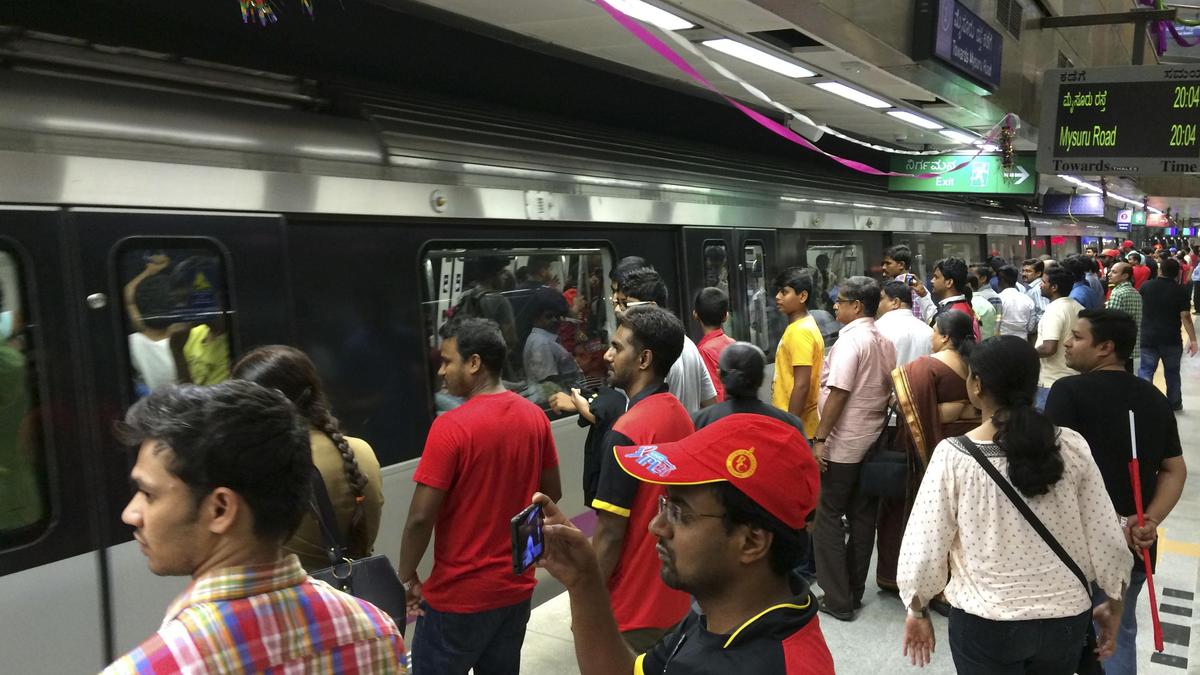
Bengaluru metro to extend services till 2 a.m. for IPL match on March 28
The Hindu
Bengaluru Metro extends services until 2 a.m. on March 28 for IPL match, ensuring convenient travel for spectators.
The Bangalore Metro Rail Corporation Ltd. (BMRCL) has announced an extension of metro services on March 28 in view of the TATA IPL T20 match scheduled to be held in the city.
According to a release, the last train services from all terminal stations, which usually end around 11 p.m., will be extended up to 2 a.m. (early hours of March 29). The last trains will depart from Whitefield (Kadugodi) at 12.30 am and Challaghatta at 12.45 am, while services from Silk Institute and Madavara will run till 12.45 am. Bommasandra services will continue until 1 a.m. and from R.V. Road until 2 a.m. The last train from Nadaprabhu Kempegowda Station, Majestic, towards all four directions will leave at 1.30 a.m.
To facilitate seamless travel, BMRCL said that IPL match tickets will include a QR code enabling two-way metro travel. This facility will be available on both printed and digital tickets, allowing spectators to commute conveniently without purchasing separate metro tickets.
Spectators have been advised to use designated metro stations based on their stadium entry points. Those accessing gates from Cubbon Road are advised to use Cubbon Park Metro Station, while those entering from Link Road should use Mahatma Gandhi Road Metro Station, both located within walking distance of the stadium.
In addition, BMRCL has arranged extra parking facilities across multiple metro stations. On match day, parking will be available at a flat rate of ₹30 for two-wheelers and ₹60 for cars, valid until the closure of metro services. Commuters are encouraged to park at these stations and travel by metro to ease traffic congestion in the Central Business District and surrounding areas, stated release.
The BMRCL has urged passengers to follow instructions from police, stadium authorities, and metro staff to ensure safety and avoid overcrowding. It added that station entry may be regulated or temporarily restricted if required in the interest of passenger safety.


Residents of Thiruporur constituency face civic challenges amid rapid urbanization, impacting resources, infrastructure, and local livelihoods.

NTK chief Seeman criticizes competitive populism and freebies at a rally, warning against northern influence in Tamil Nadu politics.

A 32-year-old man is arrested for abusive social media posts and mid-air misconduct involving Bengaluru police and Indigo Airlines.

A tragic bus-truck collision in Markapuram kills 10-12 and injures over 20, prompting a state investigation and condolences from the Chief Minister.

Telangana sets up control rooms after a deadly bus fire in Markapuram, aiding victims' families from Andhra Pradesh.

Microplastics, especially nylon fibres, are present in Chennai’s beach sediments in relatively low abundance, but low overall microplastic abundance does not necessarily imply low ecological risk. Even small particles can cause long-term ecological damage by affecting marine life, moving up the food chain, and eventually impacting human health through contaminated seafood.

Fuel outlets in Hyderabad remain crowded for the third day, as LPG auto drivers face ongoing shortages despite government assurances.

Assembly polls 2026: Follow updates from The Hindu on the upcoming elections in five States on March 26, 2026

40% of West Bengal's voters under adjudication have been deleted, sparking concerns and protests ahead of upcoming elections.

Trump claims Iran is afraid to negotiate a deal amid ongoing conflict, despite Tehran's denial of participation in talks.

Government mandates LPG supply cut-off for households not switching to available piped natural gas (PNG) within three months.

Congress faces eviction from its historic 24 Akbar Road office as it considers legal options against the Centre's final notice.

The Hindu Morning Digest gives a select list of stories to start the day. Read the top news today on March 26, 2026