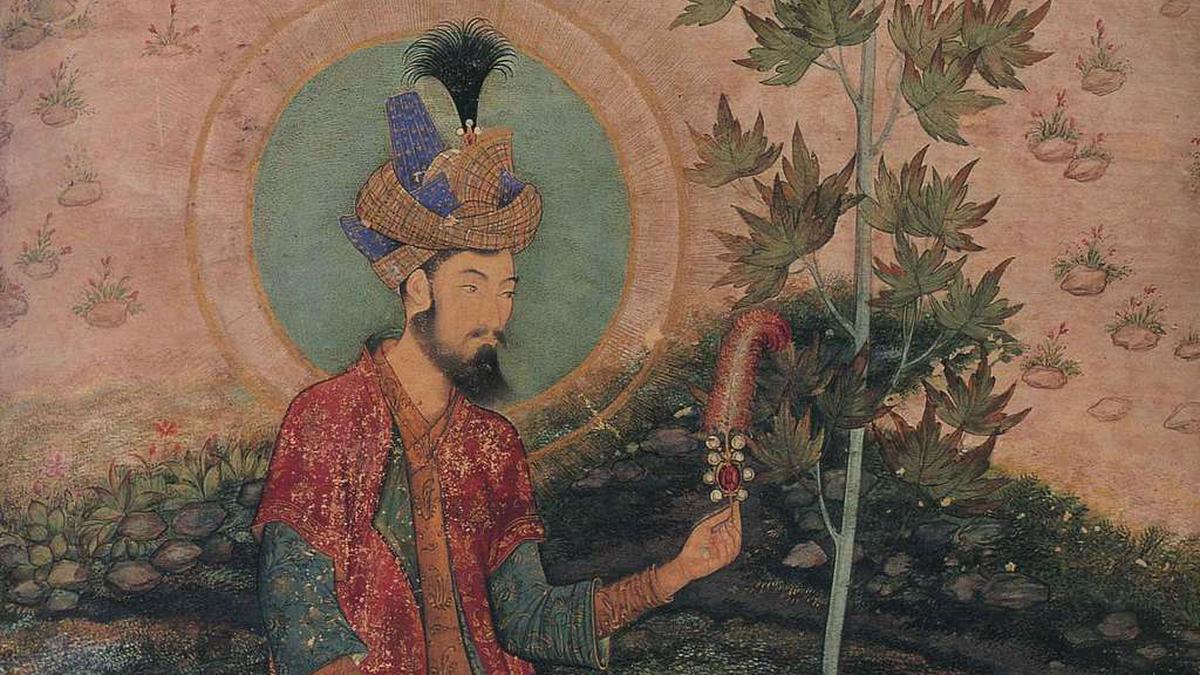
Why historian Ebba Koch wants to spotlight Mughal emperor Humayun, who she calls ‘the most intriguing ruler of the dynasty’
The Hindu
Koch’s book ‘The Planetary King: Humayun Padshah, Inventor and Visionary on the Mughal Throne’ was launched in New Delhi on Humayun’s birth anniversary, March 6
Neither mourned, nor remembered by millions, Humayun is almost the forgotten Mughal emperor. Sandwiched between Babur, the founder of the Mughal dynasty, and Akbar, the greatest Mughal emperor, Humayun cuts a forlorn figure. Deeply interested in astronomy and astrology, he was a man of many oddities, and deserves more than the cursory attention that has been his fate in school textbooks.
Shining the light on him now is Austrian art and architecture historian Ebba Koch who has taught at Oxford and Harvard, and in 2016, became advisor to the Aga Khan Trust for Culture (AKTC).
Her book The Planetary King: Humayun Padshah, Inventor and Visionary on the Mughal Throne (Mapin Publishing and AKTC) was launched in New Delhi on the emperor’s birth anniversary on March 6. Koch describes Humayun as a man remembered more for his failures than successes. He proved to be a comeback man, however, winning back the kingdom he lost, and there is certainly more to him than what is known in the public domain, said Koch at the book’s release. Edited excerpts:
Indeed. Humayun is chiefly remembered as a political and military failure because he lost to his rival Sher Shah Suri what Babur had conquered in India, had to seek refuge in Iran and fight in Afghanistan to regain his throne in Delhi. He did not write his autobiography and what his historian Khwandamir recorded ( Qanun-i Humayuni) is so eccentric that it eludes general comprehension. Abu’l Fazl glorifies Humayun as the father of Akbar but then he fades increasingly from historical memory and is best known through his splendid tomb, erected by Akbar in Delhi. In the book, I try to take the view away from previous approaches to Humayun to form a more holistic picture of the second Mughal padshah to restore him to the place he should rightfully occupy in Mughal history.
Humayun is not considered a great warrior even though historians have studied his battles and increasingly rehabilitated him as a general. But if we combine this aspect of the monarch with his intellectual persona, it implies enlarging the world of Timurid-Mughal princes and including Humayun within an extraordinary group of educated and gifted savants who were also diplomats, mathematicians, astronomers, astrologers and generals. Humayun did not conform to the established notions of kingship, he was a free thinker and broke social conventions. The originality of his thinking and his inventions made it difficult for future generations to understand him and thus they preferred to ignore Humayun.
Near Humayun’s Tomb was the Purana Qila, the palace fortress, and other Mughal buildings. Shah Jahan wanted to have his own capital according to his ideas and started its construction with a palace fortress, the Red Fort, opposite Salimgarh, which had been the residence of the Mughal emperors when they visited Delhi before Shahjahanabad. Interestingly, it was Shah Jahan who showed a new interest in Humayun. His court poet Abu Talib Kalim Kashani wrote a poem on Humayun’s tomb, and Shah Jahan saw the domed mausoleum as inspiration for the Taj Mahal. Shah Jahan also gave a new architectural expression to the solar cult of the Mughal emperors which had been initiated by Humayun’s planetary court.
I can’t think of any ruler with Humayun’s knowledge and interest in astronomy and astrology in Indian history. Humayun had the best scientists to advise him. The scholar Muslih al-Din al-Lari from Shiraz was at Humayun’s court in the 1530s; he wrote on cosmological concepts which would have been of interest to the padshah. A special favourite of Humayun’s was Maulana Nur al-Din Tarkhan from Jam in Khurasan, who was distinguished for his knowledge of mathematics, astronomy, and the use of the astrolabe. Abu’l Fazl mentions the Hindu astronomer or astrologer Maulana Chand, who had ‘great skill in and knowledge of the astrolabe and the details of the star catalogues and casting horoscopes’. He was placed by the padshah in his wife-consort Hamida Begam’s entourage at Amarkot to cast the horoscope at Akbar’s birth.


Abhishek Banerjee challenges BJP's Suvendu Adhikari in Nandigram, pledging community health initiatives if Trinamool Congress wins.

Rising LPG shortages in Karnataka boost firewood demand, reviving an informal market as households and hotels seek alternatives.

Against the backdrop of intense poll activity, a 400-metre stretch of an arterial road in the outskirts of Chennai (technically in Madurapakkam panchayat under Tambaram assembly constituency) presents a salute to the idea of res publica, which underpins India’s system of governance, where citizens have a say, at least before a government is securely ensconced in the seat of power. A Republic Day initiative shines bright every night

Fadnavis claims zero FIR in Ajit Pawar crash is a defamation attempt by Karnataka against Maharashtra's investigation efforts.

Set to unfold as a one-day pop-up on April 5, the Easter Sadya brings together both vegetarian and non-vegetarian menus, offering a peek into the food traditions of the Syrian Christian (Nasrani) community. While the traditional Sadya is often associated with dishes such as sambar, avial, and rice, this version expands to include community-specific festive dishes.

BJP nominates mother of R.G. Kar victim Abhaya to contest from Panihati in West Bengal Assembly elections.

Veteran Malayalam actor-director E.A. Rajendran passes away at 71, leaving behind a rich legacy in the film industry.

Dakshina Kannada Zilla Panchayat has rolled out digital mode of water bill generation and collection in 23 gram panchayats on a pilot basis for the first time in Karnataka. This is set to be extended to the remaining 200 panchayats shortly, according to the Zilla Panchayat Chief Executive Officer Narwade Vinayak Karbhari.

Bengaluru police questioned a man carrying ₹6 lakh for medical expenses at Vidhana Soudha, later releasing him after verification.

BJP accuses Bengaluru's Congress government of corruption in e-Khata issuance, halting infrastructure projects due to financial mismanagement.

Misinformation in Hyderabad sparks panic buying, causing disruptions as residents react to unfounded rumors of an impending lockdown.

Bengaluru Metro extends services until 2 a.m. on March 28 for IPL match, ensuring convenient travel for spectators.

A bus truck-collision in Andhra Pradesh's Markapuram district, killing several. Catch LIVE updates here!