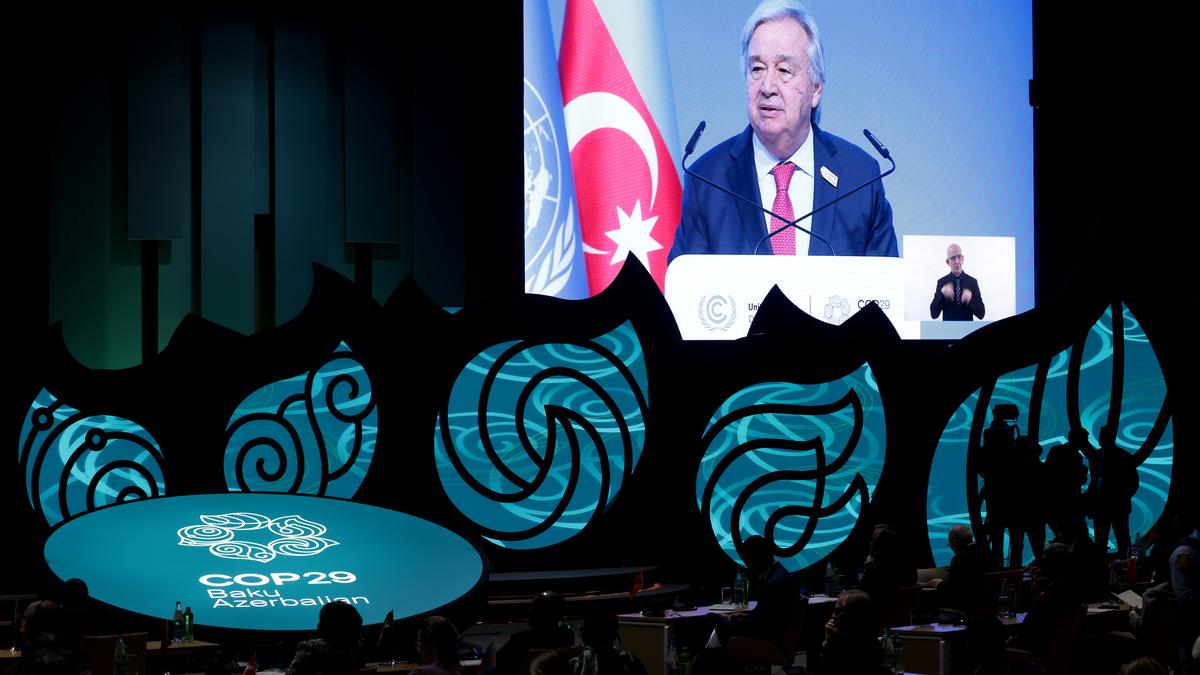
Why are countries fighting over climate finance at COP29?
The Hindu
The main task for nearly 200 countries at the U.N.’s COP29 climate summit is to broker a deal that ensures up to trillions of dollars in financing for climate projects worldwide.
The main task for nearly 200 countries at the U.N.'s COP29 climate summit is to broker a deal that ensures up to trillions of dollars in financing for climate projects worldwide.
Wealthy countries pledged in 2009 to contribute $100 billion a year to help developing nations cope with the costs of a transition to clean energy and adapting to the conditions of a warming world. Those payments began in 2020 but were only fully met in 2022. The $100 billion pledge expires this year.
Countries are negotiating a higher target for payments starting next year, but some have been reluctant to confirm its size until it is clear which countries will contribute.
Instead, they are circling around the idea of a multi-layered target, with a core amount from wealthy countries' government coffers, and a larger sum that includes financing from other sources such as multilateral lending institutions or private investors.
In the past, public money made up the bulk of contributions to the $100 billion goal.
Donald Trump's victory in the U.S. election has overshadowed the COP29 talks, because of expectations he will halt U.S. climate finance contributions.
That would leave a hole in any new global target that other donors would struggle to fill. Some climate negotiators also expect the overall target agreed at COP29 to be smaller, given the expected lack of contributions from the world's biggest economy.


Malayalam superstar Mohanlal will be reuniting with filmmaker Priyadarshan, it was announced recently. It will mark the 100th film of Priyadarshan and is backed by Mohanlal’s longtime collaborator, Antony Perumbavoor

Gautham Vasudev Menon loses Madras High Court appeal, ordered to pay ₹4.25 crore to R.S. Infotainment with interest.

AIADMK faces its toughest challenge in 53 years as it prepares for the crucial 2026 T.N. Assembly elections.

Lakmé Fashion Week x FDCI 2026 in Mumbai: What worked and what didn’t

Telangana CM announces underpass beneath Begumpet Airport runway to alleviate traffic congestion in Hyderabad.

Congress leader Ramesh Chennithala claims an alliance between Pinarayi Vijayan, Modi, and Shah aims to undermine UDF in Kerala elections.

CCB arrests Bengaluru couple for running a fake government job scam, cheating over 100 victims out of crores.

The enduring legacy of Araiyar Sevai

Telangana integrates with the 'Vahan' platform and eliminates 2% tax on second vehicles, enhancing transport services and transparency.

Delhi CM Rekha Gupta presents the Economic Survey 2025-26, highlighting growth in income and fiscal deficit details.

Ready for IPL 2026? The Chennai Super Kings’ 'Roar 26' event delivered several Dhoni moments, fan frenzy and an energetic AR Rahman concert.

An alleged dating app scam in Hyderabad's Jubilee Hills has reportedly swindled a man of ₹28,000 at a pub.

T.N. Chief Secretary and DGP visit Governor at Lok Bhavan, presenting flowers in courtesy call.