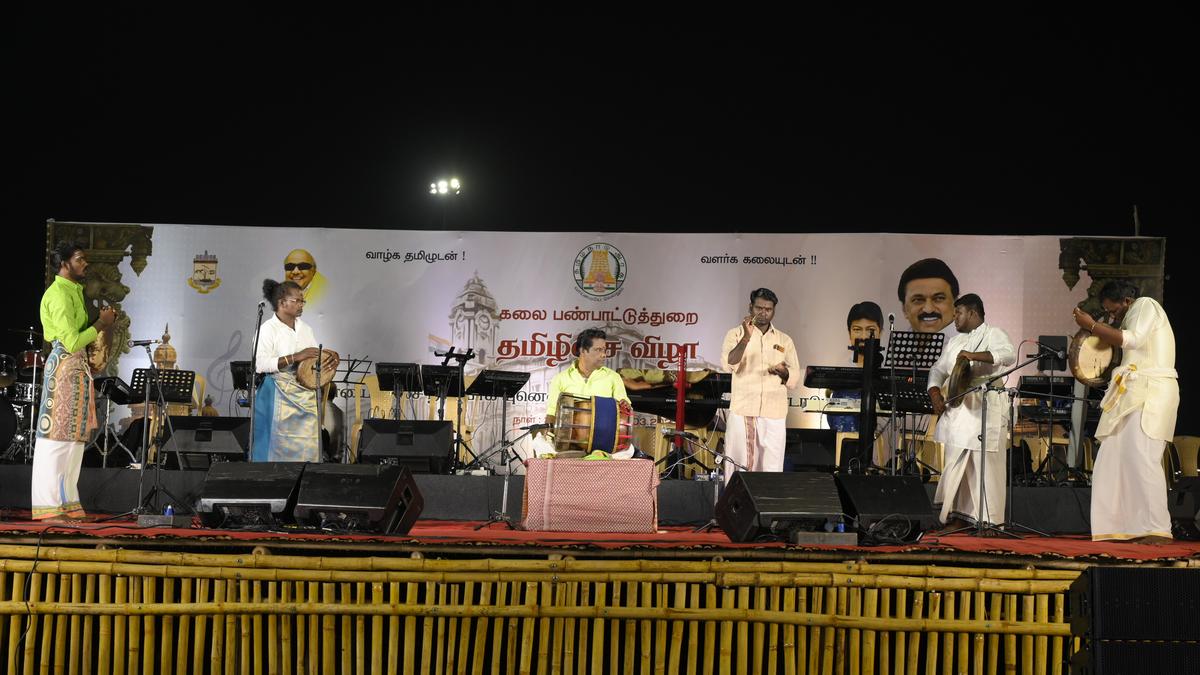
When thavil met magudam and thappu on the Marina
The Hindu
A historic musical collaboration featuring thavil, magudam, and thappu celebrated Chennai's UNESCO City of Music designation on Marina Beach.
On Sunday (March 1, 2026), the sands of the Marina Beach reverberated with the resonant strains of the thavil — a classical percussion instrument — alongside the earthy rhythms of the magudam and mantham, folk instruments traditionally accompanying Kaniyaan Koothu, and the vibrant beats of thappu melam.
The unique ensemble was organised by the Tamil Nadu government’s Department of Art and Culture to commemorate UNESCO’s declaration of Chennai as a City of Music. Two-day musical events were held at Valluvar Kottam and the Marina.
Leading the performance was thavil exponent and Padma Shri awardee Kongapattu A.V. Murugaian. He was joined by magudam players Ganesamurthy and Daniel Jebaselvan, and thappu player P. Kalaivanan and his brother P. Mutharasan. Though their traditions are distinct and their playing techniques markedly different, the artistes — without the benefit of rehearsal — achieved a remarkable musical synergy, blending classical precision with folk vitality to create a memorable sonic experience.
“It is a moment of pride that the thavil, a Carnatic classical percussion instrument, joined hands with two folk percussion traditions. It is a somewhat difficult task to perform together. I listened to them play and concluded that we could collaborate without rehearsal,” Mr. Murugaian said.
Magudam, the high-pitched percussion instrument, and mantham, which provides the bass, normally accompany Kaniyaan Koothu performed in Sudalaimadan temples in the southern districts of Tamil Nadu. Sudalaimadan, regarded as an avatar of Lord Siva, is the presiding deity of cremation grounds. Kaniyaan Koothu is staged during the Kodai (annual festival) of these temples. Though rooted in folk tradition and evoke primal feelings, the artistes demonstrated an ability to evoke rhythmic patterns comparable to those of classical percussion.
B. Hemanathan, Deputy Director of the Art and Culture Department, said it was the first time the thavil and these folk percussion instruments had come together in an ensemble. “The folk percussion artistes hail from Tirunelveli district and produce rhythms unmatched by other folk instruments. Normally, such an ensemble would require hours of practice and rehearsal. But these artistes achieved synchronisation without rehearsal or written notation. It was pure imagination. The performance energised the audience,” he said.


A round-up of the events and programmes held in various colleges in Tiruchi and other districts in the Cauvery delta region.

Karnataka Minister assures KSIC Filature Factory will remain operational, addressing concerns over a proposed stadium on its land.

Bulbulz Biryani and Kebab at Habba Kadal in Coonoor lays out an all-new Kashmiri menu

Tamil Nadu's rising oral cancer cases call for urgent awareness, early detection, and effective tobacco cessation strategies to combat the epidemic.

A historic musical collaboration featuring thavil, magudam, and thappu celebrated Chennai's UNESCO City of Music designation on Marina Beach.

CUSAT leads KIRF 2025 rankings in Kerala, with Rajagiri College and CET excelling in their respective categories.

Telangana Minister Tummala Nageshwara Rao is stranded in Dubai due to flight suspensions amid escalating Middle East tensions.

Road closure near US Consulate General in Hyderabad causes traffic diversions; motorists advised to follow new routes.

Streaming service Prime Video has announced the new season of its acclaimed show, Aspirants. Created and produced under the banner of The Viral Fever (TVF), the season 3 of the show is directed by Deepesh Sumitra Jagdish. It will premiere on Prime Video on March 13.

A study reveals 1 in 4 Indian breast cancer patients carry inherited genetic variants beyond known BRCA genes, urging broader testing strategies.

Vessel traffic through the Strait of Hormuz declines sharply amid escalating tensions in West Asia, impacting global oil shipments.

As of 10 a.m. on Monday, 31 outbound and 28 inbound flights stood cancelled

Hyderabad and Nalgonda will see a brief lunar eclipse on March 3, 2026, with moonrise at 6:22 p.m.