When Madras Checks meet African memory: inside the Siddi women’s kavand quilt tradition
The Hindu
Threads of Confluence, a travelling exhibition, tells the story of a grand African migration to India, and the export of a premium Indian fabric, combining tales of slavery, settlement, and stitching
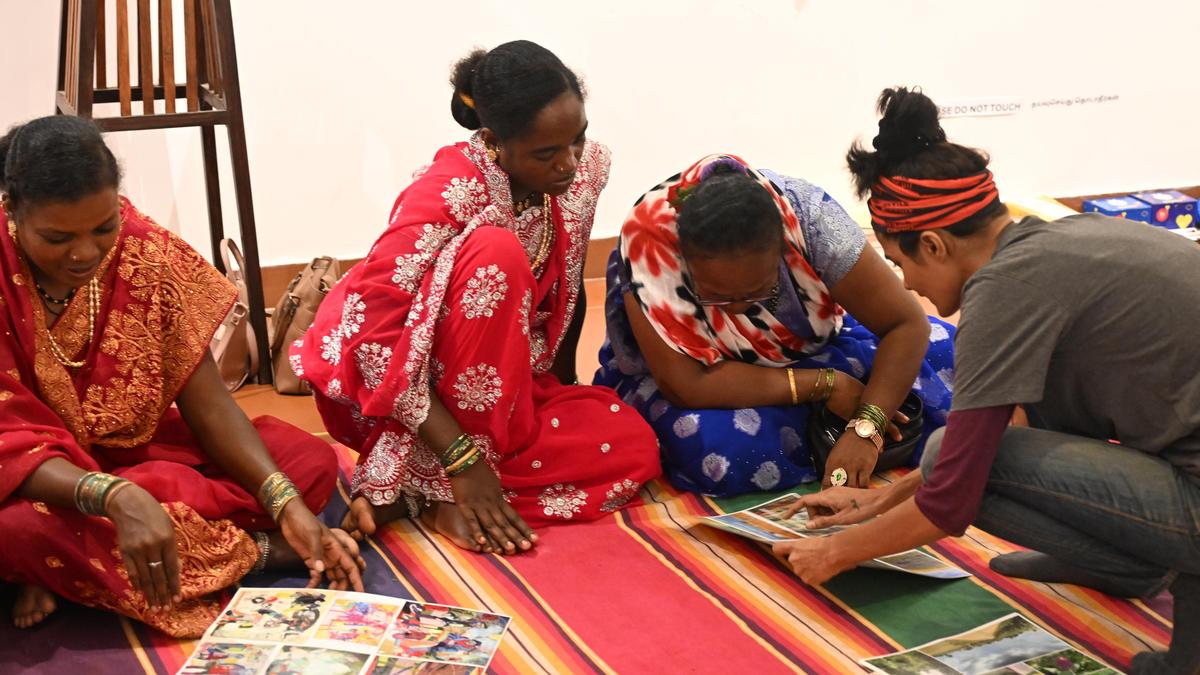
Hanaphabi and Saidambi Naik, two middle-aged women from the Kalaghatgi taluk in Karnataka’s Dharwad district, were restless at first to speak in front of a camera. A few whisper-filled moments later, Saidambi took the lead in telling their story of stitching memory.
“We are both from the Siddi community in north Karnataka but our origins are in Sindh, Pakistan and parts of Africa. We have left our village to come to Chennai to show our kavands (quilts),” Saidambi says in the Siddi dialect, which has a mix of words borrowed from Konkani, Marathi, Kannada, Urdu and Hindi.
The two women rarely get the chance to leave their village because the community tends to distrust outsiders. Bearing distinctly African features, the Siddis have been historically discriminated against by colonisers and locals alike. “We sometimes travel to our relatives’ houses close to our villages but otherwise, we just work in the fields and stitch the quilts,” says Hanaphabi.
Since 2015-16, as their quilts started to be recognised as crafts, Siddi women have been slowly venturing outside their villages to showcase their craft. Leading the way is art historian and community practitioner Anitha N. Reddy, who has been working with the community, across 15-20 villages. Reddy first saw a kavand at a friend’s home in the Western Ghats, 15 years ago. “During a trip to a Siddi village, I had given away a bunch of my clothes to my friend’s family. The next time I arrived, I was admiring a quilt that my friend’s wife had stitched. She pointed to the blanket, showing me scraps of my clothes which had made it to the piece. It was amusing but also captivating,” she says.
That set Reddy on a journey of understanding the quilt. Elaborating on the significance of the kavand, Saidambi says, “The most ornate quilts are reserved for marriages. It is an heirloom passed on to our daughters. If you do not take a quilt to your in-laws’ house, you might not be treated well. You will also not have a sheet to cover yourself with in the winter. We also make quilts for our newborns.”
The art exhibition ‘Threads of Confluence’ was held at DakshinaChitra Museum in Chennai last month. | Photo Credit: B. Jothi Ramalingam


Anna University partners with Ramco Systems to create an advanced ERP lab for enhanced industrial engineering education.

NDA announces candidates for 12 Kozhikode seats in Kerala Assembly polls 2026 as UDF and LDF ramp up campaigning.

As India formulates its next steps in the Israel-U.S.-Iran war, it is necessary to consider not only what it will mean for the whole region but also its own ties with each neighbour

CITU criticizes the Centre's privatization efforts for VSP, alleging employee removal over production increase and financial mismanagement.

Visakhapatnam Customs House's short film "Right Turn" wins Honourable Jury Mention at the 10th Indian World Film Festival.

Economist Arvind Subramanian advises CM Revanth Reddy on strengthening Telangana's finances during a meeting in Hyderabad.

Supreme Court emphasizes stakeholder consultation for legal education reforms, hesitant to change five-year law course duration.

Authorities in Andhra Pradesh are set to tranquillise a roaming tiger near Annavaram temple for safety and conservation.

MEA criticizes USCIRF for bias, urging focus on vandalism of Hindu temples in the U.S. over selective criticism of India.

Bengaluru's Urban Development aims to beautify underutilized flyover spaces, enhancing city aesthetics and improving green cover initiatives.

Indian Navy warships escort merchant vessels in the Gulf of Oman, ensuring safe passage amid regional tensions under Operation Sankalp.

A rare crab species exhibiting both male and female traits was discovered in Silent Valley, revealing unique biological characteristics.

Gujarat court convicts five in 2016 Una flogging case; punishment announcement scheduled for March 17, 2026.