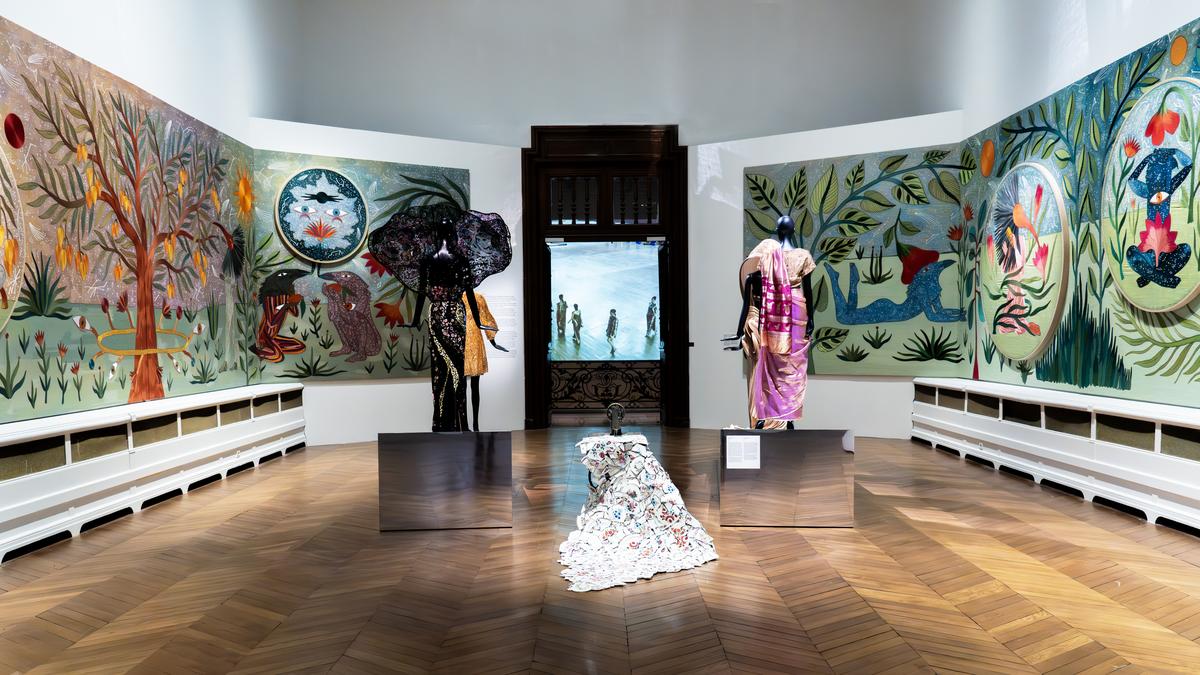
When ‘Ce qui se trame’ traced centuries of textile history between India and France
The Hindu
Discover the landmark exhibition "Ce qui se trame," celebrating four centuries of Indo-French textile dialogue at Galerie des Gobelins, Paris.
At Galerie des Gobelins in Paris, the air hangs heavy with the legacy of craftsmanship. It was here, amidst a centuries-old tradition of tapestry excellence, that the textile synergy between India and France found its most iconic stage. Ce qui se trame (Textile Matters) was less an exhibition and more of an immersive spectacle — a sensory odyssey through the soul of two nations, spanning four centuries, that have mutually inspired crafted textile traditions. The title alludes to the weft of the loom and the colloquial expression in French for ‘what’s happening’ — suggesting the creative alchemy occurring behind the scenes.
Ce Qui Se Trame. Histoires Tissées Entre l’Inde et la France at Galerie des Gobelins
Born of a visionary mandate announced by French President Emmanuel Macron during his 2024 visit to India, the project emerged as a cornerstone of a new, ambitious cultural roadmap. The Institut Français and Mobilier National — which manages over 100,000 pieces of historic and contemporary furniture, carpets, and tapestries — were charged to not only honour but to actively harness the living heritage of two nations bound by a shared devotion to craftsmanship. The month-long exhibition served as a crucible for Indian and French designers to ignite new narratives.
In Le Fil d’Or, visitors discovered brocades and hand-woven silk fabrics | Photo Credit: Sophia Taillet
A handwoven triptych, created in the complex technique of samite at the Asha Workshop at Devi Art Foundation. It recreated figurative imagery from frescoes at the Sistine chapel. | Photo Credit: Sophia Taillet
The task of realising the exhibition fell to a formidable creative pairing: Mayank Mansingh Kaul, Delhi’s textile curator, and Christian Louboutin, the globally renowned red-soled luxury shoe designer with a deep love for India. Together, they infused the gallery with meticulous precision and theatrical flair, drawing together a rare assemblage from major museums and private collections across India and France. “This exhibition shows how Indian textiles have evolved through cultural exchanges,” says Kaul, “turning what could have been a project about two national identities into one of a shared culture and aesthetic.”


Acclaimed Tamil filmmaker Thiagarajan Kumararaja has reunited with his Super Deluxe star Vijay Sethupathi for his upcoming film, Pocket Novel

Legendary actor Robert Duvall, known for iconic roles in "The Godfather" and "Apocalypse Now," dies at 95.

The film is set to release in 2027 and is produced under Bhansali Productions and Maya Movies, with Mehta also serving as a writer on it

The concert is part of Kanye West's global run of headline performances and will take place in New Delhi’s Jawaharlal Nehru Stadium

Sinclair Daniel and Mark O'Brien speak of their experiences of working on 'The Copenhagen Test', balancing the action with emotion, and the challenges of filming in extreme weather

Tamil film producer V. Tamil Azhagan, known for iconic films, passes away at 70; Rajinikanth expresses deep condolences.

Arundhati Roy withdraws from Berlin Film Festival, criticizing Wim Wenders' stance on Gaza and the role of politics in art.

‘My Lord’ movie review: Except for a contrived pre-climax sequence, Raju Murugan’s film intersperses social satire and political commentary with wit, heart, and conviction

Why film adaptations that end Wuthering Heights with Catherine’s death, including Emerald Fennell’s version with Jacob Elordi and Margot Robbie, miss the point of Emily Brontë’s novel

Explore the Bronte Parsonage Museum and discover the inspiration behind Wuthering Heights, now featured in a new film.

Directed by Srikanth Odela, the film, starring Nani in the lead, tells the gripping story of a tribal community standing up for their rights

Singer Mika Singh has stepped up to pledge ₹11 lakh to help actor Rajpal Yadav, who is currently serving a six-month sentence at Tihar Jail after a series of cheque bounce issues

Aditya Atmakuri, Ashutosh Verma and Satyam Nayak of the Hindi independent band Khatth talk about their reflective new single ‘Bewaqt’