Wuthering Heights: Which is the right ending?
The Hindu
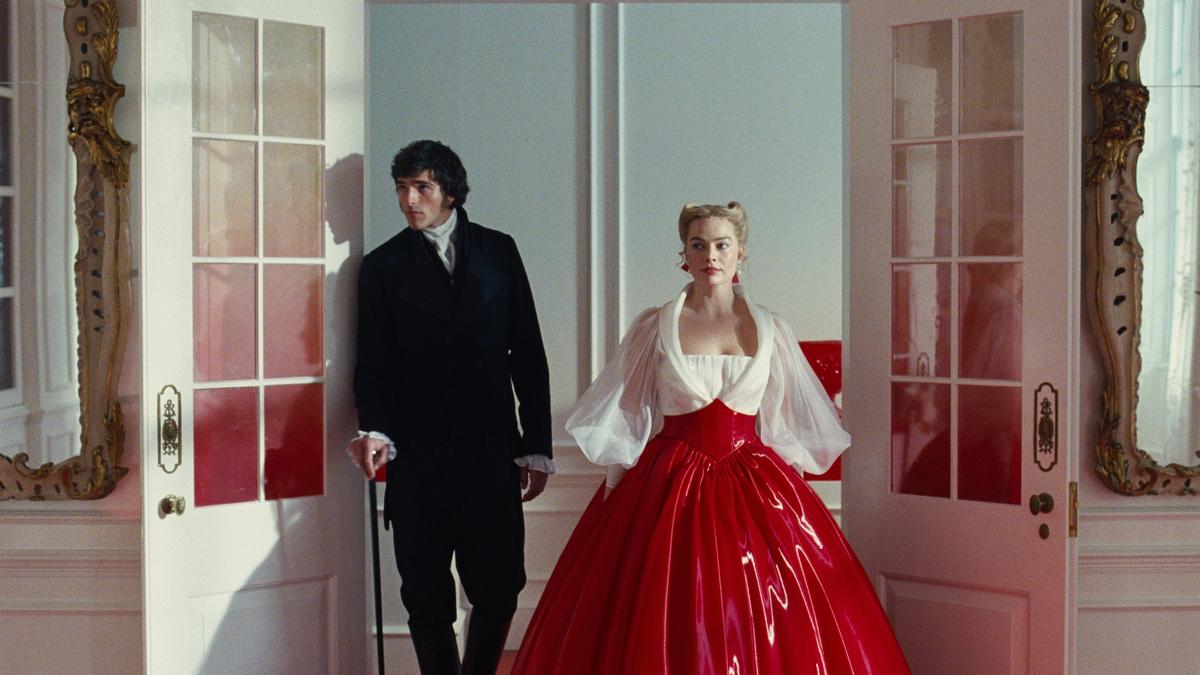
Why film adaptations that end Wuthering Heights with Catherine’s death, including Emerald Fennell’s version with Jacob Elordi and Margot Robbie, miss the point of Emily Brontë’s novel
Despite the quotation marks in the title, signifying a different take, Emerald Fennell’s Wuthering Heights, with Margot Robbie and Jacob Elordi in the lead, follows the time‑honoured template laid down in William Wyler’s 1939 adaptation of Emily Brontë’s 1847 novel.
The film, with Laurence Olivier as Heathcliff, Merle Oberon as Catherine and David Niven as Edgar Linton, ends with her death, keeping the focus on the love between the two. The Hollywoodisation of the novel, by concentrating on 16 of the novel’s 34 chapters, ensures Heathcliff’s Byronic‑hero status.
With Catherine’s death, the character of Heathcliff loses his counterbalance and ends up being pointlessly vengeful, banging about gloomy corridors making everyone’s life miserable. Filmmakers recognised that and decided to defang the anti‑Romantic novel by ending it with Catherine’s death and made it a story of undying, tragic love instead of a destructive car wreck.
Brontë’s novel, incidentally the only one she wrote, tells the story of a foundling of indeterminate race who is adopted by the Earnshaws, a wealthy family in Yorkshire. In Wuthering Heights, the Earnshaws’ home, Heathcliff finds love, respect and also unfortunately abuse.
This image released by Warner Bros. Pictures shows Jacob Elordi in a scene from "Wuthering Heights." (Warner Bros. Pictures via AP) | Photo Credit: AP
He forms a relationship with the daughter of the house, Catherine, and when she marries Edgar Linton, a rich neighbour, Heathcliff sets off on a path of revenge.


‘My Lord’ movie review: Except for a contrived pre-climax sequence, Raju Murugan’s film intersperses social satire and political commentary with wit, heart, and conviction

Why film adaptations that end Wuthering Heights with Catherine’s death, including Emerald Fennell’s version with Jacob Elordi and Margot Robbie, miss the point of Emily Brontë’s novel

Explore the Bronte Parsonage Museum and discover the inspiration behind Wuthering Heights, now featured in a new film.

Directed by Srikanth Odela, the film, starring Nani in the lead, tells the gripping story of a tribal community standing up for their rights

Singer Mika Singh has stepped up to pledge ₹11 lakh to help actor Rajpal Yadav, who is currently serving a six-month sentence at Tihar Jail after a series of cheque bounce issues

Aditya Atmakuri, Ashutosh Verma and Satyam Nayak of the Hindi independent band Khatth talk about their reflective new single ‘Bewaqt’

Explore the challenging clues and solutions of The Hindu Sunday crossword no. 43 for a fun brain workout!

Explore a strategic Goren Bridge hand featuring a modern pre-emptive raise and expert play to secure the contract.

Flipperachi, the rapper behind the viral hit ‘FA9LA from ‘Dhurandhar’, is set to bring his electrifying energy to Mumbai for his debut performance

Rahul Riji Nair's animated short 'Kingara Kavyam,' is a poignant tale of resilience based on a folklore

Shahid Kapoor just dropped the news that Season 2 of the hit series ‘Farzi’ is officially in the works. He took to Instagram to share the news with a fun picture alongside creators Raj and DK

Join 20 Stella Maris College alumni at Lalit Kala Akademi for an exhibition exploring the ocean's mystique and time's fragility.

‘Tuka Mhane, Kahe Kabira’ at Chowdiah Memorial Hall, featured vocalists Bhuvanesh Komkali and Jayateerth Mevundi, who rendered a series of compositions of the two great mystics