What is a dark comet? A quick guide to the ‘new’ kids in the Solar System Premium
The Hindu
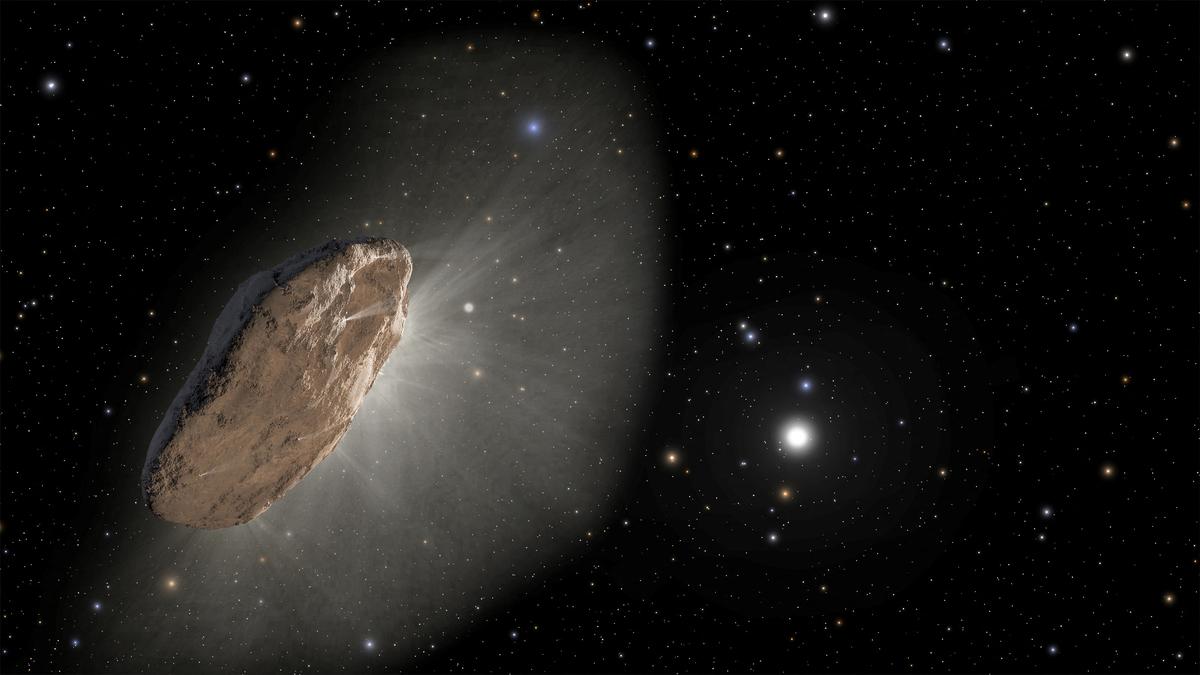
Oumuamua’s speed and path around the Sun don’t match a typical asteroid, but it also has no bright tail or nucleus (icy core) we normally associate with comets.
In 2017, NASA discovered and later confirmed the first interstellar object to enter our Solar System.
It wasn’t aliens. But artist impressions of the object (called ‘Oumuamua, the Hawaiian word for “scout”) do resemble an alien spaceship out of a sci-fi novel. This strange depiction is because astronomers don’t quite know how to classify the interstellar visitor.
Its speed and path around the Sun don’t match a typical asteroid, but it also has no bright tail or nucleus (icy core) we normally associate with comets. However, ‘Oumuamua has erratic motions that are consistent with gas escaping from its surface. This “dark comet” has had astronomers scratching their heads ever since.
Flash forward to today, and more of these mysterious objects have been discovered, with another ten announced just last week. While their nature and origins remain elusive, astronomers recently confirmed dark comets fall into two main categories: smaller objects that reside in our inner Solar System, and larger objects (100 metres or more) that remain beyond the orbit of Jupiter.
In fact, 3200 Phaethon – the parent body of the famous Geminid meteor shower – may be one of these objects.
Comets, often described as the Solar System’s “dirty snowballs”, are icy bodies made of rock, dust and ices. These relics of the early Solar System are critical to unlocking key mysteries around our planet’s formation, the origins of Earth’s water, and even the ingredients for life.
Astronomers are able to study comets as they make their close approach to our Sun. Their brilliant tails form as sunlight vaporises their icy surfaces. But not all comets put on such a dazzling display.


Discover efficient pressure cooking techniques to save up to 50% on fuel. OPOS B Ramakrishnan tells you how

Mercedes-Benz CLA 250+ with EQ Technology review: design, performance, range and features explained. Discover how the new electric CLA combines advanced AI, long range, fast charging and futuristic styling for the next generation of luxury EVs.

Pi Day is celebrated every year on March 14, honouring the significance of the mathematical constant π and its applications in mathematics.

Discover how sculptural interior design transforms modern spaces, blending creativity and functionality to evoke emotion and identity.

A study reveals that certain antibiotics can cause long-lasting changes in gut microbiome diversity for up to eight years.

Indian scientists and international experts are divided over a study questioning the viability of a nuclear reactor fuel called HALEU-thorium; while critics cite safety risks, proponents argue the technology is vital to achieve national energy goals.

ISRO and AIIMS partner to enhance space medicine research, focusing on human health during long-duration space missions.

A practical guide to induction setups for students, families, and home food businesses as India’s LPG supply faces its biggest disruption in years

Explore the electrifying Oscars 2026 race, featuring standout films, baffling nominations, and memorable performances amid a cinematic transition.

Zai and Rom Whitaker’s latest book for young readers, The Book of Indian Snakes, tackles common misconceptions surrounding snakes, highlighting their utility to humans

Discover PC Mahalanobis's pivotal role in India's statistical revolution and his lasting influence on modern statistics in this episode.

Explore why nothing can exceed light speed and the paradoxes that arise if it were possible.

Scientists have engineered bacteria to produce designer proteins by smuggling artificial amino acids, enabling precise drug delivery and multifunctional applications.