What does passed in ‘Guillotine’ mean in parliament?
The Hindu
Guillotine in Lok Sabha fast-tracks approval of pending Demands for Grants by voting on all simultaneously during budget sessions.
In India’s parliamentary framework, the term “guillotine” defines an expedited measure undertaken for quick approval of bills. The mechanism, time-bound in nature, is invoked by the Lok Sabha Speaker to ensure ministry-specific proposals are cleared before the financial year deadline. The decision comes into play when the House takes note of the confined time limit, forcing them for approval without debates.
Significantly, the mechanism is specifically undertaken for ‘Demands for Grants’, than any ordinary bills.
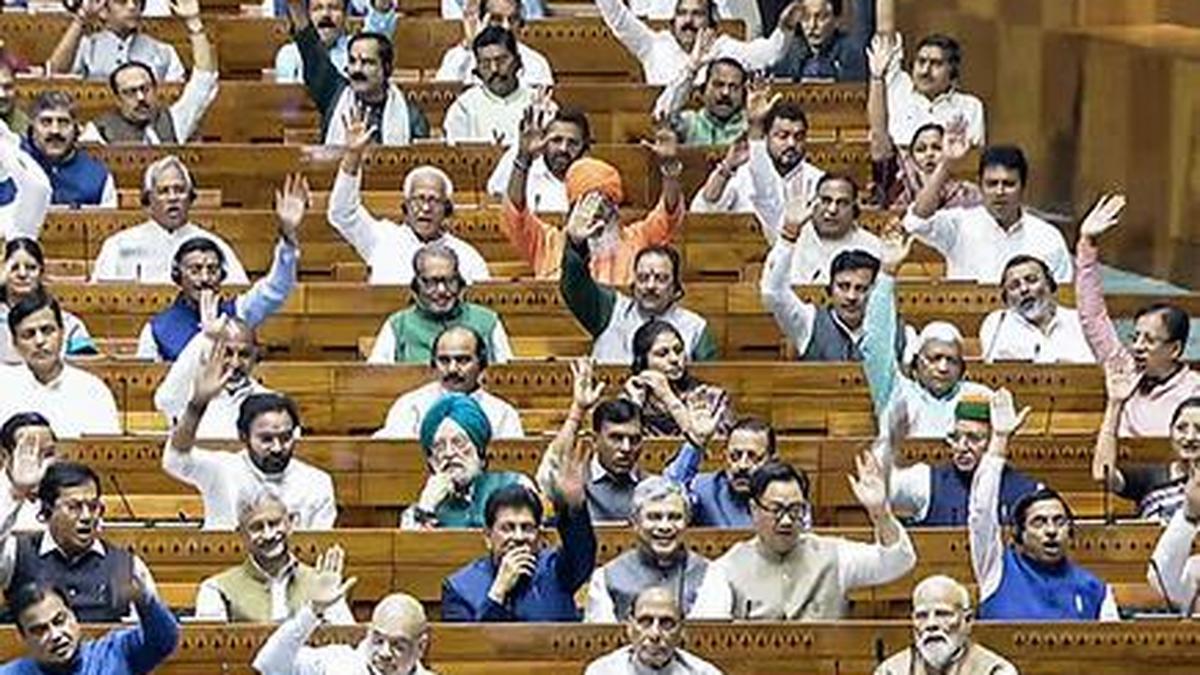
Recently, the term “guillotine” has raked up interest among general public after the Lok Sabha passed the Demands for Grants of various Ministries for 2026-27 on Wednesday (March 18, 2026). The House approved an expenditure of over ₹53 lakh crore by applying the guillotine, passing the Demands for Grants for various Ministries without a discussion in Parliament. The House had discussed Demands for Grants for two Ministries -- Agriculture and Railways.
Read | Where the guillotine falls
Following the presentation of the Union Budget, the parliament facilitates debates for “Demands For Grants”, which underlines the expenditure demands of various ministries, such as Railways, Agriculture, Defence, and Education. During the process, these demands are thoroughly scrutinised by Members of Parliament (MPs). Further, the concerned MPs raise questions and doubts about allocations, and also move cut motions to reduce spending.
However, only a limited number of demands are discussed in detail due to large number of ministries and confined discussion hours. Later, the pending list stretches further as the session proceeds, demanding the urgency for a structured closure mechanism.


Dhan announces launch of the all-new Trading Terminal - DEXT T3, designed especially for Super Traders in India

Bird flu confirmed in Kerala’s Alappuzha; 5,961 birds to be culled as authorities enforce containment measures.

Stay updated with The Hindu’s on-ground Tamil Nadu Assembly election coverage and voter insights across key constituencies.

Ustaad Bhagat Singh rehashes outdated formulas with heavy political messaging, resulting in a disjointed, boring film despite Pawan Kalyan’s presence.

Faf du Plessis highlights Sanju Samson's departure as a massive loss for Rajasthan Royals and IPL fans.

Telangana Government prioritizes farmers' welfare with loan waivers, bonuses, and support for profitable agriculture under CM Revanth Reddy.

Titan Honours India’s Sporting Icons with Tribute Timepieces at RevSportz Trailblazers 4.0

Supreme Court seeks fresh HC hearing after convict flags unfair 20-year bail and reduced prison term
Supreme Court orders fresh High Court hearing after convict challenges 20-year bail and reduced prison term as unfair.

OnePlus on Thursday launched the new wireless earbuds, the OnePlus Nord Buds 4 Pro, in India. The Nord Buds 4 Pro comes with spatial audio and real-time active noise cancellation (ANC) and claims to block up to 55 decibels of noise

Guillotine in Lok Sabha fast-tracks approval of pending Demands for Grants by voting on all simultaneously during budget sessions.

Shashi Tharoor affirms UDF's Kerala poll strategy favors elected MLAs for CM amid strong anti-incumbency against LDF.

How restaurants that don't need LPG to function are thriving during the current crisis

Puducherry's upcoming elections test the NDA's governance model amid opposition rifts and promises of stability and welfare delivery.