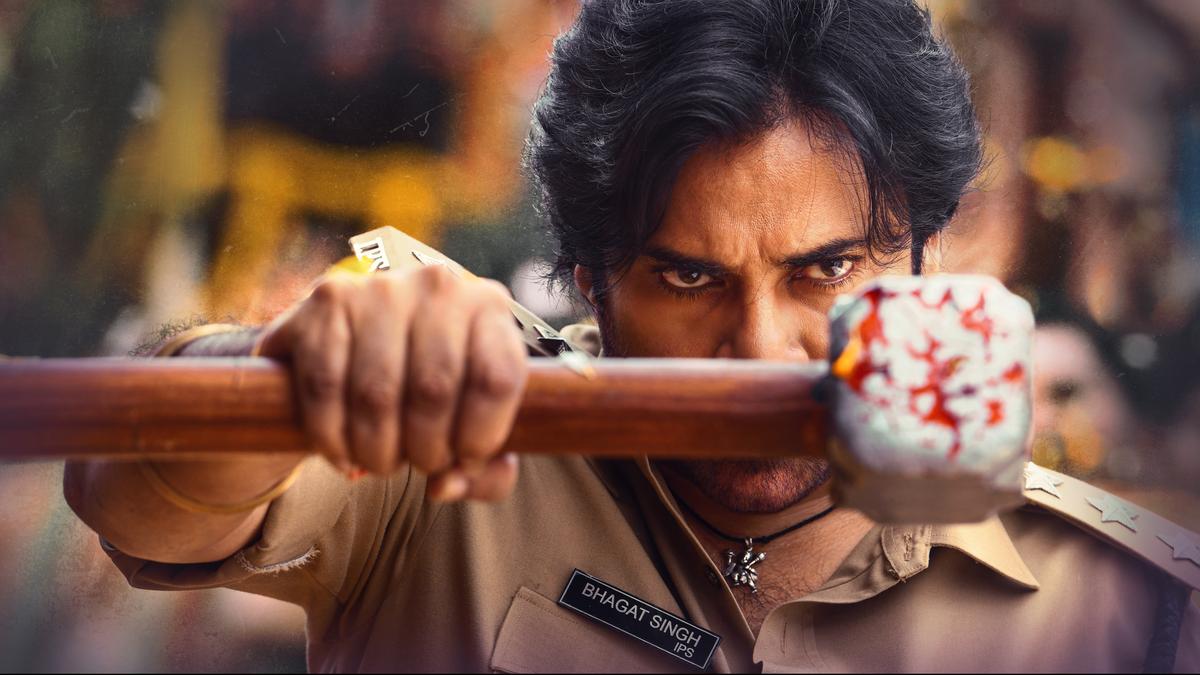
‘Ustaad Bhagat Singh’ movie review: Harish Shankar, Pawan Kalyan’s film is an incoherent bore
The Hindu
Ustaad Bhagat Singh rehashes outdated formulas with heavy political messaging, resulting in a disjointed, boring film despite Pawan Kalyan’s presence.
In 2012, when director Harish Shankar teamed up with Pawan Kalyan for Gabbar Singh, an adaptation of Dabangg, it resulted in a massy outing that capitalised on the star’s nonchalant attitude. The film entertained, even if it did not break new ground in storytelling. A lot has changed since then and the star is now the deputy chief minister of Andhra Pradesh. In Ustaad Bhagat Singh, the director rehashes the outdated template of Gabbar Singh, and infuses it with a heavy dose of ideology that powers the actor-politician today. The result is a narrative that appears to be randomly stitched together to tick a few boxes on a checklist.
The story is strictly perfunctory. One doesn’t go to a Harish Shankar and Pawan Kalyan film expecting an out-of-the-box narrative. But then, even fan service warrants coherence in storytelling. The film begins with snapshots of a covert operation as political fortunes in a State turn upside down, and goes back in time to unravel the origin story of the protagonist.
A boy who grows up in the jungle is adopted by the village headmaster (KS Ravikumar). He is inspired by teachings of Bhagavad Gita and the story of Bhagat Singh. It’s a matter of time before the guru names him Bhagat Singh. The guru, who chooses to remain a bachelor, is called upon to join politics and serve the people of the State. He in turn, makes the boy promise that he, too, will give up everything and join the line of duty when asked to. This is just one of the many attempts to draw parallels to real-life references.
The bond between this guru and the protagonist is the foil within which a story of a fearless cop plays out. The cop is on a ‘clean and green’ mission. He decimates the nexus between a drug cartel and political heavyweights, punishes perpetrators of sexual assault, imparts tough lessons to those who disrespect religious sentiments and the Indian Army. These events are narrated in a disjointed and convenient manner. Take some of these episodes away and it will not alter the larger story.
The treatment of Ustaad Bhagat Singh is similar to the mainstream cinema of a decade or two ago. Neither the writing nor the technical departments bring in anything new. Devi Sri Prasad tries to do his bit with a few high-on-energy dance numbers and Thaman raises the decibel levels each time Pawan Kalyan’s aura has to be played up. The action sequences, too, are dated and appear to be hastily assembled on the editing table. The hovering camera movements in some sequences only add to the discomfort.
In a film where the broad story becomes pointless after a while, it’s not a surprise that the female characters are just meant to be decorative. If Raashii Khanna is shortchanged with a superfluous characterisation, Sree Leela’s does not rise above the chatty, bubbly trope. The therapy sessions featuring Raashii and Sree Leela’s radio jockey act with the ‘gala gala with Leela’ act are written so lazily that they end up being annoying than amusing. The romance between Sree Leela and Pawan Kalyan tries to give the story some emotional depth, but the age gap is glaring.


Olivia Fraser’s exhibition blends Indian miniature painting and meditation through geometric forms and immersive soundscapes.

CM Naidu prays for prosperity and celebrates Telugu culture and traditions on Ugadi festival in Vijayawada.

Telangana Cyber Security Bureau conducted a cyber hygiene workshop for women journalists

Telangana's RSS shakhas have grown to 3,400

As Autumn Durald Arkapaw becomes the first woman cinematographer to pick up an Academy Award, Indian female DOPs weigh in on the long road to equality

Dhan announces launch of the all-new Trading Terminal - DEXT T3, designed especially for Super Traders in India

Bird flu confirmed in Kerala’s Alappuzha; 5,961 birds to be culled as authorities enforce containment measures.

Stay updated with The Hindu’s on-ground Tamil Nadu Assembly election coverage and voter insights across key constituencies.

Ustaad Bhagat Singh rehashes outdated formulas with heavy political messaging, resulting in a disjointed, boring film despite Pawan Kalyan’s presence.

Faf du Plessis highlights Sanju Samson's departure as a massive loss for Rajasthan Royals and IPL fans.

Telangana Government prioritizes farmers' welfare with loan waivers, bonuses, and support for profitable agriculture under CM Revanth Reddy.

Titan Honours India’s Sporting Icons with Tribute Timepieces at RevSportz Trailblazers 4.0

Supreme Court seeks fresh HC hearing after convict flags unfair 20-year bail and reduced prison term
Supreme Court orders fresh High Court hearing after convict challenges 20-year bail and reduced prison term as unfair.