Walking along Millers Road in Kilpauk is close to impossible
The Hindu
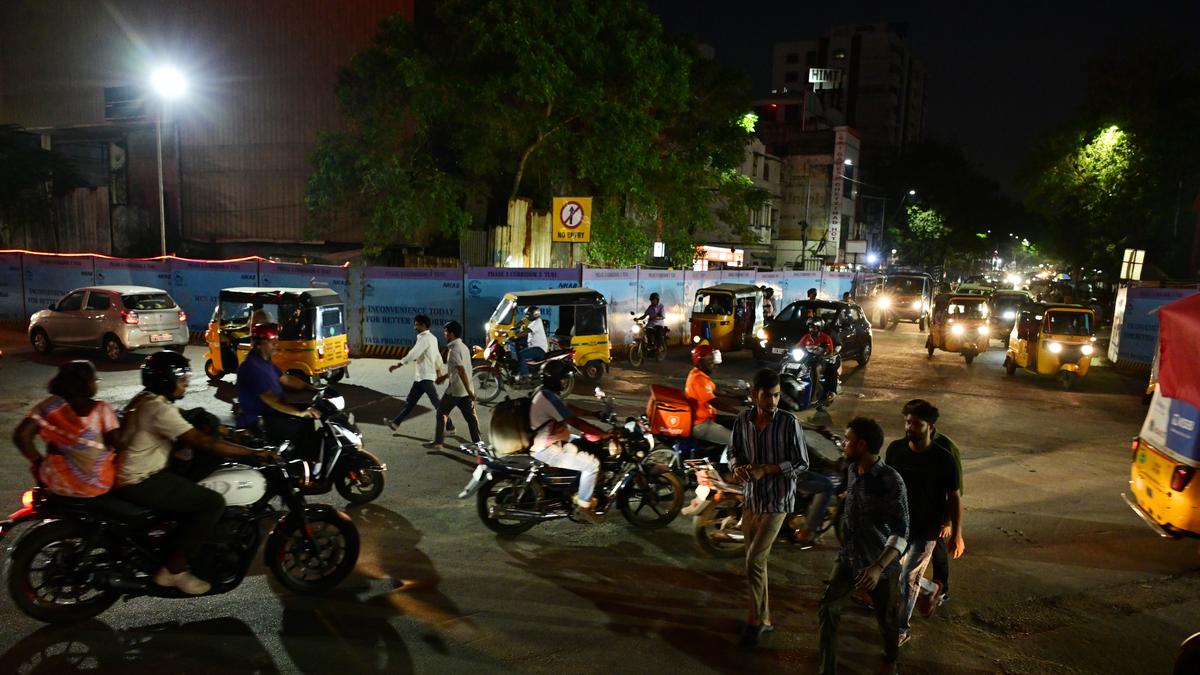
Millers Road in Kilpauk, Chennai, congested with traffic due to multiple healthcare facilities and commercial establishments, lacks pedestrian infrastructure.
Even on a Saturday morning, when traffic is fairly smooth in most parts of Chennai, Millers Road in Kilpauk is crowded with vehicles. Despite being a one-way stretch, the street, which has multiple residential apartment complexes alongside a host of healthcare facilities — hospitals, diagnostic centres and pharmacies — as well as other commercial establishments, has a steadily flowing stream of traffic, with a near-constant bottleneck towards its end.
Walking along the street is close to impossible: while wide pavements exist on one side, they are encroached upon by a number of stalls — food, books, mobile services — and even when not encroached, are broken, littered with cables, construction debris and other detritus. Walking close to the footpath is also difficult: two-wheelers and autorickshaws are parked alongside, forcing pedestrians to walk right on the street with vehicular traffic constantly rushing past.
“Traffic has increased since the Metro Rail construction began, and because of the construction, there are also issues like cables blocking parts of the road. The road now curves to meet the junction where it branches into three directions, and there is a bottleneck of traffic here. There is no traffic light and so, no indication of which vehicles are proceeding in which direction. No one knows how or when to go, which causes chaos,” says Darshan Raj, a resident of one of the apartment complexes on the street.
For autorickshaw drivers, small fares of ₹50 to ₹60 are unmanageable now, says a driver, pointing to the fact that going towards other localities entails a large circle owing to the one-way traffic.
The Metro Rail construction is ongoing for Phase 2 of Corridor 3 of the project, at one end of the street, leading to its width being narrowed. Only a small section here has a barricaded space for pedestrians — on the rest of the stretch there is no protection, despite a number of office-goers frequenting it. With a wedding hall, a large jewellery shop, restaurants, and several other establishments doing business on the street, apart from patients who visit the healthcare facilities, there is a large flow of pedestrians and vehicles, including Metropolitan Transport Corporation buses. However, crossing the road is hazardous: there is no pedestrian crossing anywhere down most of the street. A nurse who works at a hospital down the road points out that walking alongside the shops on the footpath is manageable, but crossing the road is an issue.


Abhishek Banerjee challenges BJP's Suvendu Adhikari in Nandigram, pledging community health initiatives if Trinamool Congress wins.

Rising LPG shortages in Karnataka boost firewood demand, reviving an informal market as households and hotels seek alternatives.

Against the backdrop of intense poll activity, a 400-metre stretch of an arterial road in the outskirts of Chennai (technically in Madurapakkam panchayat under Tambaram assembly constituency) presents a salute to the idea of res publica, which underpins India’s system of governance, where citizens have a say, at least before a government is securely ensconced in the seat of power. A Republic Day initiative shines bright every night

Fadnavis claims zero FIR in Ajit Pawar crash is a defamation attempt by Karnataka against Maharashtra's investigation efforts.

Set to unfold as a one-day pop-up on April 5, the Easter Sadya brings together both vegetarian and non-vegetarian menus, offering a peek into the food traditions of the Syrian Christian (Nasrani) community. While the traditional Sadya is often associated with dishes such as sambar, avial, and rice, this version expands to include community-specific festive dishes.

BJP nominates mother of R.G. Kar victim Abhaya to contest from Panihati in West Bengal Assembly elections.

Veteran Malayalam actor-director E.A. Rajendran passes away at 71, leaving behind a rich legacy in the film industry.

Dakshina Kannada Zilla Panchayat has rolled out digital mode of water bill generation and collection in 23 gram panchayats on a pilot basis for the first time in Karnataka. This is set to be extended to the remaining 200 panchayats shortly, according to the Zilla Panchayat Chief Executive Officer Narwade Vinayak Karbhari.

Bengaluru police questioned a man carrying ₹6 lakh for medical expenses at Vidhana Soudha, later releasing him after verification.

BJP accuses Bengaluru's Congress government of corruption in e-Khata issuance, halting infrastructure projects due to financial mismanagement.

Misinformation in Hyderabad sparks panic buying, causing disruptions as residents react to unfounded rumors of an impending lockdown.

Bengaluru Metro extends services until 2 a.m. on March 28 for IPL match, ensuring convenient travel for spectators.

A bus truck-collision in Andhra Pradesh's Markapuram district, killing several. Catch LIVE updates here!