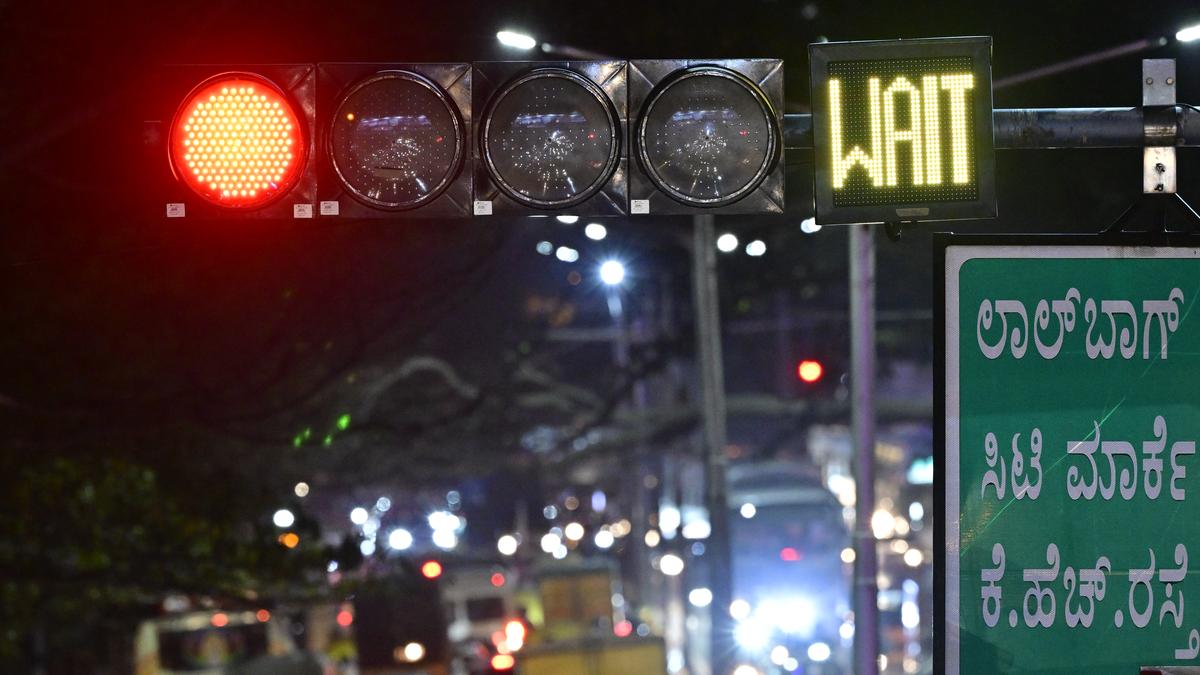
VAC signals require 6% to 17% manual interference to accommodate Bengaluru traffic
The Hindu
Bengaluru citizens debate efficiency of AI-powered VAC signals, with plans to reduce manual signalling for improved traffic flow.
“On Saturday evening, I was travelling from J.P. Nagar side to Jayanagar 4th Block when I had to cross the Aurobindo junction. The AI signal there had switched to MNL, which indicated manual signalling and it took me more than two signals to get a green and go ahead. I was there for at least five minutes,” shared Sharmada Rao, who was commuting in a car.
Citizens of Bengaluru cannot make up their minds about the Vehicle Actuated Control (VAC) signals powered by AI, installed by the Bengaluru Traffic Police (BTP). When the number box in the lighting system flashes ‘VAC’, it means that the signal cycles are being controlled by AI and when it flashes MNL, it means that the traffic police personnel are operating the signal cycles.
While citizens appreciate the efficiency of VAC mode, most of them say that in the MNL mode, they end up spending more time at the signals. According to BTP officials, on average, while these systems run on an automated mode about 94% of the time (in a day), during the remaining 6% (majorly during the evening peak hours) they must be manually operated.
“The amount of manual signalling was about 40% initially. We have brought it down now. Among the 168 junctions where we have this system installed, 125 – 130 of them work on 3 to 4% manual signalling,” said M.N. Anucheth, Joint Commissioner of Police, Traffic, Bengaluru.
Over 30 junctions in the city still have a manual signalling rate of anywhere between 10% and 17% despite the installation of these AI-powered systems. The highest 17% being at the Sarjapur junction between Outer Ring Road and Hosur Road which provides the way for a lot of IT crowd movement. The Town Hall junction, Aurobindo junction, and Siddapura Circle are some other junctions which see higher manual signalling.
“Some amount of manual signalling is unavoidable in the city owing to ambulance and VIP movement. For instance, at Trinity junction, which uses MODERATO (Japanese technology), at least 40 to 50 ambulance movements occur in a day. It takes almost 30 minutes for the system to adapt from manual to AI again. We face the same kind of problem even at KC General Hospital signal in Malleswaram owing to the same reason. Ambulance priority has not been integrated as of now,” explained Mr. Anucheth.
He also added that BTP is working on reducing the manual signalling time at many of these junctions. “We are starting from the highest ones and working towards the lower ones and are working on improving the system. We would ideally want to bring it down to around 1% to 2% so that it results in just 30 minutes of manual signalling in a day,” he said.


Delhi CM Rekha Gupta presents the Economic Survey 2025-26, highlighting growth in income and fiscal deficit details.

Ready for IPL 2026? The Chennai Super Kings’ 'Roar 26' event delivered several Dhoni moments, fan frenzy and an energetic AR Rahman concert.

An alleged dating app scam in Hyderabad's Jubilee Hills has reportedly swindled a man of ₹28,000 at a pub.

T.N. Chief Secretary and DGP visit Governor at Lok Bhavan, presenting flowers in courtesy call.

Eight TSPC Maoists arrested in Hazaribag, Jharkhand, with weapons and ammunition seized during a police operation.

Four ambulances of a Jewish community service in London were set ablaze in a suspected antisemitic hate crime.

Gautham Manohar hopes his photographs serve as reminders of the Earth’s delicate beauty

Thousand Lights faces parking chaos and traffic congestion despite its political significance and ongoing development efforts.

Generic semaglutide increases accessibility, but doctors caution against misuse and quality concerns

Haryana Police removes 857 links to Badshah's 'Tateeree' for objectionable content, ensuring a safer digital environment.

Congress criticises Modi for not leveraging the upcoming BRICS+ Summit to address the West Asia crisis amid U.S. tensions.

Nagapattinam faces underdevelopment and resource challenges, impacting its rich heritage and the livelihoods of its fishing community.

One of the best games of 2025 makes it over to the PC, with a harder mode and bristling with new graphic tech