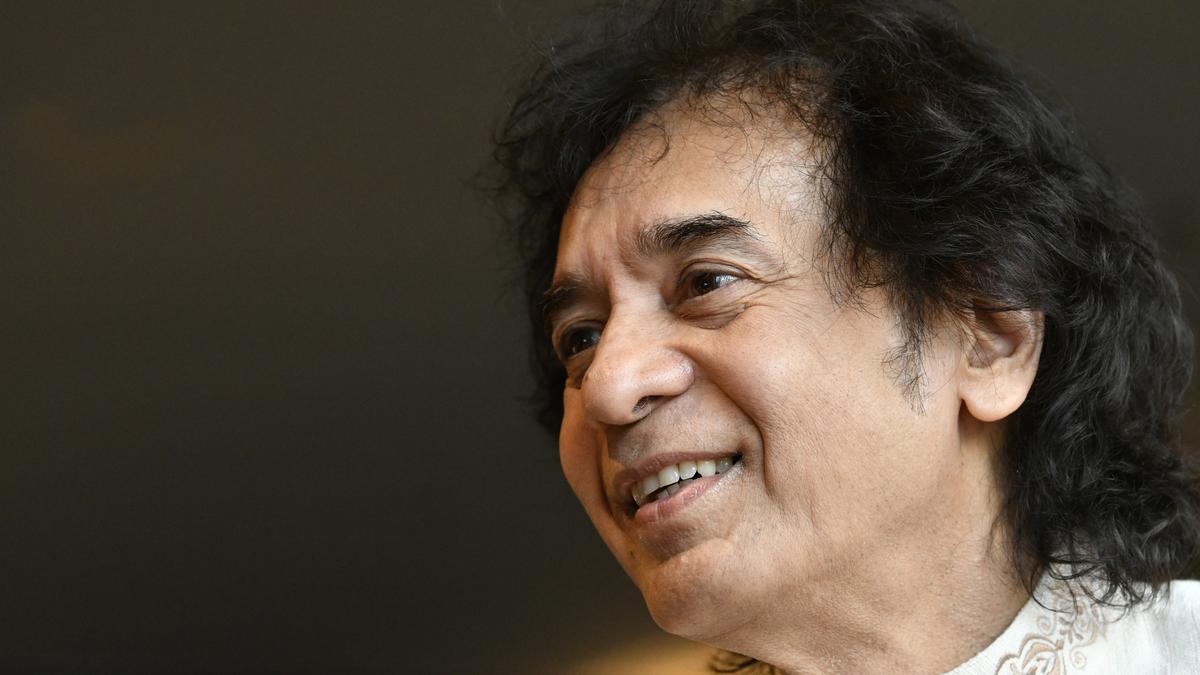
Ustad Zakir Hussain tribute: Tabla loses its vibrant voice
The Hindu
Ustad Zakir Hussain dies: A tribute to the legendary tabla maestro who revolutionised Indian classical music with creativity and versatility.
The tabla fell silent as Ustad Zakir Hussain (1951-2024), one of the greatest global ambassadors of Indian classical music, passed away on Monday (December 16, 2024) after a brief illness in San Francisco, California. A maestro who transformed the modest instrument into a robust voice for universal peace and humanity, Hussain’s incredible speed, dexterity, and creativity mesmerised audiences across cultures.
Having grown up singing odes to Mother Saraswati, verses of the holy Quran, and hymns of the Bible as a daily ritual, India’s syncretic soul echoed through Hussain’s rhythmic art. With a flair for carving stories out of percussive sound, his conversational music buzzed with a spark of spontaneity. Natural flow defined his music and personality. The Padma Vibhushan would impress the purists, enthrall the seekers of fusion, and handhold the fans of Bollywood music into his creative space with equal felicity. At the peak of his creativity genius, he bagged three Grammys in one night this February.
FOLLOW: Zakir Hussain death LIVE updates - December 16, 2024
Like his carefully designed free-flowing style, the versatile artist would execute complex rhythms, intricate patterns, and nuanced dynamics and then move on to items like the sound of traffic signal and deer’s walk, without putting music into brackets. In tune with technology, over the years, he experimented with frequencies to highlight the subtle shades of the instrument to establish that tabla is not just a rhythmic instrument but also a melodic one. He emerged on the scene alongside eminent tabla artists like Anindo Chatterjee, Shafaat Ahmed Khan, Kumar Bose, and Swapan Chaudhuri, but Hussain’s role in popularising tabla and providing it a global platform remains unparalleled.
Born to Ustad Alla Rakha, the eminent accompanist of Pandit Ravi Shankar, credited with taking tabla to foreign shores, tabla chose Hussain. He grew up in Mumbai in an environment where his father believed that every instrument has its spirit. Hussain befriended the tabla at the age of three and by the time he hit teenage, the instrument had become his muse for life and perhaps an extension of his personality. After watching him play, one couldn’t see playing tabla as a chore in classical music.
His other two brothers, Taufiq and Fazal, are also noted percussionists but Hussain took his father’s legacy to the next level by adding a touch of showmanship and expanding the riches he inherited from the Punjab gharana. A keen learner and listener, Hussain was like a responsive satellite in orbit as an accompanist, shone like a star in his solos, and reserved the adventurous streak of a meteor for creating fusion music.
A child prodigy who gave his first professional performance at 12, Hussain was not regimented by his teacher-father. Rooted in Indian tradition, he was allowed to develop wings and explore new shores. His day would start with devotional music that would invoke Hindu deities followed by polishing Koranic verses in the neighbourhood madarsa before he would join the morning prayers at the Convent school. By 19, Hussain taught at the University of Washington before joining Ustad Ali Akbar Khan’s music college in San Francisco where he met his soulmate Antonia Minnecola.


Explore the behind-the-scenes of political strategy with "Inside the War Room," a must-read for aspiring politicians and managers.

Villivakkam faces civic challenges despite infrastructure improvements, with residents demanding better healthcare, transport, and green spaces ahead of elections.

District Collector launches e-dip lottery for Settipalle land plots, benefiting 2,111 beneficiaries with planned infrastructure development.

Chengalpattu's horticulture farm launches herbal tea, Idhazh, made from sun-dried hibiscus and organic herbs.

Hyderabad is set to become a global film hub, says CM Revanth Reddy at TGFA 2025, highlighting its cinematic potential.

Sivananda Damodara Pai appointed head of RMC Chennai, known for advancing seasonal rainfall and temperature forecasting models.

Madurai Collector chairs meeting with Election Observers

CBI interrogates Anil Ambani in a ₹2,929-crore cheating case involving alleged loan fund irregularities from State Bank of India.

Tamil Nadu's 2026 election features intense competition among established parties and a new disruptor, promising unique voter choices.

Explore the contrasting management styles of England and India cricket teams, highlighting player support and development challenges faced by Liam Livingstone and Sanju Samson.

Modi and Jaishankar advocate for dialogue as India and France collaborate to de-escalate tensions amid escalating strikes on energy infrastructure.

The star-studded event was held in Mumbai and was attended by rithik Roshan, Alia Bhatt, Bobby Deol, Shahid Kapoor, Vijay Varma, Sonakshi Sinha, Jyotika, Ali Fazal, Sonali Bendre, Preity Zinta, Ravi Kishan and others

Shorts News:We are working on securing LPG, petroleum to meet our energy security needs: MEA