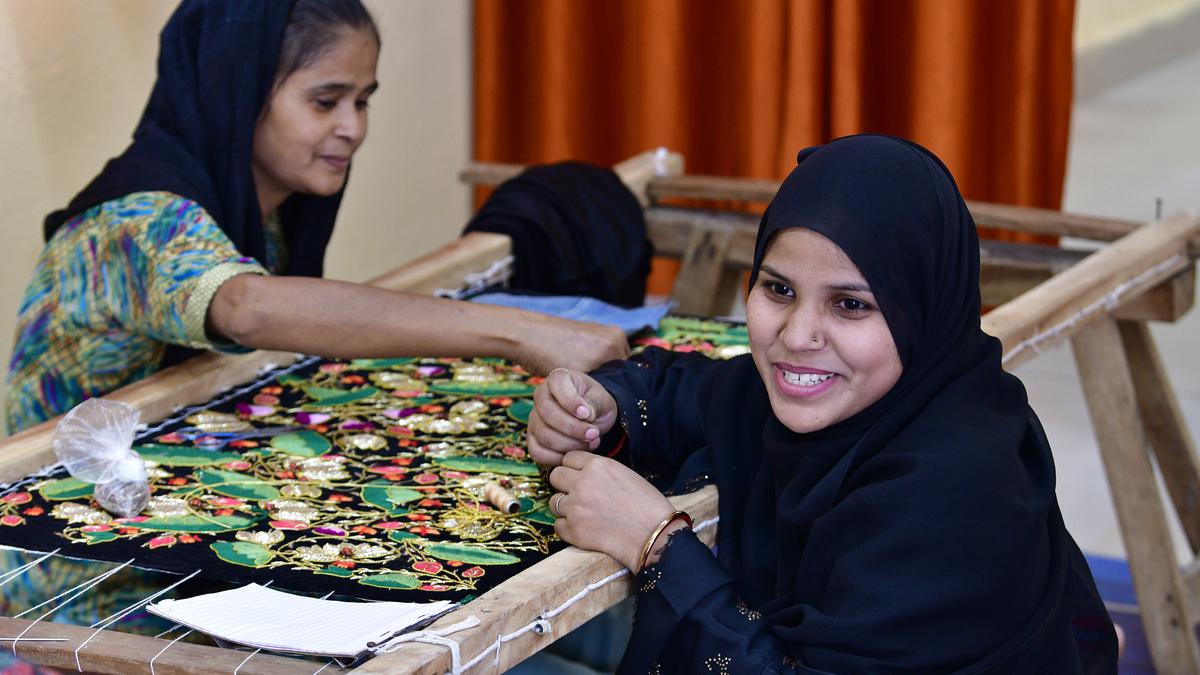
U.K. coronation kept zardozi artisans near the Taj on their toes as memorabilia mania reached a peak Premium
The Hindu
Made with the intricate zardozi embroidery technique that uses thin metal threads, the car hangers needed to reach the U.K. within a month, as memorabilia.
As the United Kingdom (U.K.) was getting ready for its new king, a quiet neighbourhood near the Taj Mahal in Agra was busy burning the midnight oil. They were quickly churning out two lakh car hangers designed like the crown that was to be worn by King Charles III at his coronation.
Made with the intricate zardozi embroidery technique that uses thin metal threads on silk, satin, or velvet, the car hangers needed to reach the U.K. within a month, as memorabilia to mark the event there.
Returns from the labour-intensive cottage industry — that has been around since the 12th century — had been diminishing. With the artisans’ livelihood under threat, the Agra Smart City Mission undertook an exercise from 2019 to reorient products to suit the export market, inbound and domestic tourist retail, and niche corporate gifting needs. They set up four micro skill development centres across the city for this.
Besides zardozi, marble inlay and carpet making were the other crafts identified. Week-long, full-day training sessions have been carried out for about 300 artisans from self-help groups (SHGs).
According to Alok Saxena, project manager of the micro skill development initiative, a market survey conducted before beginning the programme showed that tourists, both foreign and domestic, preferred to buy pocket-friendly souvenirs compact enough to carry back home. “We decided to reskill these artisans to give them design ideas on what to make,” he said.
Marble inlay work for example, focused on embellishments instead of larger designs. Similarly, in the carpet industry, the design for the famous Agra dari woven in a colour-blocking technique, was redesigned to make wall hangings with intricate embroidery. Everything was reoriented to be done by hand to bring down pollution around the Taj Mahal.
“We trained them in retaining the essence of the craft while working on the pattern,” said designer Swati Gupta, a trainer for marble inlay work.


A federal judge weighing the merits of the Pentagon’s designation of rising Silicon Valley star Anthropic as a security threat repeatedly questioned the government’s reasons for vilifying the company

When the conflict in West Asia, which began with the U.S. and Israel’s attack on Iran on February 28, escalated into a regional war, analysts said that the war would last as long as Iran had missiles or until the Gulf nations ran out of interceptors. However, with “emergency” military sales, piling monetary costs and a strained supply chain, is the U.S. becoming too constrained in its effort to keep the war going — both militarily and monetarily?

U.S.-Israel war on Iran LIVE: Follow The Hindu for updates on the West Asia conflict on March 25, 2026

Jair Bolsonaro to serve his sentence at home due to health issues, monitored by police, with a review in 90 days.

A New Mexico jury finds Meta liable for harming children's mental health, marking a significant shift in accountability for tech companies.

Modi and Dissanayake discuss energy cooperation, West Asia conflict, and global supply chain disruptions in a recent phone call.

Russia launches a massive drone and missile attack on Ukraine, signaling the potential beginning of a spring offensive.

U.S. official Elbridge Colby emphasizes India's vital role in the Indo-Pacific, highlighting mutual benefits despite existing differences.

Philippine President Marcos declares national energy emergency amid Middle East conflict, ensuring fuel and essential goods supply stability.

Mohammad Baqer Zolqadr appointed as Iran's new security chief, succeeding Ali Larijani after his assassination.

Israel plans to occupy southern Lebanon amid escalating violence, targeting Hezbollah and causing widespread destruction and civilian casualties.

Trump reveals Secretary Hegseth was pivotal in discussing military action against Iran amid escalating tensions in the Middle East.

Iran arrests 466 individuals for online activities threatening national security amid ongoing tensions with Israel and the U.S.