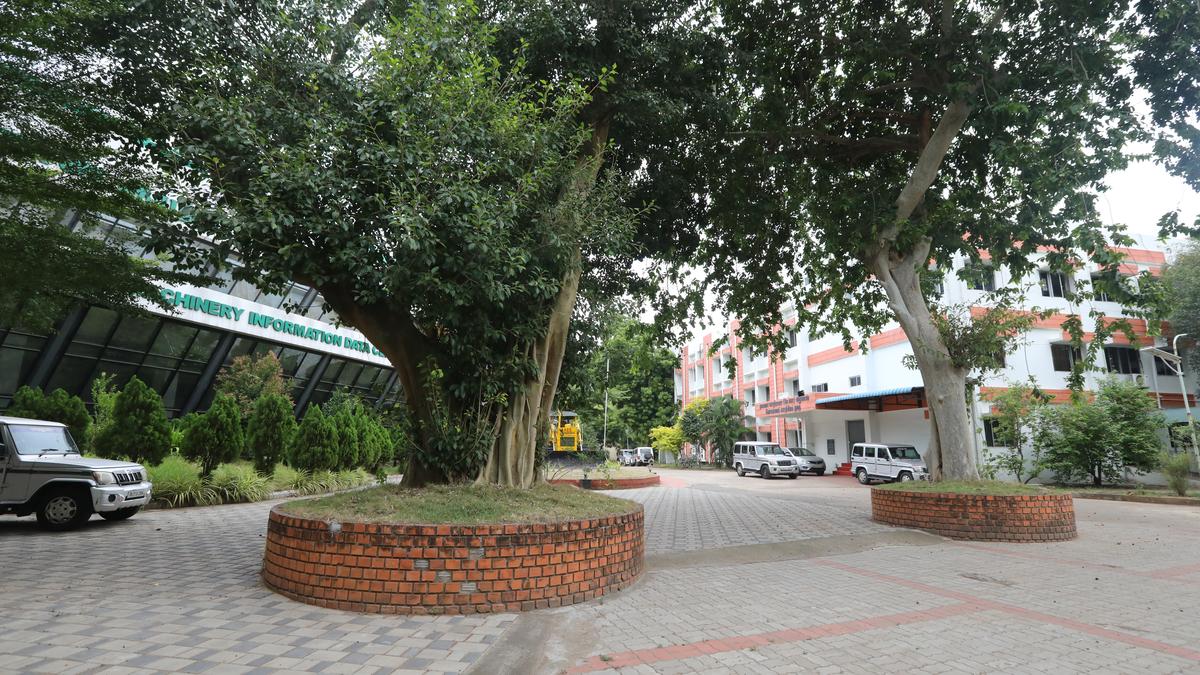
Two trees find special honour and care at a state government office in Chennai
The Hindu
In cinematography, forced perspective is a proven ruse to make the protagonist, usually a mass hero, look larger than everything else in the frame. The camera is placed just a hairbreadth’s distance away from the lead actor making everything else, animate and inanimate, secondary to their presence. A low angle would only add to the dramatic effect — it is a go-to shot to introduce the mass hero to the accompaniment of piercing whistles from the audience. We are talking Kollywood-Bollywood here. At the sprawling premises of the Tamil Nadu Agricultural Engineering Department’s office in Nandanam, right on Anna Salai, two trees benefit from an equivalent of forced perspective. The “on-screen” importance is divided between two “arboreal heroes” along the lines of Sholay. The two trees stand close to each other at a central spot facing the main gates, their feet planted on hallowed circular platforms with decorative terracotta tiles adorning their entire circumferential area. The surface of the platforms suggest an attempt at landscaping. These two trees are twins not by nature: they are separated by time and species. One is a Ficus microcarpa — its common name in Tamil is Kalalamaram, a cousin to the Alamaram (Ficus benghalensis). Its English names include Indian laurel and Malayan banyan. The other tree is a Terminalia arjuna — its common name in Tamil is Neermaruthu. It is Arjuna tree across India. These trees are twins by nurture. No other trees on the premises of this government office in Nandanam are given dedicated platforms — except for a peepal tree, which however is placed on a platform that is unadorned and looks weathered. Those whose familiarity with the landscape dates back by around 40 years ago, reveal that both trees were found even then. It was around the time, the office premises began to put on more elaborate “concrete clothes”. One of the two major buildings was thrown open in 1990. The other significant building with swanky design is relatively younger. There was dense greenery, much of it unruly and unwanted, and it had to be cleared to make way for the constructions. The Ficus Microcarpa and Terminalia arjuna were also naturally occurring, both finding themselves “on the rolls of” this government office through two different forms of dispersal (to be elaborated in a while). In the wisdom accessible to them, those on the frontline of the planning and construction decided to retain these trees. T.D. Babu of Nizhal says the trees would be much older: he puts the Ficus microcarpa at 80-90 years, and the Teminalia arjuna, 20 years younger. Babu makes an interesting observation. “The Ficus microcarpa is not rare, but less common” is how he puts it. Tautological at first hearing, that line is structured around sound logic. In these parts, one does not have to travel far from one’s moorings to see this tree. But the tree is not as common as a Ficus benghalensis. Babu observes that while the Ficus microcarpa is here as the likely result of seed dispersal by birds, the Terminalia arjuna is here as the likely result of seed dispersal by moving water. The Adyar river does not flow far from this site, and the Terminalia arjuna seed would have got dispersed during a time of overflowing and flooding, movement of water certainly less checked in those times by concrete structures. In the natural order, Terminalia arjuna occurs naturally around waterways and riverine systems.


Kerala's critical sectors face LPG shortages despite a 20% relief allocation, impacting restaurants and hotels significantly.

Explore the Sattankulam custodial torture deaths of P. Jayaraj and his son J. Benicks, revealing a shocking tale of police brutality.

Explore the Sattankulam custodial torture deaths of P. Jayaraj and his son J. Benicks, revealing a shocking tale of police brutality.

The 2026 Assembly elections in India will involve Assam, West Bengal, Kerala, Tamil Nadu, and Puducherry across 824 constituencies.

Ernakulam initiates a drive to recycle old clothes into eco-friendly mobile holders for polling stations, promoting sustainability.

BJP distances itself from vegetarianism in West Bengal, promoting non-vegetarian diets to win over local voters.

Assembly polls 2026: Follow updates from The Hindu on the upcoming elections in five States, on March 23, 2026

AIMIM partners with Humayun Kabir’s AJUP for West Bengal Assembly polls, fielding candidates in key constituencies for 2026 elections.

Tamil Nadu CM M.K. Stalin promises improvements to the 'Vidiyal Payanam' initiative, enhancing free bus travel for women and marginalized groups.

Bus services are now operating from Terminal I at Ukkadam Bus Stand to aid Terminal II's construction in Coimbatore.

Delhi's Budget Session opens with a boycott threat from AAP's Atishi over suspended legislators amid expectations for intense discussions.

The Hindu Morning Digest gives a select list of stories to start the day. Read the top news today on March 23, 2026

Protesters in Hyderabad demand the withdrawal of the controversial Transgender Amendment Bill, emphasizing rights and dignity for transgender individuals.