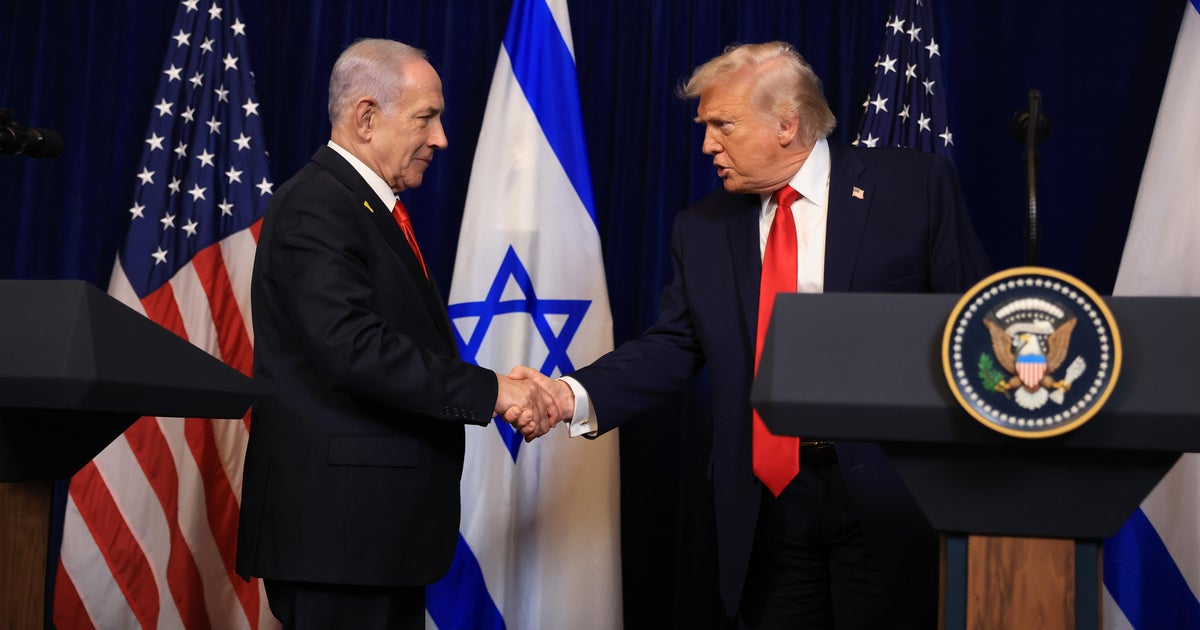
Trump told Netanyahu he would support Israeli strikes on Iran's ballistic missile program, sources say
CBSN
President Trump told Israeli Prime Minister Benjamin Netanyahu during a meeting at Mar-a-Lago in December that the president would support Israeli strikes on Iran's ballistic missile program if a deal between Washington and Tehran could not be reached, according to two sources familiar with the matter who spoke to CBS News on condition of anonymity to discuss national security issues.
President Trump told Israeli Prime Minister Benjamin Netanyahu during a meeting at Mar-a-Lago in December that the president would support Israeli strikes on Iran's ballistic missile program if a deal between Washington and Tehran could not be reached, according to two sources familiar with the matter who spoke to CBS News on condition of anonymity to discuss national security issues.
Two months later, CBS News has learned that internal discussions between senior figures in the U.S. military and intelligence community have started to contemplate the possibility of supporting a fresh round of Israeli strikes on Iran. American deliberations have focused less on whether Israel could act than on how the United States might assist, including the provision of aerial refueling for Israeli aircraft and the delicate matter of securing overflight permission from countries along the potential route, said two other U.S. officials with knowledge of the matter.
It's not clear what countries would grant overflight permission for the U.S. to refuel Israeli aircraft for a potential strike. Jordan, Saudi Arabia and the United Arab Emirates have all publicly said they would not allow their airspace to be used for any strikes on Iran or Iranian strikes on any other country.
But the ongoing conversations inside the national security apparatus coincided with a visible show of force from the United States towards Iran. On Thursday, CBS News reported that a second U.S. aircraft carrier, the USS Gerald R. Ford and its flotilla of warships, would be dispatched to the Middle East, joining an already substantial American presence. Four U.S. officials said the carrier strike group is expected to redeploy from the Caribbean, a movement that would place formidable firepower within range of Iran at a moment of heightened strain.
All of it comes as the Trump administration pursues negotiations with Tehran over its nuclear program. Israeli Prime Minister Netanyahu remains openly skeptical of diplomacy with Iran and flew to Washington last Wednesday for talks with President Trump. Netanyahu released multiple statements insisting that any Iran accord include restrictions on ballistic missiles and funding of proxies in the region, issues that would extend any deal beyond the nuclear program itself.


President Trump's longtime confidant Thomas Barrack, now serving as U.S. ambassador to Turkey and special envoy to Syria, was in regular, close contact with Jeffrey Epstein for years after Epstein's 2008 conviction for soliciting a minor, a CBS News analysis of over 100 texts and email exchanges from the newly released Justice Department documents shows. In:

Can love beat the odds? Prediction markets are taking bets this Valentine's Day that celebrity relationships can thrive — or break apart. By wagering money, bettors are setting the odds on the amorous relationships of high-profile figures, from Zendaya to Katy Perry. Edited by Cara Tabachnick In:

A relationship was in the cards for Tim and Emily Leary, but the Louisiana-based couple couldn't predict the challenges they'd face over nearly two decades of marriage. In:

Secretary of State Marco Rubio offered a reassuring message to America's allies on Saturday, striking a less aggressive but still firm tone about the administration's intent to reshape the trans-Atlantic alliance and push its priorities after more than a year of President Donald Trump's often-hostile rhetoric toward traditional allies. In:

New Yorker Shardil Ahmad always imagined meeting his future girlfriend at a coffee shop: he'd spot her thumbing through a book, curiously approach and they'd fall into easy conversation. In:

Police activity ramped up late Friday night at a location about 2 miles from Nancy Guthrie's home in Tucson, Arizona, nearly two weeks into the search for the missing 84-year-old. It was unclear what drew law enforcement to the site. In:

Washington — A partial government shutdown centered on the Department of Homeland Security began Saturday amid a stalemate over the Trump administration's controversial immigration enforcement policies. Nikole Killion contributed to this report.

The U.S. women's curling team was surprised to learn that their defeat of Canada on Friday marked an Olympic first. In:

A 10-year-old boy recounted fleeing Thursday morning as a U.S. Immigration and Customs Enforcement operation began near his school bus stop in Lindenwold, New Jersey, saying, "We all were scared." In:

The upstart Italians didn't make it easy on the Americans, and that's everything veteran forward Kelly Pannek could have asked for as the top-seeded U.S. continued its run through the Olympic women's hockey tournament. In:

In a shocking twist at the 2026 Winter Olympics, American figure skater Ilia Malinin didn't make it to the podium on Friday, failing to medal after falling twice during the free skate. Kazakhstan's Mikhail Shaidorov took home the gold. In:

Washington — The Department of Homeland Security is all but certain to shut down when the clock strikes midnight, since Congress failed to pass a bill to fund its operations before a stopgap measure lapses at the end of the day Friday. Caitlin Yilek contributed to this report.

An au pair who schemed with her employer-turned-lover to kill his wife and another man received a 10-year sentence on Friday. In: