How Washington's crossing of the Delaware presaged a changing world
CBSN
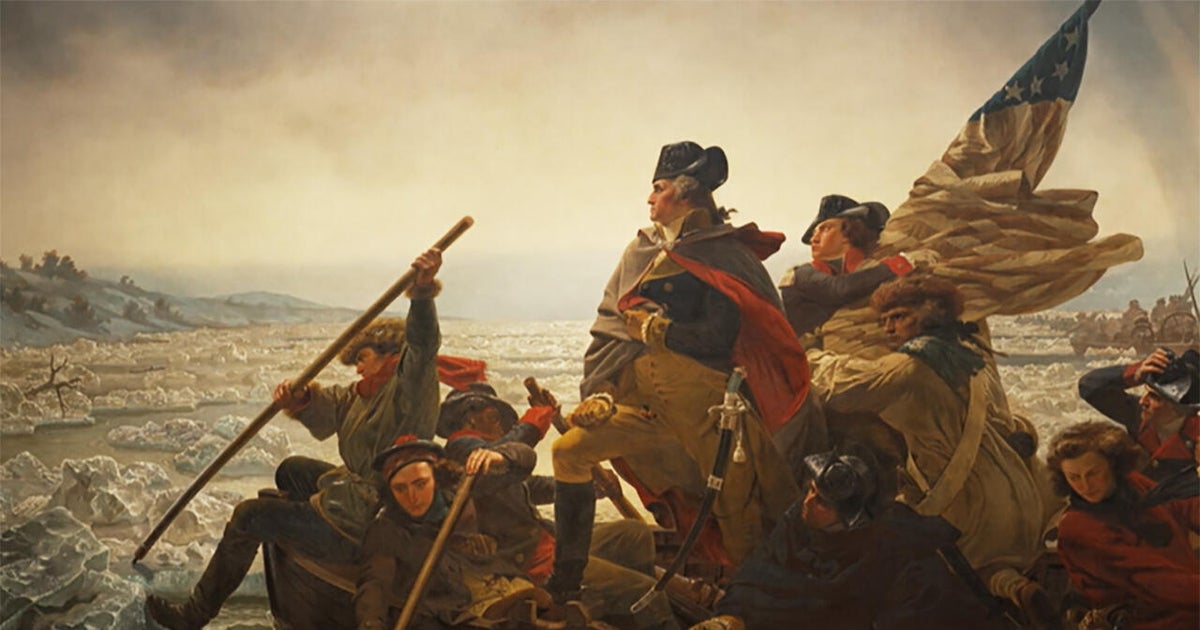
Spend some time staring at the famous painting "Washington Crossing the Delaware," and you can't miss the ice. It's everywhere. Cold weather became part of Washington's military strategy, says Alex Robb, an educator at Washington Crossing Historic Park outside Philadelphia. "It does a lot to impede the crossing and endanger the whole operation," he said, "but it actually becomes our shield." In:
Spend some time staring at the famous painting "Washington Crossing the Delaware," and you can't miss the ice. It's everywhere. Cold weather became part of Washington's military strategy, says Alex Robb, an educator at Washington Crossing Historic Park outside Philadelphia. "It does a lot to impede the crossing and endanger the whole operation," he said, "but it actually becomes our shield."
At the end of 1776, after a string of losses, Washington's army was on the verge of collapse. But Robb says that on Christmas, with ice forming in the Delaware River, the enemy assumed it was too dangerous for the Americans to cross.
They were wrong … and the cold weather handed Washington the element of surprise. His victory at Trenton was a sign that the war could still be won.
Robb said, "Looking back, had the weather proven more mild, they most definitely would've encountered resistance outside Trenton." Just a few degrees made the difference between winning and losing a battle.
At that time, Americans were used to colder winters. We know that from Thomas Jefferson's meticulous, handwritten weather records. But since then, winter has gotten warmer. "Ever since Washington was here, there has been a steady increase," said Jen Brady, a data analyst at the science non-profit Climate Central. Their research shows that average winter temperatures in the Philadelphia area have gone up and down over the years. But overall, they are now 5.5 degrees warmer than they were in 1970.


President Trump's longtime confidant Thomas Barrack, now serving as U.S. ambassador to Turkey and special envoy to Syria, was in regular, close contact with Jeffrey Epstein for years after Epstein's 2008 conviction for soliciting a minor, a CBS News analysis of over 100 texts and email exchanges from the newly released Justice Department documents shows. In:

Can love beat the odds? Prediction markets are taking bets this Valentine's Day that celebrity relationships can thrive — or break apart. By wagering money, bettors are setting the odds on the amorous relationships of high-profile figures, from Zendaya to Katy Perry. Edited by Cara Tabachnick In:

A relationship was in the cards for Tim and Emily Leary, but the Louisiana-based couple couldn't predict the challenges they'd face over nearly two decades of marriage. In:

Secretary of State Marco Rubio offered a reassuring message to America's allies on Saturday, striking a less aggressive but still firm tone about the administration's intent to reshape the trans-Atlantic alliance and push its priorities after more than a year of President Donald Trump's often-hostile rhetoric toward traditional allies. In:

New Yorker Shardil Ahmad always imagined meeting his future girlfriend at a coffee shop: he'd spot her thumbing through a book, curiously approach and they'd fall into easy conversation. In:

Police activity ramped up late Friday night at a location about 2 miles from Nancy Guthrie's home in Tucson, Arizona, nearly two weeks into the search for the missing 84-year-old. It was unclear what drew law enforcement to the site. In:

Washington — A partial government shutdown centered on the Department of Homeland Security began Saturday amid a stalemate over the Trump administration's controversial immigration enforcement policies. Nikole Killion contributed to this report.

The U.S. women's curling team was surprised to learn that their defeat of Canada on Friday marked an Olympic first. In:

A 10-year-old boy recounted fleeing Thursday morning as a U.S. Immigration and Customs Enforcement operation began near his school bus stop in Lindenwold, New Jersey, saying, "We all were scared." In:

The upstart Italians didn't make it easy on the Americans, and that's everything veteran forward Kelly Pannek could have asked for as the top-seeded U.S. continued its run through the Olympic women's hockey tournament. In:

In a shocking twist at the 2026 Winter Olympics, American figure skater Ilia Malinin didn't make it to the podium on Friday, failing to medal after falling twice during the free skate. Kazakhstan's Mikhail Shaidorov took home the gold. In:

Washington — The Department of Homeland Security is all but certain to shut down when the clock strikes midnight, since Congress failed to pass a bill to fund its operations before a stopgap measure lapses at the end of the day Friday. Caitlin Yilek contributed to this report.

An au pair who schemed with her employer-turned-lover to kill his wife and another man received a 10-year sentence on Friday. In: