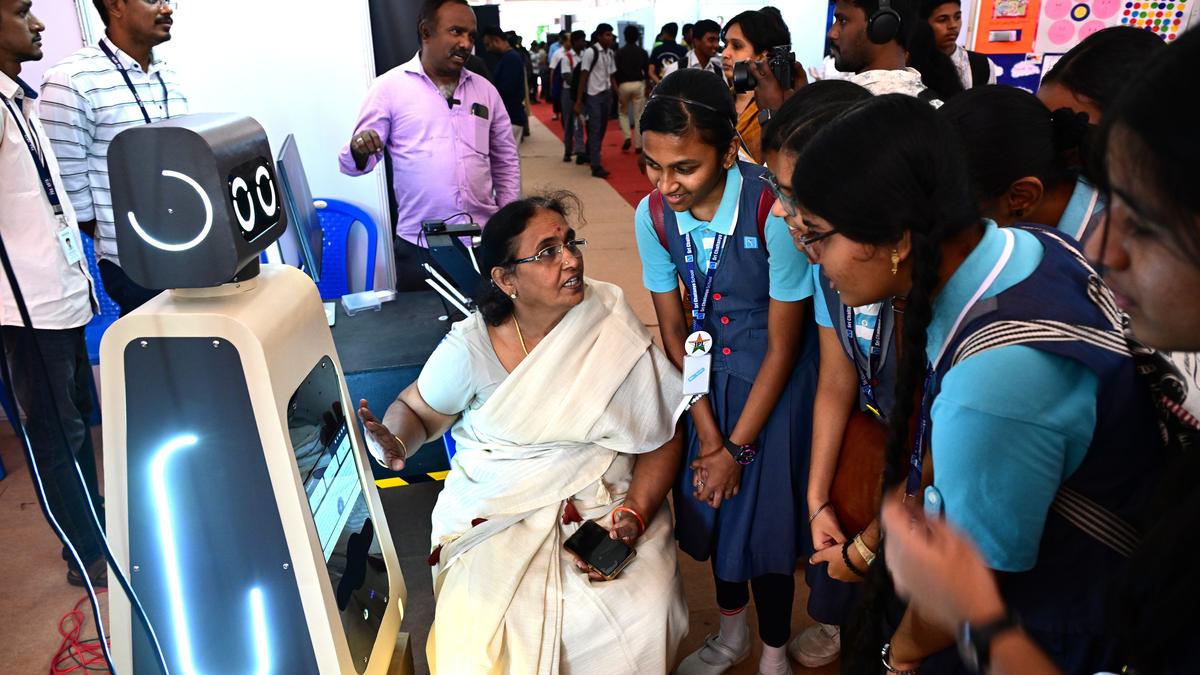
Toys for neurodivergent children showcased at Shaastra 2025
The Hindu
Cognify toy competition at Shaastra 2025 showcases innovative toys for neurodivergent children by talented teams from India.
Cognify, a toy competition organised as part of Shaastra 2025, the technical festival of the Indian Institute of Technology-Madras (IIT-M), captured the attention of all onlookers on Saturday. Two dozen teams from across India were invited to design evidence-based, adaptive toys for neurodivergent children. The teams were shortlisted following two rounds of evaluation.
Anoushka Waje from MIT Institute of Design Loni, Pune, showcased a ‘Ball Puzzle’. “This toy aims to improve cognitive and gross motor skills of children with autism aged one to three. It helps them develop certain life skills such as problem solving and socio-emotional and language growth,” she told The Hindu. They also learn to judge colour and shapes and develop self-executive and regulatory skills necessary for their overall development, she added.
Nandana Preenand, a second-year creative education student at Srishti Manipal, displayed a stacking toy made from magnets. She said, “I’m focusing on two disorders: attention-deficit/hyperactivity disorder (ADHD) and dyslexia. This toy is designed for children aged three to six and features pieces that can be stacked in any order, progressing in size. As children engage with the toy and move their hands, it helps them develop motor skills, making it easier for them to later hold pens and pencils.”
Devika P. Prasad, a user experience designer in Air India, and Divyansh Yadav, a researcher in Consumer Insights at Reliance Consumer Products Limited, explained their idea which was a book-cum-toy that aims to help kids with dyslexia learn words in a fun and interactive way.
The TouchQuest team from RV University, Bengaluru, showcased a tactile-based maze game designed specifically for children with ADHD. “Our game is carefully crafted to aid sensory integration, focus, and cognitive development, helping children with ADHD develop essential skills,” the team said. “What sets TouchQuest apart is its unique features, including the interactive gameplay with RFID tags and receiver, 3D-printed pawns, and game pieces, colourful and visually appealing designs, and a variety of themes to keep children engaged,” they said.
Shailendra Jaiswal, advisor, Toy Association of India, and lead mentor, Srijan Sanchar community, who was one of the judges at the event, said: “Every child should have the right to play. And if their needs are different...they need different toys.” He added that there weren’t many players who focused on this space in India.
Aksshith Golla, head, ReWire Shaastra 2025, and Sai Harshith Gajendra, a second-year electrical engineering student at IIT-M, said this particular event had over 1,200 registrations. “Participants were allowed to design toys using any materials or platforms,” they said.


Abhishek Banerjee challenges BJP's Suvendu Adhikari in Nandigram, pledging community health initiatives if Trinamool Congress wins.

Rising LPG shortages in Karnataka boost firewood demand, reviving an informal market as households and hotels seek alternatives.

Against the backdrop of intense poll activity, a 400-metre stretch of an arterial road in the outskirts of Chennai (technically in Madurapakkam panchayat under Tambaram assembly constituency) presents a salute to the idea of res publica, which underpins India’s system of governance, where citizens have a say, at least before a government is securely ensconced in the seat of power. A Republic Day initiative shines bright every night

Fadnavis claims zero FIR in Ajit Pawar crash is a defamation attempt by Karnataka against Maharashtra's investigation efforts.

Set to unfold as a one-day pop-up on April 5, the Easter Sadya brings together both vegetarian and non-vegetarian menus, offering a peek into the food traditions of the Syrian Christian (Nasrani) community. While the traditional Sadya is often associated with dishes such as sambar, avial, and rice, this version expands to include community-specific festive dishes.

BJP nominates mother of R.G. Kar victim Abhaya to contest from Panihati in West Bengal Assembly elections.

Veteran Malayalam actor-director E.A. Rajendran passes away at 71, leaving behind a rich legacy in the film industry.

Dakshina Kannada Zilla Panchayat has rolled out digital mode of water bill generation and collection in 23 gram panchayats on a pilot basis for the first time in Karnataka. This is set to be extended to the remaining 200 panchayats shortly, according to the Zilla Panchayat Chief Executive Officer Narwade Vinayak Karbhari.

Bengaluru police questioned a man carrying ₹6 lakh for medical expenses at Vidhana Soudha, later releasing him after verification.

BJP accuses Bengaluru's Congress government of corruption in e-Khata issuance, halting infrastructure projects due to financial mismanagement.

Misinformation in Hyderabad sparks panic buying, causing disruptions as residents react to unfounded rumors of an impending lockdown.

Bengaluru Metro extends services until 2 a.m. on March 28 for IPL match, ensuring convenient travel for spectators.

A bus truck-collision in Andhra Pradesh's Markapuram district, killing several. Catch LIVE updates here!