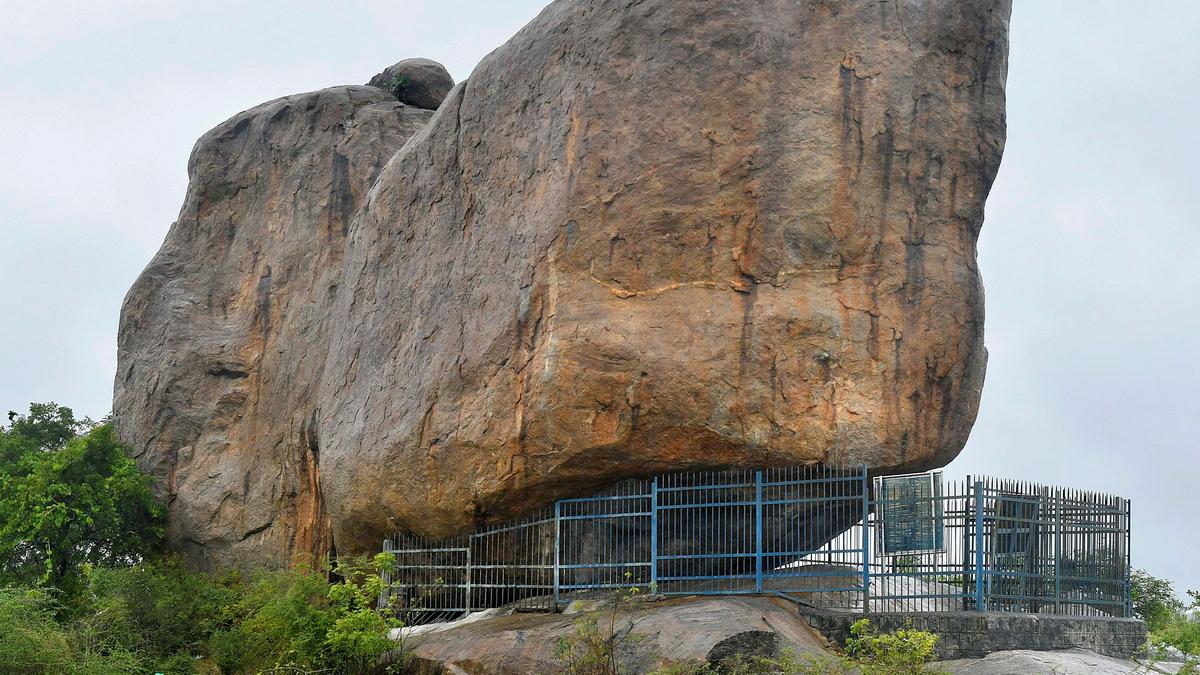
Three hillocks that boast prehistoric rock paintings in Villupuram district Premium
The Hindu
Discover the hidden treasure of prehistoric rock art in Melvalai, a village in Tamil Nadu, protected by the government.
Nestled among a maze of rocks along the Tiruvannamalai Road, Melvalai, a nondescript village around 22 km from Villupuram, is a treasure trove of prehistoric rock art. The word, Rattapparai, has become synonymous with the rock art painted in red ochre.
Though not talked about as much as other rock art sites, Melvalai and similar sites at Alampadi and Sethavarai in the district are a treasure trove and historically important. “The paintings at Melvalai date back to 3000 B.C. They throw light on the culture and history of people of this region in prehistoric times. A majority of etchings by pre-historic humans on rocks had been covered in red ochre. The paintings are of human figurines, animals, and symbols. Though some of them have paled over time, they are still very visible,” says D. Ramesh, Assistant Professor of History, Arignar Anna Government Arts College, Villupuram.
Though the three rock art sites enjoy some kind of protection, there have been instances of unregulated entry of people. These sites also face threats from quarrying and vandalism. To preserve the sites, the Tamil Nadu government has planned to declare the entire hillocks of Alampadi, Melvalai, and Sethavarai a protected monument.
According to officials, given the importance of the paintings, the State Department of Archaeology has planned to declare the entire hillocks a protected monument under sub-section (3) of Section 3 of the Tamil Nadu Ancient and Historical Monuments and Archaeological Sites and Remains Act, 1966. “Once notified, no lease or licence will be granted for quarrying of any mineral in a 300-metre radius from the boundaries of an archaeological site or remains and the entire site/hillock will be treated as protected,” says N. Rajesh, Assistant Engineer of the Department of Archaeology.
Based on the orders of T. Udhayachandran, Principal Secretary, Finance, and Commissioner of Archaeology, and R. Sivananthan, Joint Director of Archaeology, officials of the Departments of Archaeology and Revenue visited the hillocks recently to measure the areas to be declared protected. The hillock at Alampadi is located on 0.53 hectares, while the Melvalai and Sethavarai sites are spread over 4.26 and 110.79 hectares respectively.
Citing a 2003 notification from the Department of Archaeology and a 2005 order of the Tamil Development, Culture and Religious Endowments Department, Mr. Rajesh says an area of 100 metres from the protected limits and beyond it up to 200 metres near or adjoining a protected monument will be declared the prohibited and regulated areas respectively for mining and construction under Rule 33 of the Tamil Nadu Ancient and Historical Monuments and Archaeological Sites and Remains Rules, 1971.
Likewise, under a notification from the Department of Industries, Investment Promotion and Commerce and a 2021 government order, notwithstanding anything contained in any law in force for the time being, no lease or licence could be granted for quarrying of any mineral in 300 metres from the boundaries of archaeological sites or remains. Mining cannot be permitted under any circumstance in any portion of the rock once it is notified as an archaeological site, the official adds.


Farmers complained about indiscriminate stone quarrying taking place in Madurai district, particularly at Kallanai in Kalligudi taluk. They urged authorities to take necessary action to stop the indiscriminate quarrying activities and protect the environment

Madras High Court dismisses Ramadoss's petitions to freeze 'mango' symbol, emphasizing resolution through civil court, not writs.

After more-than-two-year wait, the flyover at Goripalayam junction will be commissioned on Saturday. As of now, the main arm of the new flyover, named after freedom fighter Netaji Subash Chandra Bose, will help to decongest vehicular movement from Tamukkam junction till Nelpettai junction on East Veli Street.

PAC criticizes the government for poor execution and financial delays in the ₹4,455 crore SANKALP skill development scheme.

Coimbatore is emerging as a leading hub for Global Capability Centres in Tamil Nadu, driven by strong educational infrastructure and investment.

Peace talks between fishermen from Rameswaram and Karaikal aim to resolve fishing territory disputes and ensure maritime harmony.

Telangana's Food Safety Department inspects 122 establishments in a statewide drive, enforcing compliance on cereal products and safety standards.

The Greater Bengaluru Authority expands to 86 members, enhancing representation with key political figures included.

Civil Aviation Minister Rammohan Naidu Kinjarapu on Friday e-inaugurated (virtually) the Udan Yatri Cafe at Mangaluru International Airport and digitally launched DigiYatra at the facility.

Tension in Bagalkot as stones are thrown during Shivaji Jayanti procession; police ensure safety and investigate the incident.

Uday Bala Krishnan emphasises the vital role of compassionate teachers in nurturing young minds amidst the rise of Artificial Intelligence.

A.K. Jayasankaran Nambiar appointed executive chairman of Kerala State Legal Services Authority by the Governor and Chief Justice.

Shorts News:Watch: Youth Congress workers hold ‘shirtless protest’ at AI Summit