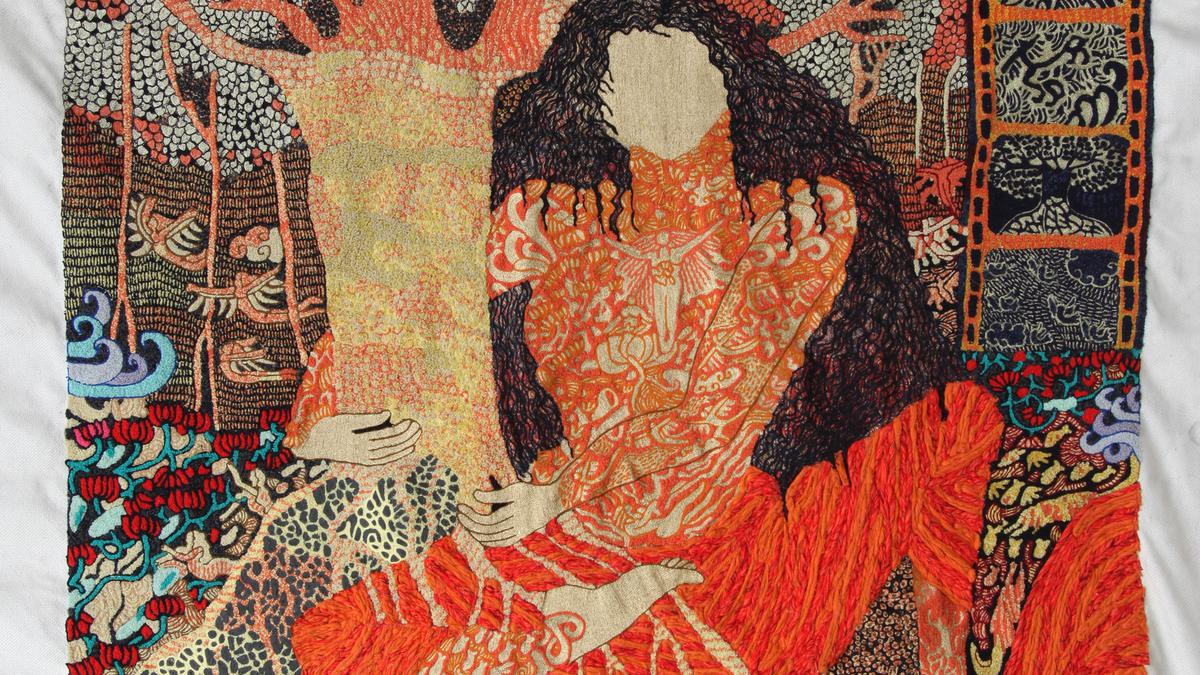
The world as a womb through the eyes of contemporary Indian artist Seema Kohli
The Hindu
India’s most recognised contemporary artist Seema Kohli’s opens her extraordinary multimedia exhibition Cut From The Same Cloth opens for preview on July 28 at Centre of Contemporary Art, Bikaner House, Delhi. She celebrates feminine cosmic energy and explores its power in relation to spirituality
Delhi-based Seema Kohli, one of the most recognised contemporary Indian artists, needs no introduction. What art connoisseurs wait for are her masterful creations that intertwine elements of daily life, teachings (of what?) and spirituality, which she captivatingly presents in a combination of paintings, drawings, sculptures, installations and multidimensional performances.
Cut From The Same Cloth is her latest labour of love that opens for preview today evening at Bikaner House with the British High Commissioner to India, Alexander Ellis, set to mark his attendance. “I have been working since 2016 on this project, allowing myself to enquire into the limits of my own art practice by constantly blurring boundaries between myth and reality, self and spirtuality,” she says.
This is the first time Seema is bringing together 15 large and small embellished embroideries, along with three paintings based on her narratives of the womb, and 18 drawings done with gold leaf and inks on archival paper that depict the instruments and material she used in the process of creating the artworks for the show.
“It is a universal odyssey and I rejoiced creating my own narrative amalgamations of Shakti, the feminine cosmic energy, which is the source of all powers of creation and destruction,” she says. In this particular journey, she says, she is guided by the verses of many saints and mystics such as Kabir, Nanak, Namdev, Baba Farid, Bulleh Shah and Shah Hussain, whose sermons scrutinised the body-spirit connection.
Seema loves to celebrate creation and change with imagery from all walks of life. She says we do not know what another dimension of existence is and, in her latest series, walks viewers through stories from existential life that inter-mingle with the spiritual. Her splendid works of weaves and stitches in silk and cotton threads on raw untreated canvas, embellished with glass beads and sequins, show winged creatures that represent cosmic journeys of the soul and mythical creatures that symbolise physical, physiological and ideological birth.
“An artist is like a river and I am an experimental artist constantly using various art mediums. My artworks celebrate the female form and the colours of life; they are vivid and living as there is a constant dialogue between me and my inner and outer world,” she says. “I express the diverse nuances of daily life by making my art less complicated because I understand the inter-wovenness of beauty and power, sensuality and spirituality. I delve in that space,” she adds.
Seema acquired a weaving loom and a charkha from weavers in Panipat for an installation that will employ the unique mechanical sonorities of the loom as “a symbolic representation of the ceaseless cosmic creation into which we are all minutely interwoven.”


Abhishek Banerjee challenges BJP's Suvendu Adhikari in Nandigram, pledging community health initiatives if Trinamool Congress wins.

Rising LPG shortages in Karnataka boost firewood demand, reviving an informal market as households and hotels seek alternatives.

Against the backdrop of intense poll activity, a 400-metre stretch of an arterial road in the outskirts of Chennai (technically in Madurapakkam panchayat under Tambaram assembly constituency) presents a salute to the idea of res publica, which underpins India’s system of governance, where citizens have a say, at least before a government is securely ensconced in the seat of power. A Republic Day initiative shines bright every night

Fadnavis claims zero FIR in Ajit Pawar crash is a defamation attempt by Karnataka against Maharashtra's investigation efforts.

Set to unfold as a one-day pop-up on April 5, the Easter Sadya brings together both vegetarian and non-vegetarian menus, offering a peek into the food traditions of the Syrian Christian (Nasrani) community. While the traditional Sadya is often associated with dishes such as sambar, avial, and rice, this version expands to include community-specific festive dishes.

BJP nominates mother of R.G. Kar victim Abhaya to contest from Panihati in West Bengal Assembly elections.

Veteran Malayalam actor-director E.A. Rajendran passes away at 71, leaving behind a rich legacy in the film industry.

Dakshina Kannada Zilla Panchayat has rolled out digital mode of water bill generation and collection in 23 gram panchayats on a pilot basis for the first time in Karnataka. This is set to be extended to the remaining 200 panchayats shortly, according to the Zilla Panchayat Chief Executive Officer Narwade Vinayak Karbhari.

Bengaluru police questioned a man carrying ₹6 lakh for medical expenses at Vidhana Soudha, later releasing him after verification.

BJP accuses Bengaluru's Congress government of corruption in e-Khata issuance, halting infrastructure projects due to financial mismanagement.

Misinformation in Hyderabad sparks panic buying, causing disruptions as residents react to unfounded rumors of an impending lockdown.

Bengaluru Metro extends services until 2 a.m. on March 28 for IPL match, ensuring convenient travel for spectators.

A bus truck-collision in Andhra Pradesh's Markapuram district, killing several. Catch LIVE updates here!